Choosing the right speaker impedance can make or break your audio experience. This guide breaks down the difference between 2 ohm and 4 ohm speakers, explains how they interact with amplifiers, and gives practical wiring and buying tips so you can get the best sound without damaging gear.
Key Takeaways
- Impedance basics: 2 ohm speakers draw more current than 4 ohm speakers at the same voltage.
- Amplifier match: Use an amp that can safely handle the lower impedance to avoid overheating.
- Power output: 2 ohm loads often deliver higher wattage, but only if the amp is designed for it.
- Wiring flexibility: Series and parallel wiring can change total load, letting you mix 2 ohm and 4 ohm speakers safely.
- Sound character: Lower impedance can give tighter bass and louder mids, while higher impedance may sound smoother.
- Installation tips: Check amp specs, use quality gauge wire, and consider heat dissipation.
- Future upgrades: Choose an amp with a bit of headroom so you can swap between 2 ohm and 4 ohm speakers later.
📑 Table of Contents
- Introduction: Why Impedance Matters
- 1. The Science of Impedance
- 2. How Amplifiers Respond to Different Impedances
- 3. Wiring Strategies: Series, Parallel, and Mixed Loads
- 4. Sound Characteristics: Does Impedance Change Tone?
- 5. Choosing the Right Speakers for Your Setup
- 6. Installation Tips and Common Mistakes
- Conclusion: Making the Right Choice
Introduction: Why Impedance Matters
When you walk into a car audio shop or a home‑theater showroom, you’ll hear a lot of talk about “2 ohm” and “4 ohm” speakers. Those numbers aren’t just marketing fluff—they describe the electrical resistance, or impedance, that the speaker presents to an amplifier. Understanding the difference between 2 ohm and 4 ohm speakers helps you avoid blown amps, get louder sound, and choose the right setup for your vehicle or room.
Think of impedance like a water pipe. A 2 ohm speaker is a wider pipe that lets more water (current) flow through, while a 4 ohm speaker is narrower, restricting flow. If your pump (the amp) can handle the wider pipe, you’ll get a stronger stream of sound. If not, the pump can overheat and fail. In the sections below we’ll walk through the science, the practical wiring tricks, and the buying decisions that let you enjoy clean, powerful audio.
1. The Science of Impedance
What Is Impedance?
Impedance is measured in ohms (Ω) and combines resistance with reactance (the speaker’s response to alternating current). For most practical purposes, the rating printed on a speaker—2 Ω, 4 Ω, 8 Ω—tells you the average load the speaker will present to an amp across the audible frequency range.
Visual guide about Difference Between 2 Ohm and 4 Ohm Speakers
Image source: alhilalhealthcare.com
How Voltage and Current Relate
Ohm’s Law (V = I × R) explains the relationship:
- Voltage (V): The push from the amplifier.
- Current (I): The flow of electrons that actually moves the speaker cone.
- Resistance (R): The speaker’s impedance.
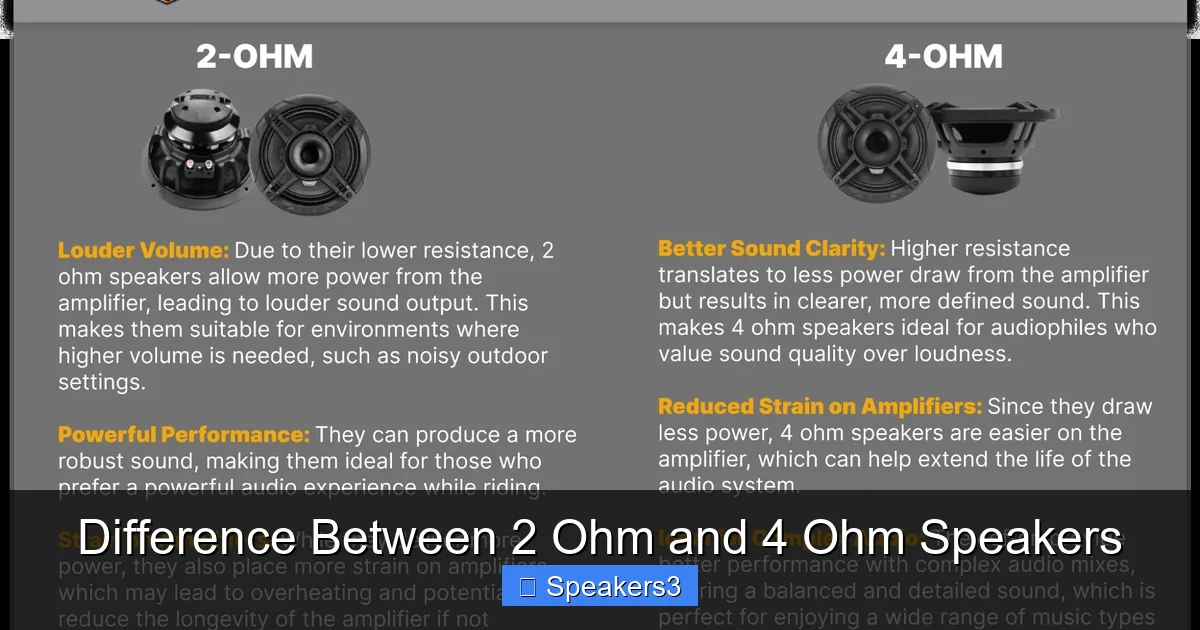
At a fixed voltage, a 2 Ω speaker will draw twice the current of a 4 Ω speaker. More current means more mechanical movement, which often translates to higher volume—if the amp can supply it.
2. How Amplifiers Respond to Different Impedances
Power Ratings and Headroom
Manufacturers list power output at specific impedances, such as “150 W RMS @ 2 Ω” or “100 W RMS @ 4 Ω.” The lower the impedance, the more power the amp can usually deliver—*provided the amp is designed for it*. An amp that’s only rated for 4 Ω may overheat or go into protection mode when fed a 2 Ω load.
Visual guide about Difference Between 2 Ohm and 4 Ohm Speakers
Image source: cdn.shopify.com
Stability and Thermal Considerations
Running a 2 Ω load pushes the amp’s output transistors harder, generating extra heat. Quality amps include larger heat sinks, better cooling fans, or built‑in current limiting. Always check the amp’s manual for the minimum stable impedance.
Practical Example
Imagine a 300 W car amp rated at 4 Ω. If you connect a pair of 2 Ω speakers, the amp might try to push 600 W, quickly reaching its thermal limit. The result could be distortion, automatic shut‑down, or permanent damage.
3. Wiring Strategies: Series, Parallel, and Mixed Loads
Series Wiring
When you wire speakers in series, you add their impedances together. Two 2 Ω speakers in series become a 4 Ω load—perfect for an amp that likes 4 Ω. This method is simple but can reduce overall efficiency because the voltage divides across each speaker.

Visual guide about Difference Between 2 Ohm and 4 Ohm Speakers
Image source: images-wixmp-ed30a86b8c4ca887773594c2.wixmp.com
Parallel Wiring
Parallel wiring does the opposite: the total impedance drops. Two 4 Ω speakers in parallel become a 2 Ω load. This increases current demand on the amp, so only use it if the amp is rated for 2 Ω.
Mixed Impedance Set‑ups
If you have a mix of 2 Ω and 4 Ω speakers, you can combine series and parallel connections to achieve a safe total load. For example, pair a 2 Ω and a 4 Ω speaker in series (6 Ω), then place another identical pair in parallel with the first pair. The overall load becomes 3 Ω, which may still be too low for many amps, so always calculate carefully.
For a deeper dive on series wiring, see our guide on 2 8 Ohm Speakers In Series.
4. Sound Characteristics: Does Impedance Change Tone?
Volume and Dynamics
Because a 2 Ω speaker can draw more current, it often produces higher SPL (sound pressure level) at the same voltage. This can make bass feel tighter and mids punchier, especially in a well‑matched system.
Clarity and Damping
Higher impedance (4 Ω) speakers sometimes exhibit better damping factor, meaning the amp can control the speaker cone more precisely. This can result in smoother, less “boomy” sound, which many audiophiles prefer for music listening.
Real‑World Listening Test
Take two identical speaker models, one rated 2 Ω and the other 4 Ω. Power both with an amp that can safely handle 2 Ω. You’ll likely notice the 2 Ω version is louder and has a tighter low‑end, while the 4 Ω version may feel more relaxed and less prone to distortion at high volumes.
5. Choosing the Right Speakers for Your Setup
Assess Your Amplifier
Start by reading the amp’s spec sheet. If it lists “2 Ω stable,” you have the freedom to use 2 Ω speakers or wire them in parallel for extra power. If the amp only mentions “4 Ω minimum,” stick with 4 Ω speakers or use series wiring to raise the load.
Consider Your Vehicle or Room
Cars with limited space often benefit from 2 Ω speakers because you can get more output from a smaller enclosure. Home theater rooms, where space isn’t a constraint, may favor 4 Ω speakers for smoother integration with AV receivers.
Future‑Proofing
If you think you might upgrade later, choose an amp that can handle both 2 Ω and 4 Ω loads. That way you can start with 4 Ω speakers for safety and switch to 2 Ω when you’re ready for higher power.
Need ideas for car speaker combos? Check out our review of 6 3 4 Car Speakers for a balanced setup that works well with both impedances.
6. Installation Tips and Common Mistakes
Use Proper Gauge Wire
Lower impedance draws more current, so thicker wire (lower gauge number) reduces voltage drop and heat. For 2 Ω speakers, 12‑ gauge is a safe choice in most cars; 14‑ gauge works for 4 Ω.
Check Connections
Loose or corroded terminals increase resistance, effectively raising the system’s impedance and causing uneven power distribution. Clean all contacts and use lock‑ring terminals where possible.
Avoid Over‑Powering
Just because an amp can deliver 500 W into 2 Ω doesn’t mean you should run the speakers at that level. Most speakers have a maximum RMS rating; stay below it to prevent cone damage.
Heat Management
Install the amp in a well‑ventilated location, and consider adding a small fan if you plan to run 2 Ω loads for extended periods. Monitoring the amp’s temperature during the first few weeks helps you catch problems early.
Testing Before Final Mount
Before you glue or bolt speakers in place, do a quick bench test. Connect them to the amp, play a familiar track, and listen for distortion or overheating. Adjust wiring or gain settings as needed.
Conclusion: Making the Right Choice
The difference between 2 ohm and 4 ohm speakers boils down to current draw, power potential, and how they interact with your amplifier. If you have a robust, low‑impedance‑stable amp and want maximum loudness, 2 Ω speakers are a great match. If you prefer a simpler, safer setup or are using a standard home‑theater receiver, 4 Ω speakers will give you clean, reliable performance.
Remember to match the speaker impedance to your amp’s capabilities, use proper wiring techniques, and keep an eye on heat. With these steps, you’ll enjoy powerful sound without risking your equipment—whether you’re blasting music in a car or setting the mood in a living room.
Frequently Asked Questions
What happens if I connect a 2 ohm speaker to an amp that only supports 4 ohm?
The amp will try to push more current than it’s designed for, which can cause overheating, distortion, or automatic shut‑down to protect the circuitry.
Can I safely run a 4 ohm speaker on a 2 ohm‑stable amp?
Yes. A 2 ohm‑stable amp can handle higher impedances without issue; it will simply deliver less power, which is safe for the speaker.
Is there a noticeable sound quality difference between 2 ohm and 4 ohm speakers?
Typically, 2 ohm speakers can produce louder output and tighter bass when paired with a compatible amp, while 4 ohm speakers often sound smoother and are less prone to distortion at high volumes.
How do I calculate the total impedance when wiring multiple speakers?
Use series (add impedances) and parallel (reciprocal sum) formulas. For two identical speakers in parallel, total impedance = speaker impedance ÷ 2.
Do I need a special amplifier for 2 ohm speakers?
Yes, the amp must be rated as “2 Ω stable” or “2 Ω capable.” Check the manufacturer’s specs before connecting low‑impedance speakers.
Can I mix 2 ohm and 4 ohm speakers in the same system?
It’s possible, but you must design the wiring (using series/parallel combinations) so the overall load stays within the amp’s safe impedance range.