2 8 Ohm Speakers in Series

Wiring 2 8 ohm speakers in series creates a 16-ohm total load, halving the power delivered to each speaker from your amplifier. This simple series connection is ideal for matching high-impedance amps or adding speakers without dangerously lowering impedance. It requires correct polarity and identical speaker types for balanced sound, offering a safe but less powerful setup compared to parallel wiring.
Key Takeaways
- Total Impedance Doubles: Connecting two 8-ohm speakers in series results in a 16-ohm load (8 + 8 = 16 ohms).
- Power is Halved Per Speaker: An amplifier driving a 16-ohm load delivers less total power, so each 8-ohm speaker receives approximately half the amp’s rated power at 8 ohms.
- Amplifier Safety First: Series wiring increases load impedance, making it a safe method to avoid overloading an amplifier designed for higher-ohm loads.
- Polarity is Critical: Incorrect wiring (reversed polarity) causes phase cancellation, leading to weak, thin bass and poor sound quality.
- One Fails, Both Stop: In a series circuit, a single disconnected or failed speaker breaks the circuit, silencing both speakers entirely.
- Best for Identical Speakers: For even sound, use two speakers with the same sensitivity and power handling; mismatched speakers will sound unbalanced.
- Simple but Limited: Series wiring is straightforward but offers no independent volume control and is less common than parallel in most home systems.
📑 Table of Contents
- Understanding the “Why”: Speaker Impedance Made Simple
- Step-by-Step: How to Wire 2 8 Ohm Speakers in Series
- The Electrical Math: Impedance and Power in a Series Circuit
- The Great Debate: Pros and Cons of Series Speaker Wiring
- Amplifier Compatibility and Safety: The Most Critical Section
- Practical Applications: When and Where You’d Use This Setup
- Common Mistakes and Troubleshooting: Getting It Right
- Conclusion: Is Series Wiring Right for You?
Understanding the “Why”: Speaker Impedance Made Simple
Before we dive into the nuts and bolts of connecting 2 8 ohm speakers in series, let’s demystify the term “impedance.” Think of speaker impedance (measured in ohms, Ω) as the speaker’s electrical resistance to the current your amplifier sends it. It’s not a fixed value; it’s a complex load that varies with frequency. The “8 ohm” rating is a nominal average, meaning the speaker presents a load around 8 ohms for most of its operating range. Your amplifier is designed to deliver its maximum power and current into a specific impedance range, typically 4, 6, or 8 ohms.Connecting multiple speakers changes the total impedance the amplifier “sees.” How you connect them—in series or parallel—dictates this total. Series wiring adds impedance, while parallel wiring reduces it. This fundamental principle is the key to safely expanding your audio system without damaging your expensive amplifier.
Analogy: Water Flow and Electrical Resistance
Imagine electrical current as water flowing through pipes. The speaker is like a water wheel (the load). Impedance is the restriction in the pipe. An 8-ohm speaker is a moderately restrictive wheel. If you put two of these wheels in series (one after the other in the same pipe), the water has to push through both restrictions. The total resistance to flow increases, making it harder for the pump (your amplifier) to push water through. This is series wiring: total impedance is the sum of each speaker’s impedance.
Step-by-Step: How to Wire 2 8 Ohm Speakers in Series
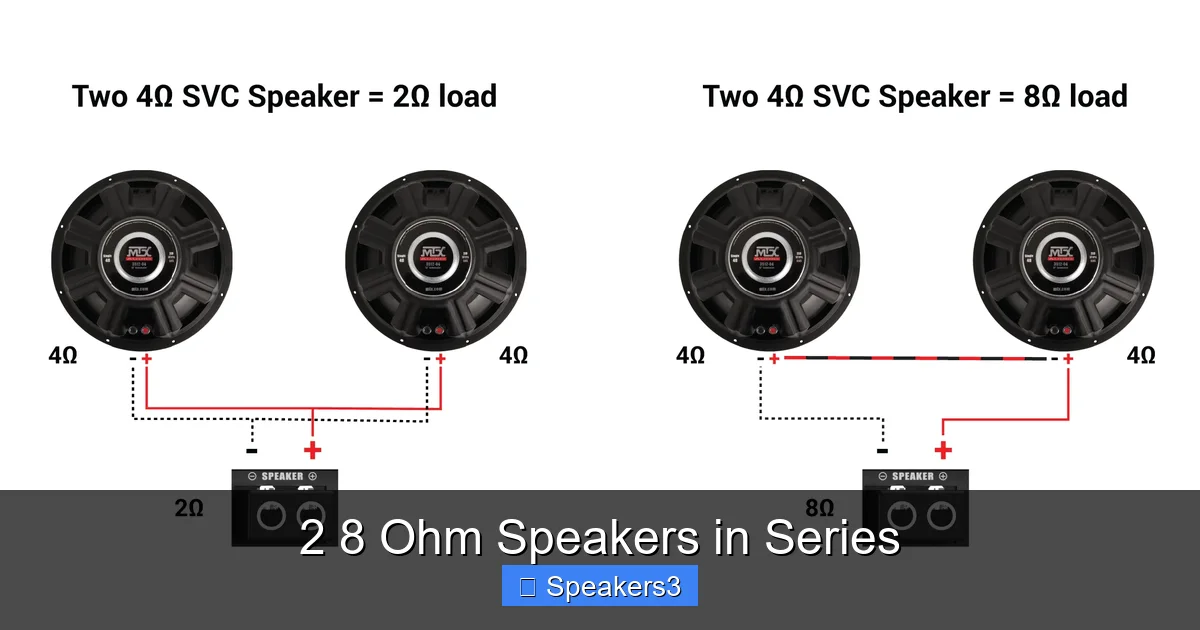
Now for the practical part. Wiring two 8-ohm speakers in series is one of the simplest electrical connections you can make in audio. You’re creating a single, continuous path for the electrical signal from your amplifier, through the first speaker, through the second speaker, and back to the amplifier. Here’s exactly how to do it.
Visual guide about 2 8 Ohm Speakers in Series
Image source: mtx.com
Tools You’ll Need
- Speaker wire: 16-14 gauge is standard for most home and car audio runs under 50 feet.
- Wire strippers/cutters.
- Amplifier with speaker terminals.
- Two 8-ohm speakers.
The Connection Process: A Clear Path
1. Identify Terminals: On your amplifier, locate the positive (+) and negative (-) terminals for one channel (e.g., “Front Left”). On each speaker, identify its binding posts or terminals, also marked + and -.
2. Create the Series Link: Take a length of speaker wire. Connect one end to the positive (+) terminal of Speaker A. Connect the other end of that same wire to the positive (+) terminal of Speaker B. This is your “series link.”
3. Connect to the Amplifier: Now, take another length of speaker wire. Connect one end to the negative (-) terminal of Speaker A. Connect the other end to the positive (+) terminal of your amplifier’s chosen channel. This completes the path from amp to Speaker A.
4. Complete the Circuit: Finally, take your last length of speaker wire. Connect one end to the negative (-) terminal of Speaker B. Connect the other end to the negative (-) terminal of the same amplifier channel. You have now created a single, unbroken loop: Amp (+) → Speaker A (+) → [Series Link] → Speaker B (+) → Speaker B (-) → Amp (-).
Visual Check: The “One Path” Rule
A quick way to verify your series connection is to trace the path with your finger. You should be able to start at the amplifier’s positive terminal and follow a single, continuous wire path through both speakers’ positive terminals, through both speakers’ voice coils, and out through both speakers’ negative terminals, finally returning to the amplifier’s negative terminal. There should be no forks or dead ends. This is a pure series circuit.
The Electrical Math: Impedance and Power in a Series Circuit
Understanding the math behind 2 8 ohm speakers in series isn’t just academic—it’s crucial for predicting performance and ensuring safety. Let’s break down the two key calculations: total impedance and power distribution.
Visual guide about 2 8 Ohm Speakers in Series
Image source: geoffthegreygeek.com
Calculating Total Impedance: Simple Addition
In a pure series circuit, total impedance (Z_total) is the straightforward sum of all individual impedances. For two 8-ohm speakers:
Z_total = Z1 + Z2 = 8Ω + 8Ω = 16Ω
Your amplifier will now see a 16-ohm load instead of an 8-ohm load. This is the primary effect of series wiring: it raises the load impedance.
Power Distribution: The Voltage Divider Effect
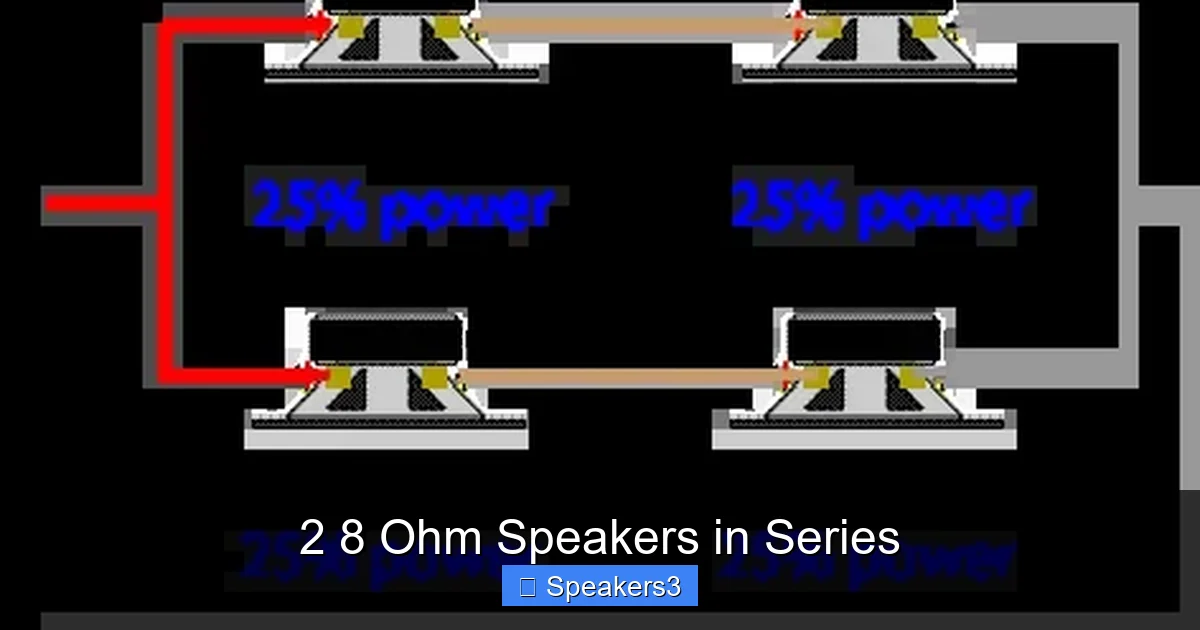
Here’s where it gets interesting. An amplifier’s output voltage is (mostly) constant for a given input signal. In a series circuit, this voltage is divided across the two speakers according to their impedance. Since both speakers are identical (both 8Ω), they will share the voltage equally. Because power (P) equals voltage squared divided by resistance (P = V²/R), each speaker gets a fraction of the total power.
If we assume an amplifier can deliver, for example, 100 watts into 8 ohms, its maximum output voltage (V_max) can be derived from P = V²/R → V = √(P*R) = √(100 * 8) ≈ 28.3 volts.
Driving a 16-ohm load, the same 28.3 volts is across the entire 16-ohm series pair. Total power into 16 ohms is P_total = V² / 16 ≈ (28.3²) / 16 ≈ 50 watts. Since this 50 watts is split evenly between the two equal 8-ohm speakers, each receives about 25 watts.
Key Takeaway: Compared to running a single 8-ohm speaker at 100W, each of your two series-wired 8-ohm speakers gets only about 25W from that same amp. The total system power is roughly halved.
The Great Debate: Pros and Cons of Series Speaker Wiring
Like any technical approach, wiring 2 8 ohm speakers in series comes with significant advantages and notable drawbacks. Knowing them helps you decide if this method is right for your specific situation.
Pros: Why You Might Choose Series
- Amplifier Protection: This is the biggest pro. If your amplifier is rated for 8-16 ohms and you want to add a second speaker, series wiring prevents you from dropping the impedance to 4 ohms (which would happen in parallel). A 16-ohm load is much easier on most amps, reducing current draw and heat.
- Simplicity of Wiring: It requires only one additional wire (the series link) compared to running a single speaker. There’s no need for complex parallel jumpers.
- Use of Existing Wiring: In some retro-fit or commercial installations (like multi-room paging systems), long speaker wire runs already exist. Series wiring can sometimes utilize this existing single-conductor cable more easily.
Cons: The Trade-Offs You Accept
- Reduced Power and Volume: As calculated, each speaker gets less power. For a given amp, you will get significantly lower maximum volume than with a single 8-ohm speaker or a parallel pair.
- Single Point of Failure: If one speaker’s internal wiring fails, its voice coil opens, or its connection at the terminal loosens, the entire circuit opens. Both speakers will go silent, and you’ll have to check both to find the fault.
- No Independent Volume Control: Since they are in series, the same current flows through both. You cannot adjust the volume of one speaker independently without affecting the other.
- Mismatched Speaker Issues: If the two 8-ohm speakers have different sensitivities (dB SPL for 1W/1m), the louder one will dominate. The difference can be stark and unpleasant, as the power is split equally regardless of efficiency.
- Damping Factor Reduction: An amplifier’s damping factor (its ability to control speaker motion) is slightly reduced with a higher impedance load like 16 ohms, though this is often a minor audible factor.
Amplifier Compatibility and Safety: The Most Critical Section
This is non-negotiable. Mismatching speaker impedance with your amplifier is the fastest route to a costly repair bill. The golden rule: Never connect a speaker load with an impedance lower than your amplifier’s minimum rating.
Reading Your Amplifier’s Specifications
Check your amp’s manual or the back panel. You’ll see something like: “Speaker Output: 8Ω” or “Minimum Load: 4Ω.” The first means it’s optimized for 8-ohm loads and may not like 4 ohms. The second means it can safely drive a 4-ohm minimum load. If it says “4Ω min,” you can safely connect two 8-ohm speakers in parallel (4Ω total). If it says “8Ω min” or “6Ω min,” you should not parallel two 8-ohm speakers (which would create 4Ω). In that case, wiring 2 8 ohm speakers in series to create a 16-ohm load is the safe, correct choice.
What Happens If You Overload an Amp (Low Impedance)?
When you connect a load that’s too low (e.g., 4Ω to an 8Ω-min amp), you’re asking the amplifier to deliver more current than its power supply and output transistors are designed for. The result: the amp works harder, gets hotter, clips (distorts) at lower volumes, and can eventually overheat and fail. You might smell burning electronics or see the protection circuit kick in (amp shuts down).
What Happens If You Under-Load an Amp (Very High Impedance)?
Connecting a very high impedance (e.g., 32Ω) is generally safer for the amp’s transistors—it draws less current. However, the amp may struggle to deliver its full power. The output voltage might not swing high enough to drive the speakers to loud volumes, leading to a weak, underpowered sound. The amp might also sound less dynamic. A 16-ohm load from two 8-ohm speakers in series is usually well within the safe operating area for most 8-ohm-rated amps, just with reduced power output.
Practical Amplifier Matching Examples
- Scenario A: You have a vintage tube amp rated for 8-16 ohms. You want two speakers. Solution: Wire them in series for 16 ohms. Perfect match.
- Scenario B: You have a modern solid-state receiver rated for 6-8 ohms (min 6Ω). Two 8-ohm speakers in parallel = 4Ω – DANGER. Solution: Wire them in series for 16 ohms. The amp will work fine, just with less power.
- Scenario C: You have a robust car amplifier rated for 2 ohms. Two 8-ohm speakers in series = 16 ohms. Result: Extremely safe, but you’ll get a tiny fraction of the amp’s potential power. You’d likely prefer parallel for 4 ohms in this high-power scenario.
Practical Applications: When and Where You’d Use This Setup
Given the power penalty, where is series wiring actually a smart choice? It’s a niche but valuable technique for specific scenarios.
1. High-Impedance Commercial & Multi-Zone Systems
Many background music, paging, and distributed speaker systems (like in offices, restaurants, or large homes with 70V/100V line transformers) use series/parallel “daisy-chain” wiring to maintain a total load within the amplifier’s rating. While those systems use transformers, the core series principle for impedance management is identical.
2. Matching Older or Delicate Amplifiers
Vintage tube amplifiers and some high-end audiophile solid-state amps are often optimized for 8-16 ohm loads and can be stressed by 4-ohm loads. If you want to add a second speaker to such an amp, series wiring is the safe, recommended path to protect your valuable equipment.
3. Simple Stereo-to-Mono Setups
Need to feed two speakers in a large room from a single amplifier channel? Series wiring is the simplest method. You’d take your amp’s left channel outputs and series-wire two speakers for the left side, and do the same for the right. This avoids the need for a stereo-to-mono summing converter or a second amp.
4. Car Audio “Tweeter” Additions
In car audio, you might add a high-passed tweeter in series with an existing mid-woofer. The tweeter’s high impedance at low frequencies (due to its capacitor) combined with the woofer’s rising impedance can create a manageable total load, while the capacitor blocks low frequencies from the tweeter. This is a more advanced application but relies on series principles.
5. DIY and Temporary Setups
For a quick test, a temporary PA setup, or a beginner’s first speaker project, the simplicity and safety of series wiring (higher impedance = less chance of frying the amp) make it an excellent learning tool.
Common Mistakes and Troubleshooting: Getting It Right
Even a simple series connection can go wrong. Here are the most frequent pitfalls and how to fix them.
Mistake 1: Reversed Polarity on One Speaker (Out of Phase)
Symptom: Very weak, thin sound, especially in the bass. The speakers seem to cancel each other out. This is because the cones are moving in opposite directions (one in, one out) for the same signal, causing destructive interference.
Fix: Double-check every terminal connection. The wire from the amplifier’s positive must go to the positive terminal of the first speaker. The wire from that speaker’s negative must go to the positive of the second speaker. The wire from the second speaker’s negative must go to the amplifier’s negative. All + to + (through the series link) and all – to – in the final connections.
Mistake 2: Thinking You Have Series, But You Wired Parallel
Symptom: Amplifier overheats, distorts at low volume, or goes into protection. You measure 4 ohms total resistance with a multimeter (with the amp off and speakers disconnected).
Fix: Recall the parallel formula: (Z1 * Z2) / (Z1 + Z2). For two 8-ohm speakers, that’s 4 ohms. You likely connected both positives to amp + and both negatives to amp -. To correct it, you must insert that series link between the two speakers as described in the wiring guide.
Mistake 3: Using Mismatched Speakers
Symptom: Sound is uneven; one speaker seems much louder or “hotter” than the other, even when placed symmetrically.
Fix: Ideally, use two identical speakers from the same model and production batch. If you must mix, try to match their sensitivity ratings (dB SPL) as closely as possible. Be prepared for an unbalanced soundstage.
Mistake 4: Forgetting the Amplifier’s Minimum Impedance
Symptom: You wired in series (16Ω), but your amp is a low-impedance car amp rated for 2Ω. It will work, but you’re getting a tiny fraction of its power, leading to disappointment in volume.
Fix: Research your amp’s specs. If it’s a high-power, low-impedance stable amp, parallel wiring (4Ω) is likely the better choice for maximum output. Series is for when you need to raise impedance to meet an amp’s minimum.
Diagnostic Tip: Use a Multimeter
Always measure the final DC resistance of your connected speaker pair with the amplifier turned off and unplugged from power. Set your multimeter to the ohms (Ω) setting. Place one probe on the amplifier’s positive terminal connection point (where your first wire attaches) and the other on the amplifier’s negative terminal connection point. You should read approximately 16 ohms (the DC resistance will be slightly lower than the AC impedance, e.g., ~14-15Ω is normal for two 8Ω speakers). If you read 4 ohms, you wired in parallel. If you read infinity (OL), you have an open circuit—a loose connection or a blown speaker.
Conclusion: Is Series Wiring Right for You?
Wiring 2 8 ohm speakers in series is a fundamental audio skill that trades power for safety and simplicity. It results in a 16-ohm load, where each speaker receives a fraction of the amplifier’s total power. This method shines when your amplifier has a minimum impedance of 8 ohms or when you’re working with delicate vintage gear—it’s the safest way to add a second speaker without risking overload.However, it comes with real compromises: lower overall volume, a single point of failure, and the absolute requirement for identical, correctly polarized speakers. For most modern home theater receivers (which are 4-ohm stable), wiring two 8-ohm speakers in parallel for a 4-ohm load is more common and delivers more power. But when in doubt, or when protecting a cherished amplifier, series wiring is the prudent, engineer-approved choice. Remember the golden rule: always match your total speaker load impedance to your amplifier’s specified minimum. When done correctly, this simple series connection provides a reliable and safe path to expanded sound.
Frequently Asked Questions
Does wiring 2 8 ohm speakers in series damage my amplifier?
No, it is generally safer for your amplifier. Series wiring increases the total impedance (to 16 ohms), which reduces the current draw from the amp. This protects amplifiers that are not rated for low-impedance (4-ohm) loads. Damage only occurs if you connect a load below the amp’s minimum rating.
How much power will each speaker get compared to a single 8-ohm speaker?
Each speaker will receive approximately one-quarter of the power your amplifier can deliver into an 8-ohm load. For example, if your amp is rated at 100W into 8 ohms, each 8-ohm speaker in a series pair (16-ohm total load) will get about 25W. The total power to both speakers is about half the amp’s 8-ohm rating.
Can I use two different brands or models of 8-ohm speakers in series?
You can, but it’s not recommended for critical listening. Mismatched sensitivity (efficiency) means one speaker will play much louder than the other, creating an unbalanced sound. For the best results, always use two identical speakers with the same specifications.
What happens if one speaker fails or gets disconnected in a series pair?
The entire circuit will open, and both speakers will go silent. In a series circuit, current must flow through both speakers. If the voice coil in one blows or a terminal connection loosens, the path is broken. You must check both speakers to find the fault.
Should I use series or parallel wiring for two 8-ohm speakers?
It depends entirely on your amplifier. If your amp’s minimum impedance is 4 ohms, parallel wiring (4-ohm load) is safe and delivers more power. If your amp’s minimum is 6 or 8 ohms, you must use series wiring (16-ohm load) to avoid overloading it. Always consult your amplifier’s specifications first.
Do I need to worry about the length of wire between the two speakers in the series chain?
For typical home or small-room installations (runs under 50 feet), the resistance of standard 16-gauge speaker wire is negligible and won’t affect the total impedance or sound quality. For very long runs (100+ feet), use thicker gauge wire (14 or 12 gauge) to minimize resistance and power loss, but the series connection principle remains the same.