English pronunciation can be a real hurdle for Spanish speakers, especially when sounds don’t exist in their native language. This guide breaks down the toughest words, explains why they’re tricky, and gives easy‑to‑follow tricks so you can sound more natural fast.
Key Takeaways
- Vowel length matters: English distinguishes short and long vowels, unlike Spanish.
- Consonant clusters are a challenge: Words like “strengths” bundle several consonants together.
- Th‑sounds need practice: Spanish has no /θ/ or /ð/ sounds, so “think” and “this” require special attention.
- Word stress changes meaning: Misplacing stress can turn “record” (noun) into “record” (verb).
- Practice with real sentences: Context helps lock the correct pronunciation in memory.
- Use visual cues: Watching mouth movements speeds up learning.
- Consistent exposure: Listening to native speakers daily reduces anxiety and builds fluency.
📑 Table of Contents
- Why English Pronunciation Feels Different for Spanish Speakers
- 1. Vowel Length and Diphthongs That Trip Up Spanish Speakers
- 2. Consonant Clusters That Feel Like a Tongue‑Twister
- 3. The “Th” Problem: /θ/ and /ð/ Sounds
- 4. The “R” Roller: Flapped vs. Trilled
- 5. Word Stress and Rhythm: Where the Emphasis Goes
- 6. Putting It All Together: Real‑World Practice
- 7. Common Mistakes and How to Fix Them
- Conclusion
- Further Reading
Why English Pronunciation Feels Different for Spanish Speakers
Spanish is a phonetic language: most letters have one sound, and words are read exactly as they are written. English, on the other hand, is full of exceptions, silent letters, and sounds that simply don’t exist in Spanish. This mismatch creates three main obstacles:
- New vowel qualities: English has 12 pure vowel sounds plus diphthongs, while Spanish has five clear‑cut vowels.
- Consonant clusters: Spanish rarely strings three or more consonants together at the start or end of a word.
- Th‑sounds and the “r”: The dental fricatives /θ/ and /ð/ (think, this) and the American “flapped r” are foreign to Spanish ears.
Understanding these differences is the first step toward mastering those tricky words.
1. Vowel Length and Diphthongs That Trip Up Spanish Speakers
Short vs. long vowels
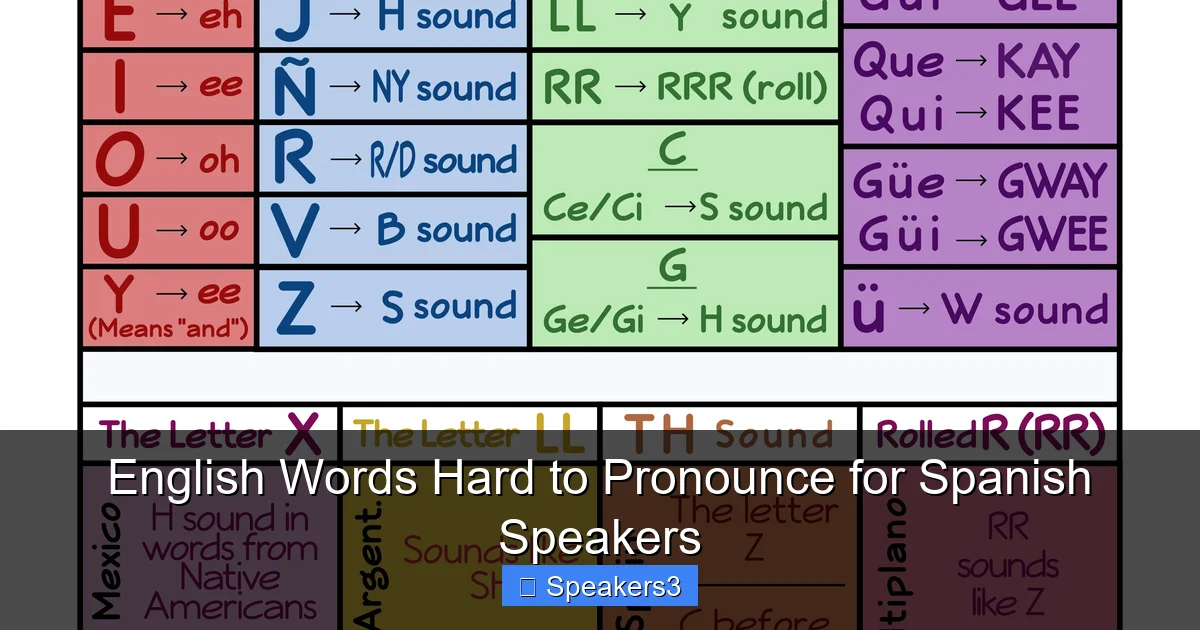
In Spanish, “a” always sounds the same. In English, “a” can be short as in cat (/kæt/) or long as in cake (/keɪk/). Mispronouncing the length changes the word entirely.
Visual guide about English Words Hard to Pronounce for Spanish Speakers
Image source: i.pinimg.com
Common trouble words
- Ship vs. Sheep – “ship” uses a short /ɪ/; “sheep” uses a long /iː/.
- Full vs. Fool – short /ʊ/ versus long /uː/.
- Bet vs. Bait – short /e/ versus diphthong /eɪ/.
Practical tip
Practice by pairing the short and long version side by side: “ship‑sheep, full‑fool, bet‑bait”. Say each pair slowly, feeling the mouth open wider for the long vowel.
2. Consonant Clusters That Feel Like a Tongue‑Twister
What is a cluster?
A consonant cluster is a group of two or more consonants without a vowel in between. Spanish syllables usually follow a (C)V(C) pattern, so clusters such as “spl‑”, “str‑”, or “‑ths” feel unnatural.
Visual guide about English Words Hard to Pronounce for Spanish Speakers
Image source: contents.pep.ph
Hard clusters for Spanish speakers
- Strengths – /strɛŋθs/ (four consonants at the end).
- World – /wɜːrld/ (the “rl” blend).
- Twelfth – /twɛlfθ/ (three consonants together).
- Sixths – /sɪksθs/ (two “s” sounds separated by “θ”).
Practice strategy
Break the word into smaller pieces, pronounce each piece, then join them gradually:
- “strengths” → “str‑en‑ths”.
- Say each piece slowly, then speed up.
- Record yourself and compare with a native speaker.
3. The “Th” Problem: /θ/ and /ð/ Sounds
Why “th” is tough
Spanish has no dental fricatives. The tongue either touches the teeth for /t/ or stays behind the teeth for /d/. This makes “think” (/θɪŋk/) and “this” (/ðɪs/) sound like “tink” and “dis”.
Visual guide about English Words Hard to Pronounce for Spanish Speakers
Image source: img.11665.com
Examples that often cause mistakes
- Think vs. Sink
- These vs. Dez
- Thorough vs. Tor‑ough
- Clothes vs. Close
Tip to master the sound
Place the tip of your tongue gently between the upper and lower teeth and blow air for /θ/. For /ð/, add voice. Practice with minimal pairs: “thin‑tin”, “then‑den”.
4. The “R” Roller: Flapped vs. Trilled
Spanish “r” vs. English “r”
Spanish uses a tapped or trilled “r”. English “r” is a postalveolar approximant, produced without touching the tongue to the roof of the mouth. This difference leads to words like “red” sounding like “led”.
Words that need attention
- Very – /ˈvɛri/ (not a rolled “r”).
- Car – /kɑːr/ (smooth “r”).
- More – /mɔːr/ (no trill).
Exercise
Practice by saying “uh‑uh‑uh” (the sound you make when hesitating) and then attach it to the vowel: “uh‑uh‑uh‑er”. It mimics the English “r”.
5. Word Stress and Rhythm: Where the Emphasis Goes
Stress changes meaning
English words often shift meaning with stress. Spanish stress is predictable (usually on the penultimate syllable). English words like “record” (noun) vs. “record” (verb) require a mental reset.
Key stress patterns
- Nouns & adjectives: stress on the first syllable (e.g., present – “gift”).
- Verbs: stress on the second syllable (e.g., present – “to give”).
- Compound nouns: first‑word stress (e.g., blackboard).
Practice tip
Mark the stressed syllable in bold when you write a word, then say it aloud: **RE**‑cord vs. re‑**CORD**.
6. Putting It All Together: Real‑World Practice
Daily listening routine
Spend 10 minutes a day listening to native speech—podcasts, YouTube videos, or audiobooks. Pause after each sentence, repeat the tricky words, and mimic the intonation.
Shadowing technique
Play a short audio clip, then immediately repeat what you heard, matching speed, stress, and rhythm. This “shadowing” method builds muscle memory.
Use technology
Apps like Forvo or Google Translate’s pronunciation feature let you hear a word spoken by a native speaker. Record your version and compare.
Practice with friends
Find a language‑exchange partner who is a native English speaker. Ask them to correct you on the specific words listed above.
7. Common Mistakes and How to Fix Them
Silent letters
Words like “knight” (silent “k” and “gh”) or “debt” (silent “b”) often cause spelling‑pronunciation mismatches. Remember: if the letter isn’t pronounced, ignore it when you speak.
Final consonant devoicing
English often voices the final consonant differently than Spanish. “Bag” ends with a voiced /g/ but “back” ends with a voiceless /k/. Practice by holding the sound longer for voiced consonants.
Over‑generalizing Spanish rules
Don’t assume every “c” before “e” or “i” sounds like “s”. In words like “cello” it’s a “ch” sound.
Conclusion
English pronunciation may feel like a maze, but breaking it down into vowel length, consonant clusters, th‑sounds, r‑sounds, and stress makes it manageable. By focusing on the specific words that give you trouble, using simple drills, and exposing yourself to native speech daily, you’ll notice real progress within weeks. Remember, consistency beats perfection—keep practicing, stay curious, and soon those once‑hard words will roll off your tongue with ease.
Further Reading
For a deeper dive into challenging vocabulary, check out our article on hard English words for Spanish speakers. If you’re curious about which languages are easier for Spanish speakers, the guide on easiest languages to learn for Spanish speakers offers great insights.
Frequently Asked Questions
Why do Spanish speakers struggle with English vowel length?
Spanish has only five vowel sounds, each with a consistent length. English distinguishes short and long vowels, so words that look similar can sound very different.
What is the best way to practice the “th” sound?
Place your tongue lightly between your teeth and blow air for /θ/. Add voice for /ð/. Practice with minimal pairs like “think‑sink” and “then‑den”.
How can I improve my English word stress?
Listen to native speakers and mark the stressed syllable in bold when you write the word. Repeat the word focusing on that stress until it feels natural.
Are there apps that can help with pronunciation?
Yes. Forvo, Google Translate, and many language‑learning apps let you hear native pronunciations and record your own for comparison.
Do silent letters affect pronunciation?
Silent letters are not spoken, so you should ignore them when saying the word. For example, “knight” is pronounced /naɪt/.
Can watching movies help with tricky English words?
Absolutely. Subtitles let you see the spelling while you hear the correct pronunciation, reinforcing both reading and speaking skills.