Hard English Words for Spanish Speakers
Learning English presents unique challenges for Spanish speakers, primarily due to fundamental differences in phonetics, spelling inconsistencies, and deceptive “false friends.” This guide breaks down these specific hurdles, offering clear explanations and actionable strategies to overcome them. Master the tricky “th” sound, navigate irregular spelling, and avoid common translation pitfalls to build confidence and fluency.
So, you’re a native Spanish speaker tackling English. You’ve got the motivation, the grammar basics, and maybe even a decent vocabulary. But then you hit a wall. You try to say “think” and it comes out as “sink.” You confidently say you’re “embarrassed” about being pregnant. You stare at “colonel” and wonder if the English language is just trolling you. You’re not alone. The journey from Spanish to English is filled with specific, predictable pitfalls that can make even the brightest learner feel stuck. This isn’t about general difficulty; it’s about the particular ways English breaks the rules your Spanish-speaking brain has come to expect. Let’s map out the territory of these hard English words for Spanish speakers, understand why they’re tricky, and arm you with strategies to conquer them.
Key Takeaways
- Phonetic Gaps: Spanish lacks several English sounds (/θ/, /ð/, /ʃ/, /v/, distinct vowel sounds), making their pronunciation a primary obstacle.
- Spelling-Pronunciation Disconnect: English’s irregular orthography means you cannot reliably sound out words, unlike Spanish’s phonetic system.
- False Friends Are Traps: Cognates like “embarrassed” (embarazada) or “actual” (actual) can lead to serious misunderstandings due to semantic drift.
- Grammar Structures Differ: English has more verb tenses, no grammatical gender for nouns, and different article/preposition usage (e.g., “interested in” vs. “interesado en”).
- Idioms Are Cultural: Phrases like “break a leg” or “it’s raining cats and dogs” are nonsensical literally and must be learned as whole concepts.
- Consistency & Exposure Is Key: Regular listening, targeted pronunciation practice, and mindful vocabulary learning are more effective than rote memorization.
📑 Table of Contents
- The Phonetic Puzzle: Sounds That Simply Don’t Exist in Spanish
- Spelling vs. Pronunciation: The Great disconnect
- False Friends (Falsos Amigos): The Deceptive Cognates
- Grammar Gymnastics: Structures That Defy Direct Translation
- Cultural Context and Idioms: When Words Don’t Mean What They Say
- Strategies for Mastery: Turning Weaknesses into Strengths
The Phonetic Puzzle: Sounds That Simply Don’t Exist in Spanish
The single biggest hurdle is often the sound system. Spanish is a phonetic language with a consistent, 5-vowel system. English is a phonological minefield with about 14-15 vowel sounds (depending on the dialect) and consonants that simply have no equivalent in Spanish. Your mouth has literally learned different muscle movements for decades. Retraining it is the first step.
The Dreaded “th” Sounds (/θ/ and /ð/)
This is the classic poster child for English pronunciation problems. Spanish has no interdental fricatives—the sounds made by placing the tongue between the teeth. You have two to master:
- /θ/ (voiceless): As in think, bath, three. It’s a soft, hissing sound. The most common mistake is substituting /s/ (“sink” for “think”) or /t/ (“tink”).
- /ð/ (voiced): As in this, mother, weather. It’s the buzzing, voiced version. The common errors are /d/ (“dis” for “this”) or /z/ (“zis”).
Practice Tip: Place the tip of your tongue gently between your upper and lower front teeth. For /θ/, push air out gently without vibrating your vocal cords. For /ð/, do the same but engage your vocal cords (you should feel a buzz). Practice minimal pairs: think/sink, thigh/sigh, then/den, bathe/bade.
The Vowel Chaos: Beyond a, e, i, o, u
Spanish vowels are pure and short. English vowels are often diphthongs (gliding sounds) and change dramatically based on context. The letter ‘o’ alone can sound like /oʊ/ in go, /ʌ/ in love, or /ɑː/ in lot. The letter ‘a’ can be /æ/ in cat, /ɑː/ in father, or /eɪ/ in name.
- The Schwa Sound (/ə/): This is the most common vowel sound in English and it doesn’t exist in Spanish. It’s a relaxed, neutral “uh” sound found in unstressed syllables: about, sofa, banana, the ‘a’ in comma. Spanish speakers tend to over-pronounce every vowel with its “full” sound, making speech sound stiff and foreign.
- Diphthong Traps: Words like boat (/oʊ/) or my (/aɪ/) are single syllables that glide from one vowel position to another. Practicing them as a single, smooth unit is key.
Practice Tip: Use the International Phonetic Alphabet (IPA) as a map, not a full language. Focus on listening and repeating. Use online dictionaries that show IPA (like Cambridge or Merriam-Webster). Clap out the syllables of a word and identify which one is stressed—the unstressed ones are schwa candidates.
Consonant Clusters and Final Consonants
Spanish syllables typically end in a vowel (CV or VC structure). English loves consonant clusters at the beginning and end of words, which can feel like running a linguistic obstacle course.
- Initial Clusters: splash, strength, twelfth. Spanish often epenthesizes a vowel, turning “school” into “eschool.”
- Final Consonants: Words ending in /s/, /d/, /t/, /k/ are often softened or dropped in connected speech (a feature called elision), but they must be pronounced clearly in isolation. Practice words like tests, desks, world (the infamous ‘r’ + ‘l’ cluster).
- The /v/ vs. /b/ Confusion: Spanish has only one bilabial sound that varies between [b] and [β]. English has a distinct /v/ (top teeth on bottom lip). “Very” often becomes “berry.”
Practice Tip: Isolate the cluster. Say “sp” then “spit.” Say “st” then “stop.” For final clusters, start slow: “wor…ld,” then speed up. Use a mirror to see lip and tongue placement for /v/.
Spelling vs. Pronunciation: The Great disconnect
If Spanish spelling is a reliable code, English spelling is a historical artifact full of ghost letters and borrowed rules. You cannot sound out English words with confidence. This leads to two major problems: mispronouncing written words and misspelling spoken ones.
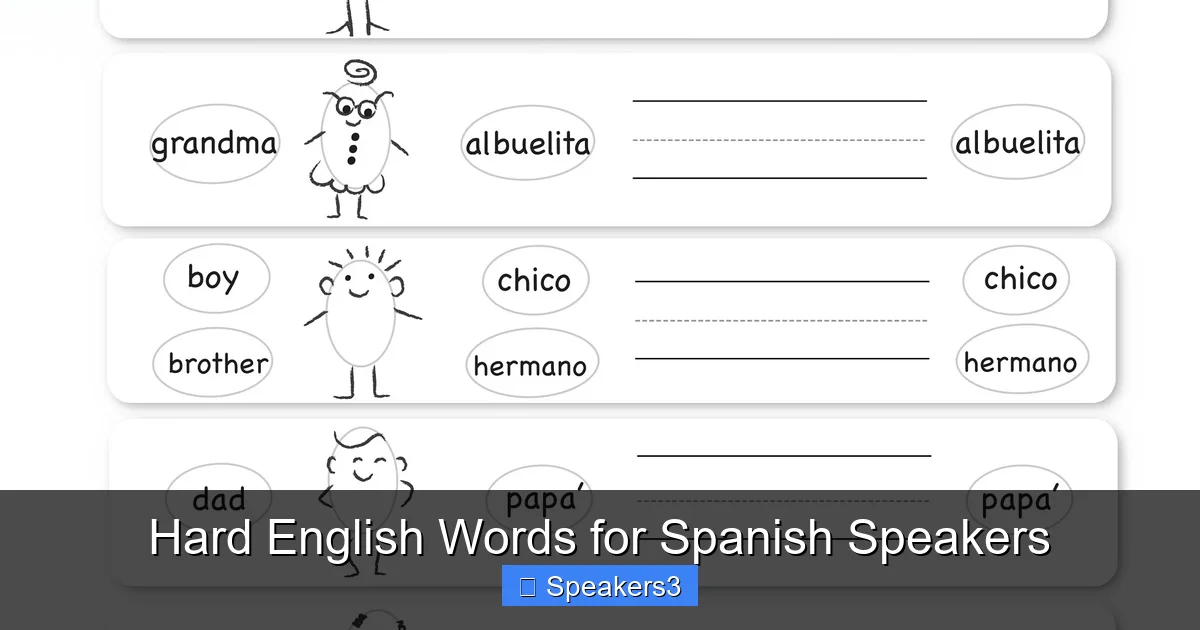
Visual guide about Hard English Words for Spanish Speakers
Image source: i2.wp.com
The “ough” Abomination
The letter combination ‘ough’ is legendary for its inconsistency. It can be pronounced in at least 8 ways:
- /oʊ/: though (though)
- /uː/: through
- /ɔː/: cough
- /ʌf/: tough (like “stuff”)
- /ɒf/: tough (British, like “cough”)
- /aʊ/: bough
- /ə/: through (in “throughout”)
- /ɜː/: hiccough (rare, like “thorough”)
This is not an exception; it’s the rule. Other examples: read (present) vs. read (past), lead (metal) vs. lead (guide), bass (fish) vs. bass (low sound).
Silent Letters and Deceptive Vowels
English is littered with letters that are written but not spoken. The ‘k’ in knight, the ‘b’ in doubt, the ‘w’ in write. Vowels can be long (say their name: a in cake) or short (as in cat), but there’s no simple rule. The magic ‘e’ at the end often makes the preceding vowel long (cap vs. cape), but not always (have has a short ‘a’ despite the ‘e’).
Practical Mindset Shift: You must treat English spelling and pronunciation as two separate, linked-but-not-identical skills. When you see a new word, always check its pronunciation in a reliable dictionary with audio. When you hear a new word, try to guess the spelling, but be prepared for surprises. Use spelling mnemonics not for rules (they rarely work), but for specific words: “I definitely forgot the finite part of the word.”
False Friends (Falsos Amigos): The Deceptive Cognates
This is where confidence can plummet rapidly. Spanish and English share thousands of Latin-derived words that look and often sound similar. Most are true friends (cognates) and are a huge advantage. But the ones that aren’t—the false friends—are linguistic landmines that can cause embarrassment or serious miscommunication.
Visual guide about Hard English Words for Spanish Speakers
Image source: cdn.prod.website-files.com
The Most Dangerous Offenders
These are the ones you must memorize as “different words,” not as translations.
- Embarazada: Does NOT mean “embarrassed.” It means pregnant. Saying “Estoy muy embarazada” when you mean “I’m very embarrassed” is a catastrophic error.
- Actual: Does NOT mean “actual” (real, true). It means current or “present.” “La situación actual” is “the current situation.”
- Asistir: Does NOT mean “to assist” (help). It means to attend (an event, a class). “Asistí a la reunión” = “I attended the meeting.”
- Recordar: Does NOT mean “to record” (audio/video). It means to remember. “Recordar” is “to remember.” “Grabar” is “to record.”
- Librería: Does NOT mean “library.” It means bookstore. A library is a “biblioteca.”
- Éxito: Does NOT mean “exit.” It means success. An exit is a “salida.” “El éxito” is success.
- Constipado: Does NOT mean “constipated.” It means having a cold (nasal congestion). Constipation is “estreñimiento.”
How to Tame False Friends
Don’t just learn the word; learn the story of the divergence. Why did “actual” shift to “current”? Often, it’s because English kept an older French/Latin meaning while Spanish evolved differently. Create a dedicated “False Friends” journal or digital note. When you encounter a new cognate, actively check if it’s a true friend. Use it in a contrasting sentence: “The current (actual) news is not actual (real) facts.” This active vigilance prevents fossilized errors.
Grammar Gymnastics: Structures That Defy Direct Translation
Spanish grammar is highly inflected (verb conjugations, gendered nouns). English is more analytic, relying on word order and auxiliary verbs. This creates specific pain points.
Visual guide about Hard English Words for Spanish Speakers
Image source: cdn.prod.website-files.com
Verb Tenses and Aspects
English has more active verb tenses (12+) than Spanish (14+ if you count all moods, but usage differs). The biggest issue is the Present Perfect (have/has + past participle). Spanish uses the Pretérito Perfecto for similar contexts, but the rules for when to use it vs. the Simple Past (Pretérito Indefinido) are different. For Spanish speakers, the distinction between:
- “I have lived here for ten years” (Present Perfect – still living here)
- “I lived here for ten years” (Simple Past – no longer living there)
…is often unclear, as Spanish might use the same tense for both. The concept of using “have” to connect a past action to the present is a grammatical nuance to practice.
Articles (The, A/An) and Gender
Spanish has gender (el/la) and number (el/los/la/las) baked into its nouns. English has only “the” (definite) and “a/an” (indefinite), with no gender. The challenge is knowing when to use an article at all. Spanish uses articles more frequently with generalities (“Me gusta el café” = I like coffee). English often omits them: “I like coffee.” Also, the rules for “a” vs. “an” are purely phonetic (based on sound, not spelling), which can be tricky: “an hour” (silent ‘h’), “a university” (you sounds like ‘y’).
Prepositions: The Great Untranslatable
Prepositions are famously idiosyncratic. You cannot translate “en,” “a,” “de” directly. You must learn the collocation (the company a verb/noun/adjective keeps).
- Interested in (not “on” or “for”)
- Depend on (not “of”)
- Married to (not “with”)
- Listen to (not “for” or just the object)
- Think about/of (different nuances)
Strategy: Stop thinking in terms of “the Spanish preposition for X.” Instead, learn the full phrase: “be responsible **for**,” “be proud **of**,” “be good **at**.” Treat the preposition as part of the verb’s identity.
Cultural Context and Idioms: When Words Don’t Mean What They Say
Language is culture. English idioms are often metaphorical, historical, or sports-based, making them impenetrable to literal translation.
Common Idioms That Confuse
- “Break a leg”: Means “good luck” (theater superstition).
- “It’s raining cats and dogs”: Means it’s raining very heavily.
- “Hit the books”: Means to study hard.
- “Bite the bullet”: Means to endure a painful or difficult situation.
- “Spill the beans”: Means to reveal a secret.
- “Piece of cake”: Means something is very easy.
Translating these literally will lead to complete confusion. They are non-compositional; the meaning is not derived from the individual words.
Formality and Register
English has a less formal “you” (you) than Spanish (tú vs. Ud.), but it compensates with vocabulary and phrasing. Words like “request” vs. “ask,” “commence” vs. “start,” “purchase” vs. “buy” signal different levels of formality. Spanish also uses “ustedes” for formal plural “you,” while English uses “you” for both. The challenge is sensing when a situation calls for more formal language (business emails, academic writing) versus the very common, phrasal-verb-heavy casual speech.
Strategies for Mastery: Turning Weaknesses into Strengths
Knowing the enemy is step one. Now, let’s build your arsenal.
Targeted Pronunciation Training
Don’t just mimic. Train deliberately.
- Use Minimal Pair Drills: Websites and YouTube channels dedicated to English pronunciation (like “English with Lucy” or “Rachel’s English”) offer drills for /θ/ vs. /s/, /v/ vs. /b/, ship/sheep, etc.
- Shadowing Technique: Listen to a short audio clip (podcast, audiobook) and immediately repeat aloud, trying to exactly match the speaker’s rhythm, intonation, and sound quality. Start slow.
- Record Yourself: We often hear what we *think* we said, not what we actually said. Record your pronunciation of target words and compare it to a native speaker’s.
Smart Vocabulary Acquisition
When learning a new word, especially a cognate, do this checklist:
- Listen to the pronunciation. Say it aloud 5 times.
- Check if it’s a false friend. Is its meaning identical? If not, what’s the trap?
- See it in 2-3 example sentences. How is it used? What prepositions does it take?
- Note its collocations. What words does it commonly pair with? (e.g., “make a decision,” “do homework”).
Use spaced repetition software (Anki, Quizlet) but include audio clips and example sentences, not just the word and translation.
Embrace the Chaos (and the Fun)
Finally, adopt the right mindset. The irregularities of English are not a bug; they are a feature of its rich, mongrel history. The very things that make it “hard”—the French influences, the Germanic roots, the global borrowings—are what give it its vast expressive power. Your Spanish is a superpower here; your brain is already adept at complex grammar. You’re not learning a broken system; you’re learning a different system. The goal isn’t to sound like a native—a goal that can be frustrating and endless. The goal is clarity and effective communication. A slight accent is a badge of linguistic courage. Mispronouncing “th” is understandable. Saying “embarazada” when you mean “embarrassed” is a funny story you’ll never repeat. Learn from the mistakes, laugh at them, and keep going. Every time you correctly use “the” with a non-specific noun or nail the schwa in “about,” you’re hacking the system. That’s the real victory.
Frequently Asked Questions
Is English harder for Spanish speakers than Spanish is for English speakers?
Generally, yes, in terms of pronunciation and spelling. English’s irregular orthography and larger phonemic inventory create a steeper initial learning curve. Spanish grammar, while complex with verb conjugations and gender, is highly consistent and rule-based, which can be more straightforward for analytic learners.
What’s the single most important thing to work on first?
Mastering the key missing sounds, especially the “th” (/θ/ and /ð/) and vowel distinctions (like ship/sheep). Focusing here early prevents fossilizing bad pronunciation habits and dramatically improves listening comprehension and spoken clarity.
How can I stop translating word-for-word from Spanish?
Force yourself to learn in chunks. Instead of memorizing “actual = actual,” learn the phrase “the current situation” = “la situación actual.” Use a monolingual English dictionary for intermediate learners. Consume content (TV, podcasts) where you can understand 70-80% without translation, forcing your brain to think in English contexts.
Are there any ‘rules’ for English spelling that actually work?
Few reliable ones exist. The most useful are: 1) “I before E except after C” (but with many exceptions like “weird,” “science”). 2) A silent ‘e’ at the end often makes the preceding vowel long (cap/cape). 3) “C” is soft (/s/) before ‘e’, ‘i’, ‘y’ (cent, city). Ultimately, you must treat spelling as a separate memorization task. Reading extensively with a focus on word patterns helps more than rules.
What are some resources specifically for Spanish speakers learning English?
Seek out content that explicitly contrasts the two languages. Look for YouTube channels or blogs titled “English for Spanish speakers” or “Inglés para hispanohablantes.” They will specifically address false friends, pronunciation challenges like “th,” and grammar contrasts. Also, use bilingual dictionaries (like WordReference) that highlight false friends and usage notes.
How long will it take to overcome these ‘hard words’?
It’s a continuous process, not a destination. You can significantly reduce the most glaring errors (like “embarazada”) in a few focused weeks. Mastering the core pronunciation differences can take months of consistent practice. The key is consistent, mindful exposure and practice. Focus on progress, not perfection. Celebrate the small wins—the first time you automatically use “interested in” correctly, or a native speaker understands your “th” without asking you to repeat.