Licensing your SaaS isn’t just a formality—it’s the legal backbone of your business. A well-crafted license agreement defines how customers can use your software, protects your intellectual property, limits your liability, and sets clear payment terms. Choosing between subscription, usage-based, or hybrid models is a critical strategic decision. You must include core legal clauses like scope of use, data privacy, and termination rights. Implementing this correctly requires careful drafting, often with a lawyer, and clear communication to users. Getting it wrong can lead to revenue loss, legal disputes, and security risks.
So, you’ve built a fantastic software-as-a-service (SaaS) product. The code is clean, the interface is intuitive, and you’re ready to sign up your first customers. You’ve thought about marketing, sales, and support. But have you thought about the legal document that actually governs every single interaction with your users? That’s your SaaS license agreement, and knowing how to license a SaaS correctly is one of the most important—and often overlooked—steps in building a sustainable, protected business.
Think of your SaaS license as the rulebook for your platform. It tells users what they can and cannot do. It protects your hard work from being stolen or misused. It limits your financial risk if something goes wrong. And it sets the stage for a predictable, professional relationship. Skipping this step or using a weak, generic template is like building a house on sand. Everything might seem fine until the first big storm—a customer dispute, a data breach, or a competitor copying your features—hits, and your legal foundation crumbles.
This guide will walk you through everything you need to know about how to license a SaaS. We’ll break down the different license models, dissect the essential legal clauses, provide a step-by-step implementation plan, and highlight the common pitfalls that can trip up even the most savvy founder. Our goal is to move you from confusion to confidence, giving you the actionable knowledge to secure your software and your business.
Key Takeaways
- Licensing is foundational: Your SaaS license agreement is the primary contract governing the relationship with every customer, defining rights, responsibilities, and protections.
- Model choice drives strategy: The license model (subscription, usage-based, freemium, etc.) directly impacts your pricing, revenue predictability, and customer acquisition strategy.
- Clarity prevents conflict: Vague terms in your license lead to disputes. Be explicit about permitted use, restrictions, data ownership, and service levels.
- IP protection is non-negotiable: You must explicitly state that you retain all intellectual property rights to the software, and customers only receive a limited, revocable license to use it.
- Compliance and data are critical: Modern licenses must address data privacy laws (GDPR, CCPA), security safeguards, and data processing responsibilities to mitigate massive regulatory risks.
- Termination clauses must be fair but firm: Define clear grounds for termination (non-payment, breach) and the consequences, including data retrieval or deletion processes, to ensure a clean exit.
- Professional legal review is essential: While templates exist, a lawyer specializing in SaaS and software licensing is crucial to tailor the agreement to your specific risks and business model.
📑 Table of Contents
- What Exactly is a SaaS License? (And Why It’s Not Your Terms of Service)
- The Strategic Choice: Selecting Your SaaS Licensing Model
- Deconstructing the SaaS License Agreement: The 10 Essential Clauses
- The Step-by-Step Implementation Plan: From Draft to Live
- Common Pitfalls & How to Avoid Them
- The Future of SaaS Licensing: Trends to Watch
- Conclusion: Your License is Your Business’s Bedrock
What Exactly is a SaaS License? (And Why It’s Not Your Terms of Service)
Before we dive into the “how,” we must be crystal clear on the “what.” A SaaS license is a legal grant from you, the software owner, to your customer. It gives them a limited, non-exclusive, non-transferable right to access and use your cloud-based application over the internet, typically in exchange for a fee. It is a **license**, not a sale. You are not selling the software itself; you are selling the *right to use* the software as a service.
This is a critical distinction from traditional on-premise software, where a customer might buy a perpetual license to install the software on their own servers. With SaaS, the software lives on your servers, and you maintain control. The license agreement is the contract that formalizes this arrangement.
License Agreement vs. Terms of Service (ToS): The Key Difference
Many people use “license agreement” and “terms of service” interchangeably, but they serve different primary purposes, though they are often combined into a single document called the “Terms of Service and License Agreement.”
- The SaaS License Agreement: Focuses on the intellectual property rights. It defines the scope of the user’s license, what they can do with the software, and what they absolutely cannot do (like reverse engineering or reselling access). Its core purpose is to protect your IP.
- The Terms of Service (ToS): Focuses on the service relationship. It covers account creation, acceptable use policies, payment terms, disclaimers of warranty, limitations of liability, and dispute resolution. Its core purpose is to manage the business relationship and risk.
For a SaaS business, these two concepts are so intertwined that they are almost always merged. When you are how to license a SaaS, you are effectively creating a comprehensive legal framework that covers both the grant of rights (license) and the rules of engagement (service terms).
The Strategic Choice: Selecting Your SaaS Licensing Model
Your license model is the engine of your revenue. It’s not just a legal choice; it’s a fundamental business strategy. The model you choose dictates how you price, how customers buy, and how you scale. Here are the most common models for how to license a SaaS.
Visual guide about How to License a Saas
Image source: superconverters.com
1. The Subscription License (The Gold Standard)
This is the most familiar SaaS model. Customers pay a recurring fee—monthly or annually—for continued access to the software. The license is granted for the subscription period and automatically renews unless cancelled.
- How it works: Fixed fee per user (per-seat), per month/year. E.g., $50/user/month.
- Best for: Most B2B and many B2B SaaS products with predictable feature sets. It provides stable, recurring revenue (MRR/ARR) which is highly valued by investors.
- Example: Slack, Salesforce, Microsoft 365. You pay for the right to use the service for the billing period.
2. The Usage-Based (or Consumption-Based) License
Here, the fee is tied directly to how much the customer uses the service. Instead of paying for access, they pay for consumption.
- How it works: Billing is based on metrics like API calls, data processed, transactions completed, or storage used. E.g., $0.10 per 1,000 API calls.
- Best for: Infrastructure tools (AWS, Twilio), platforms where usage varies wildly between customers, or products where value is directly proportional to volume.
- Challenge: Revenue can be unpredictable for you and surprising for customers if not managed with clear usage tiers and alerts.
3. The Freemium / Free Trial License
This is a marketing and adoption model layered on top of a core license (usually subscription). It grants limited access for free to attract users, with the goal of converting them to paid plans.
- How it works: A “free” license with strict caps (e.g., 10 users, 1GB storage, limited features) or a time-limited full-access trial (e.g., 14 days). The license for the free/trial tier is explicitly defined in your agreement.
- Best for: Products with broad appeal, low marginal cost per user, and a clear “aha moment” that demonstrates value quickly.
- Critical: Your license agreement must explicitly state the limitations of the free tier and that it can be revoked or converted to a paid plan at any time.
4. The Perpetual License (Rare for Pure SaaS, but a Hybrid Option)
This is the old-school model where a customer pays a large upfront fee for a “perpetual” right to use a specific version of the software. It’s uncommon for true cloud-hosted SaaS but appears in hybrid models.
- How it works: Large one-time payment. Often includes a year of maintenance/support, which must be renewed annually for updates.
- Hybrid Reality: Some vendors offer a “perpetual” license for on-premise deployment of their software, but that’s a different product offering than their core SaaS. Be very clear in your agreements which model applies.
Pro Tip: Many modern SaaS companies use a **hybrid model**. For example, a base subscription fee for core access, plus usage-based overage fees for high-volume features. Your license agreement must be meticulously drafted to support this multi-faceted structure without creating confusion.
Deconstructing the SaaS License Agreement: The 10 Essential Clauses
Now we get to the heart of how to license a SaaS. Regardless of your chosen business model, your license agreement must contain certain core clauses to be effective and enforceable. Think of this as your legal shield.
Visual guide about How to License a Saas
Image source: superconverters.com
1. Grant of License & Scope of Use
This is the core of the document. It explicitly states what you are allowing the customer to do.
- Must include: “Subject to the terms of this Agreement, Licensor grants to Customer a limited, non-exclusive, non-transferable, non-sublicensable, revocable license to access and use the Service solely for Customer’s internal business purposes.”
- Define “Service”: Attach your Service Description, SLA, and Documentation as exhibits.
- Specify Permitted Users: Is it per-named-user? Concurrent users? Geographical restrictions?
2. Restrictions on Use
This is where you draw the bright red lines. List all prohibited activities in clear, simple language.
- Common prohibitions: Using the service for illegal purposes; attempting to reverse engineer, decompile, or disassemble the software; removing proprietary notices; using automated tools (scrapers, bots) to access the service; reselling or providing the service to third parties; interfering with the service’s operation.
- Why it matters: These clauses protect your IP, your infrastructure from abuse, and your other customers’ experience.
3. Intellectual Property (IP) Rights & Ownership
Perhaps the most critical clause. You must leave zero doubt about who owns what.
- Your statement: “The Service and all related intellectual property rights are and shall remain the exclusive property of Licensor. Customer acknowledges that this Agreement does not grant any right, title, or interest in the Software or Service other than the limited license expressly set forth herein.”
- Customer Content: Address ownership of data/content the customer uploads. Typically, you grant them a license to use your platform to host their data, and you state they own it. But you also need a broad license from them to process that data to provide the service.
4. Payment Terms & Billing
This ties your license model to actual money.
- Specify: Subscription fees, usage-based rates, any setup fees, payment schedule (monthly in advance, etc.), accepted payment methods.
- Taxes: State whether quoted prices are inclusive or exclusive of taxes.
- Late Fees & Suspension: Clearly state consequences for non-payment, including your right to suspend or terminate the license after a cure period.
5. Data Privacy & Security
This is non-negotiable in 2024. Your license must align with global privacy laws.
- Data Processing Agreement (DPA): Often incorporated by reference or as an exhibit. It defines roles (you as Processor, customer as Controller), security measures, sub-processor list, and breach notification procedures as required by GDPR and CCPA/CPRA.
- Customer Obligations: State that the customer is responsible for the lawfulness of the data they upload (i.e., they have consent to collect it and share it with you).
- Security Commitment: Describe your security practices at a high level (encryption in transit/at rest, SOC 2 Type II compliance, etc.) but avoid over-promising. Use “industry-standard” or “commercially reasonable” efforts language.
6. Service Level Agreement (SLA)
This is your promise of service quality, often a separate document attached to the license.
- Define Uptime: E.g., “99.9% monthly uptime.” Define what counts as downtime (scheduled maintenance excluded?).
- Remedies: What happens if you miss the SLA? Typically service credits (a percentage refund of that month’s fee) are the sole and exclusive remedy. This limits your liability.
- Exclusions: List causes outside your control (customer error, force majeure, internet outages) that void the SLA commitment.
7. Term, Termination, and Suspension
How the license relationship starts and ends.
- Term: When does the license begin? (Usually upon account activation). Is it month-to-month, annual?
- Termination for Convenience: Can either party cancel without cause? Typically, customers can cancel subscription licenses at the end of a term with notice. You may require them to give 30 days’ notice.
- Termination for Cause: Define material breaches (non-payment, violation of restrictions). State the notice required to cure (e.g., 10 days for payment, 30 days for other breaches).
- Suspension Rights: Your right to immediately suspend access for non-payment or to prevent harm to the service or others.
- Effect of Termination: What happens to the customer’s data? Offer an export period (e.g., 30 days) before deletion. This is a key customer retention and trust feature.
8. Disclaimers & Limitation of Liability
This is your legal airbag. It limits your financial exposure.
- Disclaimer of Warranties: The service is provided “AS IS” and “AS AVAILABLE.” Disclaim all implied warranties (merchantability, fitness for a particular purpose). This is standard but must be conspicuous.
- Limitation of Liability: Cap your total liability under the agreement. A common cap is the total fees paid by the customer in the 12 months preceding the claim. Exclude liability for indirect, incidental, special, or consequential damages (like lost profits or data). This is crucial.
9. Indemnification
Who pays if there’s a third-party lawsuit?
- Your indemnification: You typically indemnify the customer against claims that your service infringes on a third party’s IP rights. This has limits (you control the defense, you can modify or replace the infringing service).
- Customer indemnification: The customer indemnifies you against claims arising from their data, their misuse of the service, or their breach of the agreement. This is very important.
10. General Provisions (The Fine Print That Matters)
These are standard but vital clauses.
- Governing Law & Venue: Which state/country’s laws govern the agreement? Where must lawsuits be filed? Choose a favorable jurisdiction for you (often where your company is based).
- Entire Agreement: States that this agreement, plus any attached SOWs/SLAs, is the whole understanding between the parties, superseding all prior discussions.
- Amendments: State that you can update the agreement with notice (e.g., 30 days) and continued use constitutes acceptance. This allows you to evolve the terms.
- Force Majeure: Excuses performance for events beyond reasonable control (war, natural disaster, major internet outage).
The Step-by-Step Implementation Plan: From Draft to Live
Knowing what should be in your license is one thing. Implementing it correctly is another. Here is a practical, ordered plan for how to license a SaaS and put it into practice.
Visual guide about How to License a Saas
Image source: cdn.shortpixel.ai
Step 1: Internal Strategy & Model Finalization
Before writing a single word, get your internal stakeholders (founders, product, finance, sales) aligned.
- Finalize your pricing and packaging. What are the tiers? What are the usage limits? This dictates the license scope.
- Define your risk tolerance. How much liability are you willing to accept? What security commitments can you realistically make?
- Identify target markets. Are you selling only to US businesses, or globally? This affects governing law and compliance clauses (GDPR, etc.).
Step 2: Draft the Agreement (With Professional Help)
Do not just copy a competitor’s ToS or use a generic online template without review. Those are starting points, not finished products.
- Hire a specialist lawyer. Invest in a lawyer who has deep experience with SaaS and software licensing. They will understand the nuances of IP, data privacy, and cloud computing contracts. This is not the place to save money.
- Provide clear context. Give your lawyer your business model, pricing page, and product docs. The more they understand your business, the better the agreement.
- Iterate. Expect a first draft that is heavily protective of you (the vendor). Your lawyer will help you balance that with what customers will reasonably accept in your market.
Step 3: Build the Technical & UX Integration
The license must be presented and accepted in a legally sound way.
- Clickwrap vs. Browsewrap: Use a **clickwrap** agreement. This requires the user to take an affirmative action (checking a box, clicking an “I Accept” button) after being given clear notice of the terms. This is legally enforceable. A **browsewrap** (terms linked in the footer, use of site constitutes acceptance) is much weaker and often not upheld.
- Timing of Acceptance: Present the license agreement at the point of sign-up, before payment or access is granted.
- Version Control: Your system must store a record of which version of the agreement each customer accepted and the date of acceptance.
- Changes to the Agreement: Build a process to notify users of updates (e.g., email, in-app banner) and capture their acceptance for material changes.
Step 4: Internal Training & Documentation
Your agreement is useless if your team doesn’t understand it.
- Train Sales & Support: They must be able to explain the key terms (especially restrictions and termination) without misrepresenting them. Create a cheat sheet.
- Document Your Processes: How do you handle a suspected breach? What is the escalation path for a potential termination? Document this so actions are consistent and defensible.
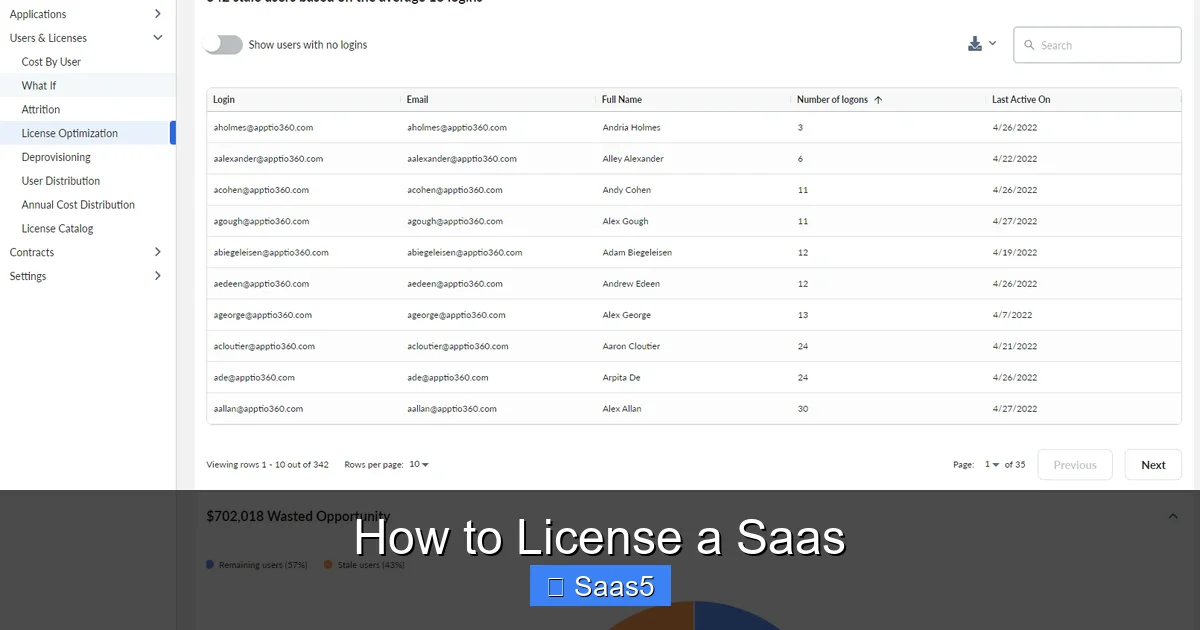
- Align Your Product: Ensure your product has features to support the license, like admin controls to manage user seats, usage dashboards for consumption-based models, and tools for customers to export their data upon termination.
Step 5: Launch & Communicate
Roll it out clearly.
- Don’t hide the link. The “Terms of Service” link should be prominent during sign-up.
- Use plain language summaries. Consider adding a one-paragraph “What This Means For You” section in plain English before the full legal text. This builds trust.
- Announce major changes. For existing customers, send a clear email explaining what’s changing, why, and what they need to do. Give ample notice (30-60 days) for material changes.
Common Pitfalls & How to Avoid Them
Even with the best intentions, founders make mistakes when learning how to license a SaaS. Here are the top pitfalls and how to sidestep them.
Pitfall 1: Using an Unmodified “Off-the-Shelf” Template
The Problem: Templates are generic. They don’t reflect your specific business model, your unique product features, or your risk profile. They may have clauses that are unenforceable in your jurisdiction or contradict your actual practices.
The Fix: Use a template only as a discussion starter with your lawyer. Every clause should be reviewed and tailored. Your lawyer will ask questions the template never considered.
Pitfall 2: Vagueness in the Grant of License
The Problem: Saying “you can use our software” is not enough. What does “use” mean? How many users? Can they build integrations on top of it? Vagueness leads to customers pushing boundaries and you having no legal footing to stop them.
The Fix: Be hyper-specific. Define “Authorized Users,” list permitted and prohibited use cases, and attach your service documentation and acceptable use policy as incorporated exhibits.
Pitfall 3: Ignoring Data Privacy & International Compliance
The Problem: Thinking a single US-centric agreement works for the world. GDPR, CCPA, PIPL (China), and other laws impose specific requirements on data processing, user rights, and cross-border data transfers. Non-compliance can result in fines of up to 4% of global revenue.
The Fix: Have your lawyer draft your DPA to be GDPR-compliant from day one. Include clauses addressing data subject rights, international data transfers (Standard Contractual Clauses), and specific disclosures for California/European users. Consider a separate, region-specific addendum for the EU.
Pitfall 4: Over-Promising in the SLA
The Problem: Marketing promises 100% uptime. The legal SLA says 99.9%. The contract controls. If your SLA is too aggressive and you miss it, your service credits could become financially crippling, and you’ve set an unrealistic expectation.
The Fix: Base your SLA on what you can realistically and sustainably achieve. 99.9% is excellent for most SaaS (about 8.6 hours of downtime allowed per year). Build in reasonable exclusions for maintenance and customer-caused issues. The SLA remedy (service credit) should be a genuine pre-estimate of damages, not a penalty.
Pitfall 5: Failing to Enforce the Agreement Consistently
The Problem: You let one large customer violate the non-resale clause because they’re “important.” Then a smaller competitor does the same and you try to enforce it. The “important” customer’s history of non-enforcement can be used as a defense (estoppel) against your enforcement action.
The Fix: Enforce the terms uniformly. Have a clear internal process for identifying breaches (e.g., automated monitoring for API abuse) and a graduated response plan (warning -> suspension -> termination). Document every step. Consistency is key to legal enforceability.
Pitfall 6: Not Planning for the End Game (Termination & Data)
The Problem: The agreement is silent on what happens to a customer’s data when they cancel. Do you delete it immediately? Hold it for 90 days? Can they export it? This leads to horror stories and angry former customers.
The Fix: Include a clear “Termination” section. Offer a post-termination data export window (e.g., 30 days) with your assistance. State what data you will delete and when. This is a critical trust and compliance (GDPR right to erasure) issue.
The Future of SaaS Licensing: Trends to Watch
The legal landscape for SaaS is evolving. As you figure out how to license a SaaS today, keep an eye on these emerging trends.
AI-Specific Clauses
If your SaaS uses AI (e.g., generative features, predictive analytics), your license must address new risks.
- Output Ownership: Who owns the content/code the AI generates? Typically, you grant the user a license to the output, but you retain ownership of the AI model itself.
- Hallucinations & Accuracy: You must strongly disclaim warranties regarding the accuracy, completeness, or reliability of AI-generated output. The disclaimer needs to be exceptionally clear.
- Training Data Rights: Do you use customer data to train your models? If so, you need explicit, opt-in consent in your agreement and privacy policy.
Carbon & Sustainability Commitments
With growing ESG focus, enterprise customers are asking about the environmental impact of their software vendors. Future licenses may include clauses related to carbon footprint reporting or commitments to sustainable infrastructure.
Increased Regulatory Fragmentation
More countries are enacting their own digital sovereignty laws, data localization requirements, and consumer protection rules. The “one-size-fits-all” global license is becoming impossible. Expect to manage a matrix of regional addendums and master agreements for different jurisdictions.
Conclusion: Your License is Your Business’s Bedrock
Learning how to license a SaaS is not a one-time task to check off a list. It’s a continuous process of aligning your legal framework with your evolving product, market, and risk landscape. A strong, clear, and fair license agreement does more than just protect you from lawsuits—it builds trust with customers by setting transparent expectations. It gives your sales team confidence. It gives your engineering team guardrails. It gives your investors confidence that your IP and revenue streams are secure.
Start with a solid strategy: choose the model that fits your business. Then, invest in a professionally drafted agreement that covers the ten essential clauses we discussed. Implement it with a seamless, clear user experience. Train your team to uphold it consistently. And stay informed about legal trends affecting your industry.
Your SaaS product is your creation. Your license agreement is the charter that allows that creation to thrive in the commercial world. Treat it with the seriousness it deserves. When in doubt, consult a specialist lawyer. The cost of getting it right is always, always less than the cost of getting it wrong.
Frequently Asked Questions
How is a SaaS license different from a traditional software license?
A SaaS license grants access to a cloud-hosted service, not ownership of the software itself. The vendor maintains and updates the software. Traditional on-premise licenses often grant rights to install and run a specific version on the customer’s own hardware, with the customer responsible for maintenance and updates. The SaaS model is a service contract with a license component, while the traditional model is primarily a license with optional support.
What is the single most important clause in a SaaS license agreement?
While all clauses are important, the Intellectual Property Rights clause is paramount. It must unambiguously state that you, the vendor, retain all ownership rights to the software, code, and underlying technology. The customer only receives a limited, revocable license to use the service. Without this crystal-clear language, you risk losing control of your core asset.
Can I change my SaaS license agreement after customers have signed up?
Yes, but you must do it carefully. Your agreement should include an “Amendments” clause that reserves your right to update the terms with notice (e.g., 30 days) and states that continued use of the service after the effective date constitutes acceptance. For material changes (like new fees or significantly altered restrictions), best practice is to require explicit re-acceptance (e.g., a login prompt). Always check the governing law, as some jurisdictions have stricter rules on unilateral contract changes.
How do I handle a customer who is violating the license terms (e.g., sharing logins, exceeding user limits)?
First, document everything. Gather evidence of the violation (logs, screenshots). Then, follow the process you’ve defined internally and in the agreement. Start with a formal written notice of breach, citing the specific violated clause and giving a cure period (if required by your termination clause). If not cured, escalate to suspension of service, and finally, termination for cause. Consistency in enforcement is legally critical.
Do I need a separate Data Processing Agreement (DPA) if I have a SaaS license?
If you process personal data of EU, UK, or California residents on behalf of your customers (which almost all SaaS does), yes, you need a DPA. GDPR and CCPA explicitly require a written contract between the Controller (your customer) and Processor (you) covering data processing terms. This is often incorporated as an exhibit to your main license agreement. Do not rely on your main ToS/Privacy Policy alone to satisfy this legal requirement.
When should I absolutely hire a lawyer for my SaaS license?
You should hire a specialized lawyer before you launch your first paid customer. Also, hire a lawyer if: you are entering an enterprise market with complex negotiations; you are adding AI features; you are expanding internationally; you receive a legal complaint or notice from a customer; or you are raising a significant funding round where due diligence will scrutinize your legal contracts. The initial investment prevents exponentially larger costs later.