Connecting two 4 ohm speakers to a 4 ohm load can be done safely by wiring them in series, parallel, or a hybrid method, depending on your amp’s power rating and desired sound. This guide breaks down the math, shows practical wiring diagrams, and offers tips to protect your gear while getting the best tone.
Key Takeaways
- Series wiring adds impedance: Two 4 ohm speakers in series create a 8 ohm load, which reduces amp stress.
- Parallel wiring halves impedance: Two 4 ohm speakers in parallel present a 2 ohm load, demanding a stable, low‑impedance amp.
- Hybrid wiring balances power: Combining series and parallel lets you achieve a 4 ohm load while sharing power evenly.
- Check your amp’s specs: Never exceed the recommended minimum load; most home amps handle 4 ohms comfortably.
- Use quality speaker wire and secure connections: Poor connections can mimic a short and damage your amp.
- Consider crossover and impedance matching: Proper crossovers protect tweeters and keep the overall load consistent.
- Safety first: Always turn off power before wiring or re‑wiring speakers.
📑 Table of Contents
Introduction: Why the 4 Ohm Question Matters
If you’ve ever stared at a pair of 4 ohm speakers and wondered how they will behave on a 4 ohm amp, you’re not alone. The numbers can be confusing, especially when you add more speakers to the mix. The key is understanding impedance—the resistance a speaker offers to the electrical signal from your amplifier.
Getting the math right isn’t just about getting louder sound; it’s about protecting your equipment. An amp forced to drive a load lower than it’s designed for can overheat, distort, or even burn out. On the flip side, a load that’s too high can make the amp sound weak and under‑powered. In this article we’ll walk through every way you can connect two 4 ohm speakers to achieve a 4 ohm load, explain the pros and cons of each method, and give you practical tips you can apply right now.
Understanding Impedance Basics
What is Impedance?
Impedance, measured in ohms (Ω), is the speaker’s opposition to the flow of alternating current (AC). It’s not a static value; it can vary with frequency, but the nominal rating—4 ohm, 8 ohm, etc.—gives you a solid baseline for wiring calculations.
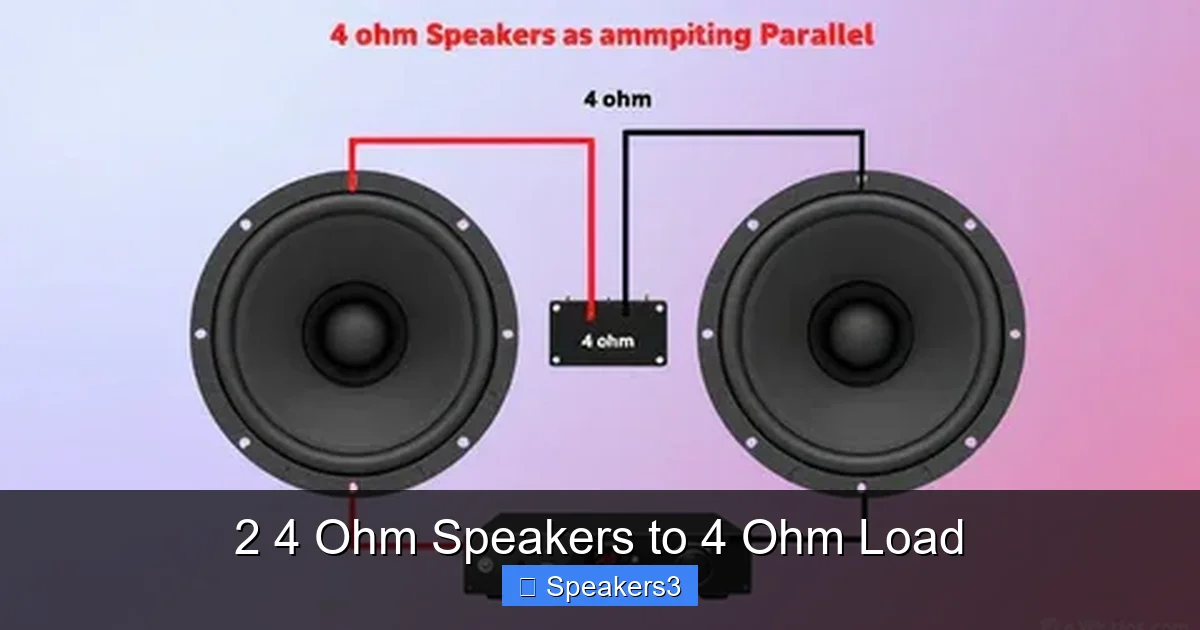
Visual guide about 2 4 Ohm Speakers to 4 Ohm Load
Image source: cdn.shopify.com
How Amplifiers React to Different Loads
Most consumer and car amplifiers specify a minimum load impedance. A typical home stereo amp might say “4 Ω minimum.” If you connect a load lower than that (like 2 Ω), the amp will try to push more current, which can cause overheating. Conversely, a higher load (8 Ω) reduces current demand, making the amp run cooler but often quieter.
Why Two 4 Ohm Speakers Are Tricky
Two 4 ohm speakers can be wired in three basic ways:
- Series – results in 8 Ω total.
- Parallel – results in 2 Ω total.
- Series‑parallel (hybrid) – results in 4 Ω total.
Choosing the right method depends on your amp’s capabilities and the sound you want.
Wiring Options for Two 4 Ohm Speakers
1. Series Wiring – Safe, but Softer
Connecting the speakers end‑to‑end (positive of Speaker A to negative of Speaker B) creates an 8 Ω load. This is the safest option for most amps that can handle 4 Ω minimum because the load is higher, not lower.

Visual guide about 2 4 Ohm Speakers to 4 Ohm Load
Image source: astropics.com
How to wire:
- Run a speaker wire from the amp’s positive terminal to the positive terminal of Speaker A.
- Connect the negative terminal of Speaker A to the positive terminal of Speaker B.
- Finish by connecting the negative terminal of Speaker B back to the amp’s negative terminal.
Because the impedance is doubled, you’ll notice a slight drop in volume. However, the sound can be clearer, especially in the bass region, because the amp isn’t being pushed to its limits.
2. Parallel Wiring – Louder, but Demanding
Parallel wiring ties the positive terminals together and the negative terminals together, halving the total impedance to 2 Ω. This configuration can produce louder output, but only if your amp is rated for 2 Ω loads.
How to wire:
- Connect the amp’s positive terminal to the positive terminals of both speakers using a short “Y” splice.
- Do the same with the negative terminals.
If your amp isn’t 2 Ω‑stable, you risk overheating. Many car amplifiers are designed for 2 Ω, but most home receivers are not.
3. Series‑Parallel (Hybrid) – The Sweet Spot
The hybrid method gives you a true 4 Ω load while sharing the power evenly between the two speakers. Think of it as two mini‑circuits: each speaker pair is wired in series, then those pairs are wired in parallel.
How to wire:
- Connect the positive terminal of Speaker A to the amp’s positive.
- Connect the negative terminal of Speaker A to the positive terminal of Speaker B (this is the series link).
- Connect the negative terminal of Speaker B back to the amp’s negative.
- Repeat the same steps for the second pair of speakers, then join the two positive wires together and the two negative wires together.
This configuration is ideal for a 4 Ω amp, giving you full power without stressing the amp. It’s the most common method for car audio installations where space and power are premium.
For a visual guide, see our article on how to wire speakers to amp, which includes wiring diagrams that match the hybrid setup.
Practical Examples: When to Use Each Method
Home Stereo Setup
Imagine a living‑room stereo with a 100 W, 4 Ω receiver. You have two bookshelf speakers each rated at 4 Ω, 50 W. The hybrid method keeps the load at 4 Ω, allowing each speaker to receive its full 50 W rating without overtaxing the amp. The result is balanced sound and safe operation.
Car Audio Upgrade
In a car, you might have a 4 Ω amp that can handle 2 Ω loads. If you want to add a second pair of 4 Ω speakers for rear fill, you could wire the front pair in parallel (2 Ω) and the rear pair in parallel (2 Ω), then connect those two groups in series (2 Ω + 2 Ω = 4 Ω). This trick is explained in detail in our guide about 2 8 Ohm Speakers In Series, which shows how series‑parallel combos can keep the overall load steady.
Portable Bluetooth Amp
Portable amps often struggle with low‑impedance loads. If you have a 4 Ω Bluetooth amp and want to power two 4 Ω speakers, the safest route is series wiring. You’ll lose a bit of volume, but you’ll protect the tiny amp from overheating.
Tips for a Clean, Reliable Connection
Use Proper Gauge Wire
For runs under 25 ft, 16‑gauge speaker wire works fine. Longer runs or higher power applications benefit from 14‑gauge or even 12‑gauge to minimize resistance.
Secure Connectors
Banana plugs, spade connectors, or high‑quality solder joints keep the connection solid. Loose connections can act like a short circuit, causing the amp to shut down or produce crackling noise.
Mind the Polarity
Reversing polarity on one speaker flips its phase, which can cause bass cancellation. Always double‑check that the positive from the amp goes to the positive on each speaker.
Integrate Crossovers When Needed
If your setup includes tweeters or mid‑range drivers, a crossover protects them from low frequencies that could damage the driver and alter the overall impedance. A well‑designed crossover keeps the total load close to the intended 4 Ω.
Check the Amp’s Heat
Even with the correct impedance, an amp can overheat if it’s driven at full power for extended periods. Give it ventilation, and consider a small fan if you’re in a tight enclosure.
Common Mistakes and How to Avoid Them
Assuming All 4 Ohm Speakers Are Identical
Speaker sensitivity (dB SPL per watt) varies. Pairing a high‑sensitivity speaker with a low‑sensitivity one in the same circuit can lead to uneven sound levels. Aim for matching specs when possible.
Forgetting the Amplifier’s Minimum Load
Never ignore the amp’s “minimum load” rating. If it says 4 Ω minimum, a parallel 2 Ω setup will quickly overheat the amp.
Mixing Impedance Without Re‑Calculating
Adding a third speaker without re‑calculating total impedance can unintentionally drop the load to 1.33 Ω (if all are in parallel), which most amps cannot handle.
Neglecting Ground Loops
In complex installations, especially car audio, ground loops can introduce hum. Use a ground loop isolator if you hear a persistent low‑frequency buzz.
Conclusion: Pick the Right Wiring for Your Needs
Connecting two 4 ohm speakers to a 4 ohm load doesn’t have to be a guessing game. By understanding series, parallel, and hybrid wiring, you can match the load to your amp’s specifications, protect your gear, and enjoy the best possible sound. Remember to check your amp’s minimum impedance, use quality wire, and keep connections tight. With these steps, you’ll be able to power your speakers confidently, whether you’re setting up a home theater, a car sound system, or a portable gig‑ready rig.
Frequently Asked Questions
Can I connect two 4 ohm speakers in series and still get enough volume?
Yes, series wiring creates an 8 Ω load, which reduces the power each speaker receives, but a quality amp can still deliver ample volume, especially for mid‑range frequencies.
Is parallel wiring safe for a typical home stereo receiver?
Most home receivers are rated for a minimum of 4 Ω, so parallel wiring (2 Ω) is not recommended unless the receiver explicitly states it can handle 2 Ω loads.
What is the advantage of a hybrid (series‑parallel) connection?
The hybrid method maintains a 4 Ω load while allowing each speaker to receive its rated power, giving you the best balance of loudness and safety.
Do I need a crossover when wiring two 4 ohm speakers together?
If you’re using full‑range speakers only, a crossover isn’t required. However, for multi‑driver systems, a crossover protects the tweeters and helps keep the overall impedance stable.
How can I tell if my amp is overheating after wiring speakers?
Feel the amp’s case after a few minutes of use; if it’s unusually hot to the touch, or if the amp shuts down intermittently, it’s likely overheating.
Where can I find more detailed wiring diagrams?
Our step‑by‑step guide on how to wire speakers to amp includes diagrams for series, parallel, and hybrid configurations.