A laptop with 16GB of RAM and a 1TB SSD is the current sweet spot for powerful, responsive computing. This combination effortlessly handles demanding multitasking, large creative projects, and modern gaming, while the ample SSD storage means you’ll never have to constantly delete files to make space. It’s a future-proof investment that eliminates common performance bottlenecks, providing a smooth experience for years to come.
Key Takeaways
- RAM vs. Storage: 16GB RAM is your laptop’s short-term working memory for active tasks, while the 1TB SSD is its long-term, ultra-fast storage for your operating system, apps, and files.
- Multitasking Mastery: This spec combo allows you to run dozens of browser tabs, multiple heavy applications (like Photoshop and Excel), and background services simultaneously without slowdowns.
- Speed is Everything: The 1TB SSD drastically reduces boot times, app launch speeds, and file transfer rates compared to traditional hard drives or smaller, slower SSDs.
- Future-Proof Storage: 1TB provides comfortable breathing room for modern OS updates, large software suites, a vast media library, and numerous games without constant storage management.
- Target User Profile: Ideal for professionals (developers, designers, video editors), serious students, mainstream gamers, and power users who refuse to compromise on speed and capacity.
- Beyond the Specs: The CPU and GPU are equally critical. A powerful processor and dedicated graphics card are needed to fully leverage the 16GB RAM for tasks like 3D rendering or high-FPS gaming.
- Upgrade Consideration: Check if the RAM is soldered or has a free slot, and if the SSD can be replaced or expanded, as this impacts long-term upgradability.
[FEATURED_IMAGE_PLACEHOLDER]
📑 Table of Contents
- Understanding the Core Components: RAM and SSD Explained Simply
- The Power Duo: Why 16GB RAM + 1TB SSD Works So Well
- Who Needs This Configuration? (It’s Not Just for “Experts”)
- Buying Guide: What to Look For Beyond the RAM and SSD
- Optimizing Your New Laptop for Peak Performance
- Future-Proofing Your Investment: Will It Age Well?
- The Verdict: Is 16GB RAM and 1TB SSD the New “Must-Have” Standard?
Understanding the Core Components: RAM and SSD Explained Simply
Before we dive into the magic of the 16GB RAM and 1TB SSD combination, let’s break down what these parts actually do. Think of your laptop as a busy office.
What is RAM (Random Access Memory)?
RAM is like the desk space in that office. It’s where your laptop temporarily holds all the information it needs for the tasks you’re actively working on—the open browser tabs, the document you’re typing in, the spreadsheet you’re calculating, the game you’re playing. The bigger the desk (more RAM), the more projects you can spread out and work on at once without everything getting cluttered and slow. When you shut down, everything on the RAM desk gets cleared away.
What is an SSD (Solid State Drive)?
The SSD is the office’s massive, super-organized filing cabinet and library. It’s where everything is permanently stored: your operating system (Windows or macOS), all your installed programs, your photos, videos, documents, and games. Unlike an old, mechanical hard drive (HDD) which is like a filing cabinet with a slow, spinning disk and a mechanical arm, an SSD uses flash memory chips. This means it has no moving parts. Accessing any file is instant, like pulling a document from a perfectly indexed digital library instead of hunting through physical folders.
So, RAM is about active, immediate work. The SSD is about permanent, fast-access storage. They are completely different but equally vital for a fast laptop.
The Power Duo: Why 16GB RAM + 1TB SSD Works So Well
For years, 8GB of RAM was the standard. But as operating systems and software become more complex, that “standard” has become a bare minimum, often leading to frustrating slowdowns. Pairing 16GB of RAM with a generous 1TB SSD creates a harmonious balance that eliminates two of the most common performance bottlenecks.
Visual guide about Laptop 16gb Ram 1tb Ssd
Image source: cdn.media.amplience.net
Eliminating the “Memory Pressure” Slowdown
With only 8GB RAM, running a modern web browser with ten tabs (each a memory hog), a word processor, a music app, and a video call can easily consume 7-8GB. Your system runs out of “desk space.” It then starts using a portion of your SSD as “virtual memory,” a slow process called swapping. This is the primary cause of that dreaded lag, stutter, and “spinning beach ball” of death. 16GB of RAM provides a massive buffer. You can run all that and still have 6-8GB free for a heavy application like a photo editor or a coding IDE. The system breathes easy, and everything feels snappy.
Storage That Doesn’t Force Constant Choices
A 256GB or 512GB SSD fills up alarmingly fast. The operating system alone can take 30-40GB. Microsoft Office or Adobe Creative Cloud? Another 10-20GB. A few modern AAA games? 80-150GB each. Before you know it, your 512GB drive is 90% full, and a full drive performs slower. You’re constantly uninstalling games or moving photos to an external drive. A 1TB SSD changes that relationship. It gives you room to breathe. You can install your entire creative suite, keep your favorite games library ready to play, store a massive photo and video archive, and still have hundreds of GBs of free space for future projects. This free space is crucial for the SSD’s own health and performance (SSDs need empty blocks to write efficiently).
Who Needs This Configuration? (It’s Not Just for “Experts”)
You might think this is only for hardcore gamers or video editors. While they are perfect candidates, the truth is this spec combo benefits a much wider range of users who value a frustration-free, productive computer.
Visual guide about Laptop 16gb Ram 1tb Ssd
Image source: i5.walmartimages.com.mx
The Professional & Creative Power User
This is the obvious audience. Software developers running virtual machines, database managers with huge datasets, graphic designers in Photoshop and Illustrator with massive PSD files, video editors working with 4K footage in Premiere Pro or DaVinci Resolve—all these applications are memory-hungry. 16GB is often the starting point for professional work. The 1TB SSD ensures project files, asset libraries, and render caches are all on the same ultra-fast drive, speeding up load and save times dramatically.
The Mainstream Gamer
While a high-end gaming laptop needs a powerful GPU first, 16GB RAM has become the standard for modern gaming. Games like “Cyberpunk 2077,” “Hogwarts Legacy,” and even competitive shooters benefit from the extra memory for higher-resolution textures and seamless open worlds. The 1TB SSD is a game-changer here. With many new games exceeding 100GB, you can install a solid library of 5-10 games without juggling installations. Load times are cut dramatically compared to HDDs, getting you into the action faster.
The Ambitious Student & Multitasking Prodigy
Think of a college student with 50 Chrome tabs open for research (each with its own video and article), a Word document, a PDF reader, Spotify, a Zoom call, and maybe a light photo editing project for a class. This is a classic recipe for slowdown on an 8GB machine. 16GB handles this chaotic, real-world workflow with ease. The 1TB SSD means they can keep all their semester’s files, textbooks (PDFs), projects, and entertainment on one drive without a storage panic.
The “I Just Want It to Last” Power User
This is the person who buys a laptop and plans to use it for 5+ years. They want to avoid buying a new one in three years because their current machine can’t handle the next OS update or a new version of their essential software. Investing in 16GB RAM and a 1TB SSD is the single best way to future-proof a laptop purchase. It provides headroom for software to become more demanding over time, ensuring the laptop feels fast and capable throughout its entire lifespan.
Buying Guide: What to Look For Beyond the RAM and SSD
Laser-focusing on “16GB RAM and 1TB SSD” is smart, but it’s only part of the story. A slow processor or a dim, low-quality screen will ruin the experience, no matter how much RAM you have. Here’s your checklist.
Visual guide about Laptop 16gb Ram 1tb Ssd
Image source: cdn.media.amplience.net
The Brains: CPU (Processor)
The CPU is the engine. For a 16GB/1TB machine to shine, it needs a capable engine to process all that data. Look for current or recent-generation Intel Core i5/i7/i9 (13th/14th Gen) or AMD Ryzen 5/7/9 (7000/8000 series). An older generation CPU (e.g., Intel 10th Gen) paired with 16GB RAM will still be good for many tasks, but for heavy video editing or engineering software, a newer, more powerful CPU is non-negotiable. Match the CPU tier to your workload: an i5/Ryzen 5 is great for general use and light gaming; an i7/Ryzen 7 is the sweet spot for professionals and serious gamers; an i9/Ryzen 9 is for the most demanding, uncompromising workloads.
The Visuals: GPU (Graphics Card)
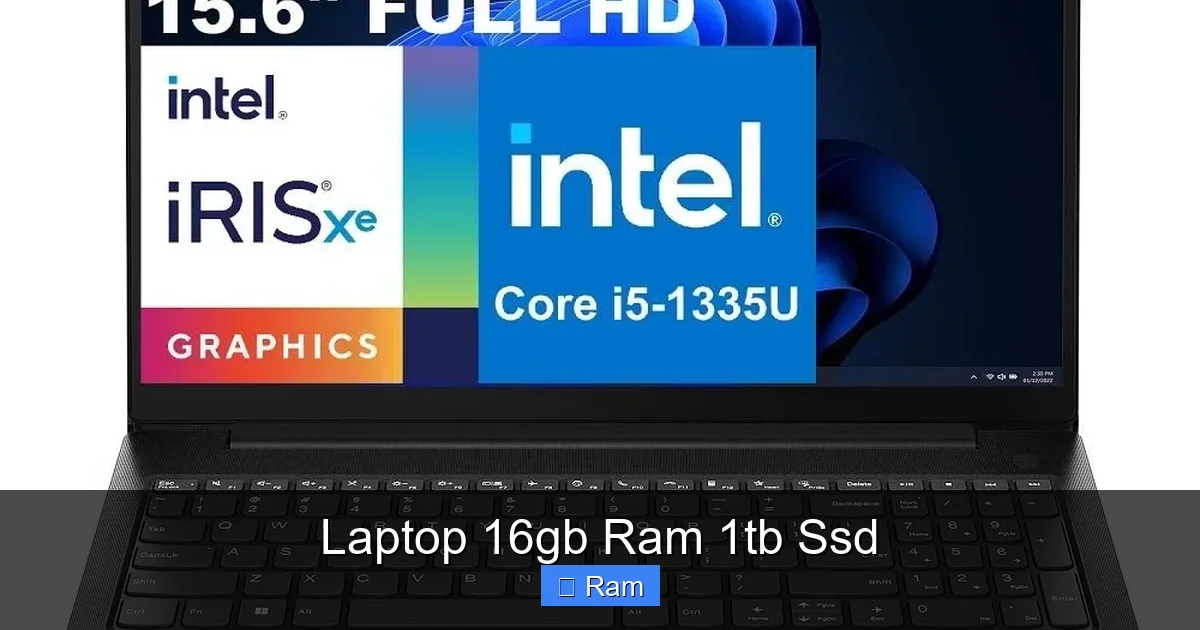
This determines your gaming and creative performance. There are two types: integrated (built into the CPU) and discrete (a separate, powerful chip). Integrated graphics (like Intel Iris Xe or AMD Radeon Graphics) have improved vastly and are fine for everyday tasks, HD video, and light gaming. However, for 1080p+ gaming at good settings, 3D modeling, or GPU-accelerated video effects, you need a discrete GPU. Look for NVIDIA GeForce RTX 4050/4060/4070 or AMD Radeon RX 7600S/7700S. The GPU model is often more important for gaming than the CPU within the same price bracket.
The Display & Build: You Look at This All Day
A 16GB/1TB laptop with a terrible, dim, low-resolution screen is a painful tool. Prioritize: Resolution: Full HD (1920×1080) is the absolute minimum. Consider QHD (2560×1440) for sharper text and images on larger screens. Panel Type: IPS offers the best color and viewing angles. Brightness: 300 nits is good; 400+ is excellent for use in brighter environments. Refresh Rate: 60Hz is standard; 120Hz+ is smoother for scrolling and gaming. Build Quality: Aluminum chassis are more durable and premium than plastic. Keyboard travel and trackpad precision matter for long typing sessions.
Optimizing Your New Laptop for Peak Performance
You’ve unboxed your shiny new 16GB/1TB laptop. Here’s how to make sure it runs at its absolute best from day one.
Initial Setup & Bloatware Removal
First, don’t just use the pre-installed Windows/MacOS setup. Go to the manufacturer’s support website (Dell, HP, Lenovo, etc.) and download the latest drivers for your specific model, especially chipset, graphics, and Wi-Fi drivers. This can solve stability and performance issues. Next, tackle bloatware—the trial antivirus software, unnecessary utilities, and “helpful” toolbars that come pre-installed on many Windows laptops. Go to Settings > Apps and uninstall anything you don’t recognize or need. This frees up RAM and SSD space from the start.
SSD Optimization: TRIM & Storage Sense
Modern SSDs self-manage well, but ensure the TRIM command is enabled (it usually is by default in Windows 10/11). TRIM helps maintain SSD speed over time. On Windows, enable “Storage Sense” (Settings > System > Storage). This automatically cleans up temporary files and empties the Recycle Bin after a set period, keeping your 1TB drive tidy. Never defragment an SSD; it’s useless and causes unnecessary write wear.
Managing Your 16GB RAM Effectively
While 16GB is plenty, poor habits can still cause slowdowns. Use the built-in Task Manager (Ctrl+Shift+Esc) to see what’s using your memory. Close heavy browser tabs you’re not using. Be mindful of running multiple memory-intensive apps simultaneously (e.g., a virtual machine + Photoshop + 50 Chrome tabs). If you find yourself constantly hitting 90%+ RAM usage, you may need to close some apps or, if possible, upgrade to 32GB. Also, ensure your power plan (in Windows) is set to “High Performance” or “Best Performance” when plugged in to prevent the CPU and RAM from throttling.
Future-Proofing Your Investment: Will It Age Well?
The goal of buying a 16GB/1TB laptop is to avoid another purchase for as long as possible. Here’s how to maximize its lifespan.
Prioritize Upgradability (If Possible)
This is a critical buying step. Many modern laptops solder the RAM directly to the motherboard, making upgrades impossible. If you buy a model with 16GB soldered, that’s it forever. Look for laptops that have at least one accessible RAM slot. This means you could potentially start with 16GB (2x8GB) and upgrade to 32GB (2x16GB) in a few years if needed. For the SSD, most laptops have a single M.2 slot. Check if there’s an empty 2.5″ bay for adding a second, larger HDD/SSD later for mass storage, while keeping the fast 1TB NVMe SSD for the OS and apps. A laptop with user-upgradable RAM and storage is a far smarter long-term investment.
Thermals and Build Quality Determine Longevity
A laptop that runs hot will throttle performance (slow down) and degrade components faster. Look at professional reviews that measure thermals and fan noise. A well-designed cooling system with quality fans and heat pipes is essential, especially for models with powerful CPUs and GPUs. A sturdy build (metal chassis) also better protects internal components from daily wear and tear than a flimsy plastic shell. A laptop that stays cool and feels solid will last longer and perform consistently better over 4-5 years.
The Verdict: Is 16GB RAM and 1TB SSD the New “Must-Have” Standard?
Without a doubt. For anyone buying a new laptop today who plans to use it for more than just basic web browsing and document editing, this configuration has moved from “premium” to “essential.” The price premium over 8GB/512GB models has shrunk considerably, making the value proposition clear.
The 16GB of RAM eradicates the anxiety of closing tabs or apps to keep things running smoothly. It provides the headroom modern software demands and the breathing room for future updates. The 1TB SSD transforms your relationship with storage from one of constant scarcity and management to one of abundance and convenience. You install what you want, keep what you love, and never worry about a “disk full” error.
When shopping, use this spec as your foundation. Then, layer on your other needs: the right CPU/GPU for your specific tasks, a beautiful and functional display, a comfortable keyboard, and solid build quality. By starting with this powerful core, you are ensuring that the laptop you buy today will be a fast, capable, and enjoyable partner for your work, studies, and entertainment for many years to come. Don’t settle for less—your future self will thank you every time the laptop boots in seconds and never makes you wait.
Frequently Asked Questions
Is 16GB RAM overkill for general use and office work?
Not at all. Modern operating systems and web browsers (especially with many tabs) use a significant amount of RAM. 16GB ensures your laptop stays fast and responsive even with dozens of apps and tabs open, providing a much smoother experience than 8GB and preventing slowdowns as software becomes more demanding over time.
Can I upgrade the RAM or SSD in a laptop with 16GB/1TB later?
It depends entirely on the specific laptop model. Many ultrabooks and gaming laptops solder the RAM to the motherboard, making it impossible to upgrade. Always check the manufacturer’s specifications or a teardown review before buying if upgradability is important to you. SSDs are more frequently upgradeable, often accessible via a simple panel on the bottom.
Is a 1TB SSD necessary, or would a 512GB be enough?
For most power users, 512GB fills up too quickly once you install the OS, core applications, a few games, and a media library. A 1TB SSD provides crucial breathing room, improves long-term performance (SSDs need free space), and eliminates constant storage management. It’s a significant quality-of-life upgrade.
Should I prioritize more RAM or a better graphics card (GPU) for gaming?
For gaming, the GPU is the #1 priority for performance and visual quality. 16GB RAM is the current recommended standard for most modern games. If choosing between a laptop with a better GPU but only 8GB RAM versus a lesser GPU with 16GB RAM, the better GPU will usually give you higher frame rates. However, the ideal is a good GPU and 16GB RAM.
Does this configuration matter differently for Windows vs. macOS laptops?
The principles are the same, but macOS is generally more memory-efficient than Windows. A MacBook with 16GB RAM will feel incredibly smooth for most tasks. However, for professional video editing with 4K/8K ProRes footage or running multiple virtual machines, 16GB is still the strong minimum on a Mac, with 32GB+ recommended for heavy pro work. The 1TB SSD benefit is identical: ample, fast storage.
How long will a 16GB/1TB laptop remain “fast” in the future?
With a reasonably powerful CPU (e.g., Intel Core i7 or AMD Ryzen 7 from the last 2-3 generations), this configuration should remain highly usable for 4-5 years for general productivity, media consumption, and light-to-medium creative work. For cutting-edge gaming or professional 3D/video work, the GPU will likely become the limiting factor before the RAM does within that timeframe. The 1TB SSD will remain fast and adequate for storage throughout its lifespan.