Hard Words to Say in English for Spanish Speakers
Learning English can be fun, but some words just won’t roll off the tongue for Spanish speakers. This guide pinpoints the hardest words, explains why they trip us up, and gives clear, easy‑to‑apply strategies so you can pronounce them like a native. Practice the tips and watch your confidence soar!
Key Takeaways
- Identify the culprits: Know which English words most often cause trouble for Spanish speakers.
- Understand the why: Learn the phonetic and rhythmic reasons behind each difficulty.
- Practice with purpose: Use targeted drills, tongue twisters, and real‑life sentences.
- Use technology: Leverage apps and online resources for instant feedback.
- Build confidence: Small daily wins lead to big pronunciation improvements.
- Connect with other learners: Join groups or find a language buddy for regular practice.
- Track progress: Record yourself and compare over time to see real growth.
📑 Table of Contents
- Introduction: Why Some English Words Feel Like a Puzzle
- 1. The Top “Hard Words” and What Makes Them Hard
- 2. Practical Tips to Tame Those Tricky Words
- 3. Building a Daily Pronunciation Routine
- 4. Real‑World Practice: From Classroom to Coffee Shop
- 5. Common Mistakes and How to Fix Them
- Conclusion: Turn “Hard” into “Handy”
Introduction: Why Some English Words Feel Like a Puzzle
Imagine you’ve mastered most of the grammar, you can write an email without a hitch, but when you try to say “squirrel” or “through” your tongue gets tangled. This is a very common experience for Spanish speakers learning English. The problem isn’t lack of knowledge; it’s the way English sounds differ from Spanish sounds.
In Spanish, every vowel has a clear, single sound and consonant clusters are rare. English, on the other hand, loves silent letters, diphthongs, and consonant blends that don’t exist in Spanish. When you hear a word like “thorough” you hear a sound that simply isn’t in your native phonetic inventory. The good news? With the right focus, you can train your mouth muscles to produce those tricky sounds naturally.
1. The Top “Hard Words” and What Makes Them Hard
Below is a curated list of English words that Spanish speakers often find difficult. Each entry explains the specific phonetic hurdle.
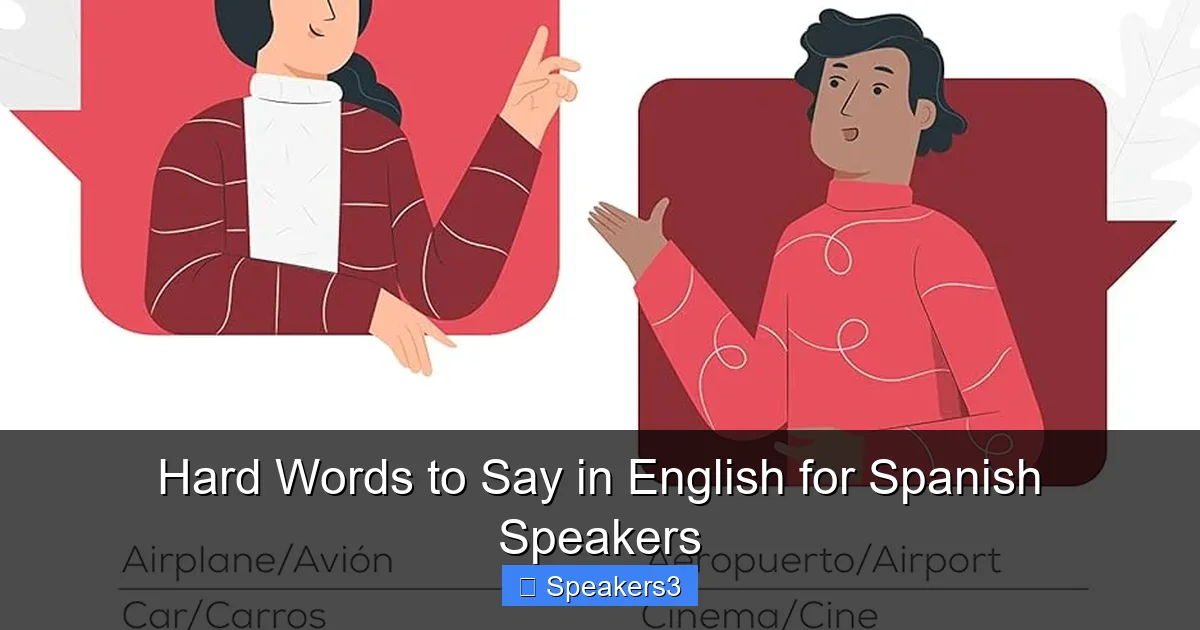
Visual guide about Hard Words to Say in English for Spanish Speakers
Image source: m.media-amazon.com
1.1. Words with the “th” Sound
Words: think, this, through, birthday, smooth
The English “th” can be voiced (this) or voiceless (think). Spanish has no equivalent, so speakers often replace it with /t/ or /d/. The tongue must be placed between the teeth, a position that feels odd at first.
1.2. Silent Letters
Words: knight, honest, island, subtle, pneumonia
In Spanish, every written letter is usually pronounced. English loves to hide letters, which leads to over‑pronouncing (e.g., saying the “k” in “knight”). Recognizing patterns—like “kn” at the start always being silent—helps.
1.3. Consonant Clusters
Words: strength, world, months, sixth, crisp
Spanish rarely strings three or more consonants together. English clusters require quick, precise movement of the tongue and lips. Breaking the cluster into smaller parts during practice eases the transition.
1.4. Diphthongs and Vowel Shifts
Words: oil, coin, house, about, air
Diphthongs are two vowel sounds blended in one syllable. Spanish vowels are pure, so sliding from one to another feels unnatural. Listening closely to native speakers and mimicking the glide is key.
1.5. Stress‑Based Mispronunciations
Words: record (noun) vs. record (verb), permit, present, object
English changes meaning with stress placement. Spanish stress rules are more predictable, so learning where to put the emphasis in English words avoids misunderstandings.
2. Practical Tips to Tame Those Tricky Words
Knowing the problem is half the battle. Here are actionable steps you can use every day.
Visual guide about Hard Words to Say in English for Spanish Speakers
Image source: 5.imimg.com
2.1. Slow‑Motion Practice
Start by saying the word extremely slowly, exaggerating each sound. For “through,” break it down: /θ/ – /r/ – /uː/ – /ɡ/. Then gradually speed up while keeping the sounds clear.
2.2. Mirror Method
Watch the shape of your mouth in a mirror. The “th” requires the tip of the tongue to peek between the teeth. Seeing yourself helps correct hidden habits.
2.3. Record and Compare
Use your phone to record yourself. Play it next to a native speaker’s pronunciation (YouTube, podcasts). Notice the differences and adjust.
2.4. Use Tongue Twisters
Fun tongue twisters target specific sounds. Try: “Six sleek swans swam swiftly south.” This sentence practices the /s/ and /sw/ clusters that trip many learners.
2.5. Leverage Technology
Apps like Elsa Speak or Forvo give instant feedback on pronunciation. They’re especially handy for words like “squirrel” where the “r” is rolled differently than in Spanish.
3. Building a Daily Pronunciation Routine
Consistency beats intensity. A short, focused routine each day yields better results than occasional marathon sessions.
Visual guide about Hard Words to Say in English for Spanish Speakers
Image source: thumbs.dreamstime.com
3.1. Warm‑Up (2 minutes)
Do simple mouth stretches: open wide, yawn, roll your lips. This relaxes the facial muscles.
3.2. Focus Word List (5 minutes)
Pick three to five hard words from the list above. Say each word 10 times, first slowly, then at normal speed.
3.3. Sentence Integration (5 minutes)
Place each word into a short sentence. Example: “The through tunnel was dark.” Speaking the word in context helps your brain remember the correct pronunciation.
3.4. Review and Reflect (3 minutes)
Listen to your recordings. Note any recurring errors and plan the next day’s focus.
4. Real‑World Practice: From Classroom to Coffee Shop
Pronunciation improves fastest when you use the language in authentic situations.
4.1. Language Exchange
Find a native English speaker who wants to learn Spanish. Swap 10 minutes of conversation in each language. You’ll get immediate correction and encouragement.
4.2. Shadowing Native Media
Pick a short video clip (news, TED Talk). Play it once, then repeat each sentence immediately after hearing it, matching rhythm and intonation.
4.3. Role‑Playing Everyday Scenarios
Practice ordering coffee, asking for directions, or making a phone call. Insert your hard words: “Could you tell me the nearest pharmacy?”
5. Common Mistakes and How to Fix Them
Even diligent learners slip up. Recognizing patterns of error helps you correct them faster.
5.1. Over‑Pronouncing Silent Letters
Solution: Create a “silent list.” When you see “kn,” mentally delete the “k” before you say the word.
5.2. Dropping the Final Consonant
Spanish speakers often omit final “t,” “d,” or “k.” Practice by tapping the back of your hand each time you finish the word to remind yourself to articulate the ending.
5.3. Misplaced Stress
Solution: Clap on the stressed syllable. For “present” (noun), clap on the first syllable; for the verb, clap on the second.
Conclusion: Turn “Hard” into “Handy”
Every language has its stumbling blocks, but they are not permanent. By understanding why words like “squirrel,” “through,” and “strength” are tough for Spanish speakers, you can target your practice precisely. Use the simple daily routine, embrace technology, and seek real‑world conversation. In a few weeks you’ll notice those words slipping out smoothly, and your confidence will rise with each successful pronunciation.
Remember, the goal isn’t perfection; it’s progress. Keep listening, keep mimicking, and keep speaking. Before long, the words that once felt impossible will become just another part of your English toolbox.
Frequently Asked Questions
What makes the “th” sound so difficult for Spanish speakers?
The “th” sound doesn’t exist in Spanish, so learners replace it with /t/ or /d/. It requires placing the tongue between the teeth, a position most Spanish speakers never use.
How can I remember which English letters are silent?
Learn common patterns: “kn” at the start, “gh” after “n,” and “b” after “m.” Practice by writing the word, crossing out the silent letters, and saying the shortened version.
Are there any apps that can help me practice these hard words?
Yes, apps like Elsa Speak, Forvo, and Speechling give instant feedback on pronunciation and let you compare your speech to native recordings.
Can watching movies really improve my pronunciation?
Absolutely. Subtitles help you match sounds to spelling, and repeating short dialogues (shadowing) trains your ear and mouth simultaneously.
How often should I practice the hard words?
Short daily sessions (10‑15 minutes) are more effective than occasional long ones. Consistency builds muscle memory.
Is it normal to still make mistakes after months of practice?
Yes. Pronunciation is a motor skill; progress can be gradual. Keep recording yourself, seek feedback, and celebrate small improvements.