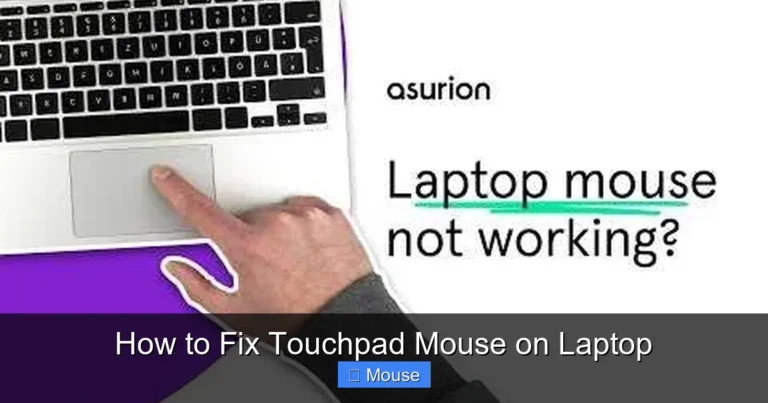
Mouse on Laptop Not Working Dell

Is your mouse on your Dell laptop not working? You’re not alone — this is one of the most common issues Dell users face. Whether it’s a frozen cursor, an unresponsive touchpad, or a completely disappeared pointer, the good news is that most fixes are simple and fast. In this guide, we’ll walk you through every possible solution to get your mouse on your Dell laptop working again in minutes.
Key Takeaways
- Check the basics first: A simple restart or accidental touchpad disable is often the culprit behind a mouse on laptop not working Dell issue.
- Update or reinstall drivers: Outdated or corrupted touchpad drivers are one of the most common causes of mouse problems on Dell laptops.
- Use keyboard shortcuts: Press Fn + F3 (or the touchpad toggle key) to re-enable a disabled touchpad on most Dell models.
- Run Windows troubleshooters: Built-in Windows tools can automatically detect and fix many mouse and touchpad issues.
- Check for Windows updates: A recent update may have caused compatibility issues that a newer patch can resolve.
- Try an external mouse: If the touchpad fails, a USB or Bluetooth mouse is a reliable temporary workaround.
- Seek professional help: If none of the software fixes work, the issue may be hardware-related and require Dell support.
📑 Table of Contents
- Introduction: When Your Mouse on Laptop Stops Working on a Dell
- Why Is the Mouse on My Dell Laptop Not Working?
- Quick Fixes: Get Your Dell Laptop Mouse Working in Minutes
- Intermediate Solutions: Driver Updates and System Settings
- Advanced Fixes: BIOS Settings and System Restore
- When It’s a Hardware Problem
- Preventing Future Mouse Issues on Your Dell Laptop
- Conclusion: Your Dell Laptop Mouse Can Be Fixed
Introduction: When Your Mouse on Laptop Stops Working on a Dell
You’re in the middle of an important project. Your fingers glide across the touchpad — and nothing happens. The cursor is frozen. Or maybe it’s completely gone. If you’ve ever found yourself frantically searching for solutions because the mouse on your Dell laptop is not working, take a deep breath. This is an incredibly common problem, and in most cases, it’s fixable in just a few minutes.
Dell laptops are known for their reliability, but even the best machines run into glitches. The touchpad — that smooth rectangle below your keyboard — is your primary pointing device. When it stops responding, it can feel like your entire laptop is broken. The truth is, the issue is usually software-related and can be resolved without a trip to the repair shop.
In this comprehensive guide, we’ll cover every angle. From the simplest fixes like checking if you accidentally disabled the touchpad, to more advanced solutions like updating drivers and adjusting BIOS settings. Whether you’re using a Dell Inspiron, XPS, Latitude, or Alienware, these steps will help you get your mouse working again. Let’s dive in.
Why Is the Mouse on My Dell Laptop Not Working?
Before we jump into solutions, it helps to understand why this happens. Knowing the root cause can save you time and prevent the problem from coming back. There are several reasons why the mouse on your Dell laptop might stop working, and they range from simple user error to deeper system issues.
Accidentally Disabled Touchpad
This is the number one reason people panic. Most Dell laptops have a keyboard shortcut that toggles the touchpad on and off. On many models, it’s Fn + F3 or Fn + F5 — the exact key varies by model. You might have pressed it without realizing it. Some Dell laptops also have a small LED indicator near the touchpad that lights up when the touchpad is disabled.
There’s also a setting in Windows that automatically disables the touchpad when an external mouse is plugged in. If you recently connected a USB mouse and then unplugged it, the touchpad might still be disabled. This is a feature, not a bug — but it can be confusing when you don’t know about it.
Outdated or Corrupted Drivers
Drivers are the software that lets your operating system communicate with hardware like your touchpad. If the touchpad driver is outdated, corrupted, or missing, your mouse won’t work. This often happens after a Windows update, a system crash, or even after installing new software that conflicts with existing drivers.
Dell laptops typically use either Synaptics or ELAN touchpad drivers. Sometimes Windows Update installs a generic driver that doesn’t fully support your specific Dell model, leading to partial or complete touchpad failure.
Windows Update Conflicts
Windows updates are supposed to make things better. But occasionally, an update introduces a bug that breaks the touchpad. This is especially common with major feature updates. If your mouse stopped working right after an update, there’s a good chance the two are connected.
Microsoft usually patches these issues quickly, but in the meantime, you might need to roll back the update or reinstall your touchpad driver manually.
Hardware Issues
Sometimes the problem isn’t software at all. Physical damage, loose internal connections, or a worn-out touchpad can cause the mouse to stop responding. If your laptop was recently dropped, exposed to liquid, or has been showing signs of wear, hardware could be the issue.
Hardware problems are less common but harder to fix on your own. We’ll cover how to diagnose this later in the article.
Quick Fixes: Get Your Dell Laptop Mouse Working in Minutes
Let’s start with the fastest solutions. These are the things you should try first because they solve the majority of cases where the mouse on a Dell laptop is not working.
Restart Your Laptop
Yes, it sounds too simple. But a restart clears temporary glitches, resets drivers, and refreshes the system. If your touchpad stopped working randomly, a quick restart might be all you need. Hold the power button for 10 seconds to force a shutdown, then power it back on.
Check the Touchpad Toggle Key
Look at the function keys at the top of your keyboard. One of them should have a small touchpad icon — often on F3, F5, or F7. Press Fn + that key to toggle the touchpad. If the touchpad was disabled, this will re-enable it instantly.
On some newer Dell models, you can double-tap the top-left corner of the touchpad to toggle it on and off. Try that as well.
Enable the Touchpad in Windows Settings
Here’s how to check if Windows has disabled your touchpad:
- Press Windows + I to open Settings.
- Go to Bluetooth & devices → Touchpad.
- Make sure the touchpad toggle is set to On.
- Also uncheck the box that says “Leave touchpad on when a mouse is connected” if you want it always active.
This is a common setting that catches many people off guard. If the toggle is off, simply turn it back on and test your touchpad.
Try an External Mouse
If you have a USB or Bluetooth mouse handy, plug it in or pair it. This serves two purposes: first, it gives you a working mouse immediately so you can continue your work. Second, it helps you diagnose whether the problem is with the touchpad specifically or with the entire system.
If the external mouse works fine, the issue is almost certainly with the touchpad hardware or its driver. If the external mouse also doesn’t work, the problem is deeper — possibly a USB port issue or a system-wide driver conflict.
Intermediate Solutions: Driver Updates and System Settings
If the quick fixes didn’t work, it’s time to dig a little deeper. These intermediate solutions address the most common software-related causes of a mouse not working on a Dell laptop.
Update the Touchpad Driver
Updating the driver is one of the most effective fixes. Here’s how to do it:
- Press Windows + X and select Device Manager.
- Expand the Mice and other pointing devices section.
- Right-click on your touchpad (it might be listed as “HID-compliant mouse,” “Synaptics,” or “ELAN”).
- Select Update driver → Search automatically for drivers.
- Follow the prompts and restart your laptop.
If Windows says the best driver is already installed, try the next step instead.
Reinstall the Touchpad Driver
Sometimes the driver isn’t just outdated — it’s corrupted. Reinstalling it from scratch can fix the issue:
- Open Device Manager again.
- Right-click the touchpad device and select Uninstall device.
- Check the box that says “Attempt to remove the driver for this device” if available.
- Click Uninstall.
- Restart your laptop. Windows will automatically reinstall the driver.
This process forces Windows to start fresh with the touchpad driver, which often resolves stubborn issues.
Download Drivers from Dell’s Website
For the best results, get the driver directly from Dell. Generic Windows drivers sometimes lack full functionality:
- Go to Dell.com/support.
- Enter your Service Tag or select your laptop model.
- Navigate to Drivers & Downloads.
- Find the Mouse, Keyboard & Input Devices category.
- Download and install the latest touchpad driver.
- Restart your laptop.
Dell’s official drivers are tested specifically for your hardware, so they tend to work better than generic alternatives.
Run the Windows Hardware Troubleshooter
Windows has a built-in troubleshooter that can automatically detect and fix hardware issues:
- Open Settings → System → Troubleshoot → Other troubleshooters.
- Find Keyboard and Hardware and Devices.
- Click Run for each one.
- Follow the on-screen instructions.
The troubleshooter will scan for problems and attempt to fix them automatically. It’s not foolproof, but it catches many common issues.
Advanced Fixes: BIOS Settings and System Restore
When basic and intermediate solutions fail, it’s time for advanced troubleshooting. These steps require a bit more technical knowledge, but they can resolve deeper issues that cause the mouse on a Dell laptop to stop working.
Check BIOS Touchpad Settings
The BIOS (Basic Input/Output System) controls hardware settings at a low level. Sometimes the touchpad gets disabled in the BIOS:
- Restart your laptop and press F2 repeatedly as it boots to enter BIOS.
- Navigate to System Configuration or Advanced (varies by model).
- Look for Touchpad, Internal Pointing Device, or Mouse settings.
- Make sure it’s set to Enabled.
- Save and exit (usually F10).
If the touchpad was disabled in BIOS, enabling it here will restore functionality immediately.
Perform a System Restore
If the mouse stopped working after a recent change — like a Windows update, new software installation, or driver update — System Restore can roll your computer back to a previous state:
- Press Windows + R, type rstrui, and press Enter.
- Select Choose a different restore point.
- Pick a date from before the problem started.
- Follow the prompts to restore your system.
System Restore doesn’t affect your personal files, but it does remove apps and drivers installed after the restore point. It’s a powerful tool for undoing recent changes that broke your touchpad.
Check for Malware
Malware can interfere with hardware drivers and system processes. If your touchpad stopped working and you’ve noticed other unusual behavior — slow performance, pop-ups, or unexpected programs — run a full malware scan:
- Open Windows Security (search for it in the Start menu).
- Go to Virus & threat protection → Scan options.
- Select Full scan and click Scan now.
- Remove any threats found and restart your laptop.
Malware-related touchpad issues are rare, but they do happen. It’s worth ruling out.
When It’s a Hardware Problem
If you’ve tried every software fix and the mouse on your Dell laptop is still not working, the issue might be physical. Here’s how to tell and what to do about it.
Signs of Hardware Failure
Watch for these indicators that point to a hardware problem:
- The touchpad is physically damaged — cracked, loose, or unresponsive to touch.
- The cursor moves erratically or jumps around on its own.
- The touchpad works in BIOS but not in Windows (this could still be a driver issue, but it’s worth noting).
- None of the software fixes in this article made any difference.
- The laptop was recently dropped, bumped, or exposed to moisture.
What You Can Do
For hardware issues, your options are:
- Use an external mouse: A USB or Bluetooth mouse is an inexpensive and reliable workaround. It won’t fix the touchpad, but it lets you use your laptop normally.
- Contact Dell Support: If your laptop is under warranty, Dell may repair or replace the touchpad for free. Visit Dell.com/support and enter your Service Tag to check warranty status.
- Visit a repair shop: A local technician can diagnose and replace a faulty touchpad. This typically costs between $50 and $150 depending on the model.
If you’re comfortable with DIY repairs, replacement touchpads are available online for most Dell models. Just make sure you get the exact part number for your specific laptop.
Preventing Future Mouse Issues on Your Dell Laptop
Once you’ve fixed the problem, you’ll want to keep it from happening again. Here are some simple habits that can prevent the mouse on your Dell laptop from stopping working in the future.
Keep Drivers Updated
Set a reminder to check for driver updates every few months. You can use Dell SupportAssist — a free tool that comes pre-installed on most Dell laptops — to automatically check for and install driver updates. Keeping your drivers current prevents many compatibility issues.
Be Careful with Windows Updates
Windows updates are important for security, but they can occasionally cause problems. Before installing a major update, create a restore point. That way, if something goes wrong, you can easily roll back. Go to Control Panel → System → System Protection → Create to make a restore point manually.
Protect Your Laptop
Physical damage is a common cause of touchpad failure. Use a protective case, avoid eating or drinking near your laptop, and handle it gently. A little care goes a long way toward keeping your hardware in good shape.
Learn the Keyboard Shortcuts
Knowing the touchpad toggle shortcut for your specific Dell model can save you a lot of frustration. Write it down or bookmark this page so you can reference it quickly if the touchpad ever stops responding again.
Conclusion: Your Dell Laptop Mouse Can Be Fixed
Dealing with a mouse on your Dell laptop that’s not working is frustrating, but it’s almost always solvable. Start with the basics — restart, check the toggle key, and verify Windows settings. If that doesn’t work, move on to driver updates and system troubleshooting. And if all else fails, an external mouse or professional repair will get you back on track.
The key is to stay calm and work through the solutions methodically. Most of the time, the fix is just a few clicks away. Don’t let a frozen cursor ruin your day — with the steps in this guide, you have everything you need to diagnose and fix the problem yourself.
If you found this article helpful, share it with a friend who might be dealing with the same issue. And remember, technology hiccups are temporary — your Dell laptop is built to last, and so is your patience.
Frequently Asked Questions
Why did my Dell laptop touchpad suddenly stop working?
Sudden touchpad failure is usually caused by an accidental disable (via the Fn key shortcut), a recent Windows update, or a corrupted driver. Try pressing Fn + F3 to re-enable the touchpad, and if that doesn’t work, update or reinstall the touchpad driver through Device Manager.
How do I enable the touchpad on my Dell laptop?
Press Fn + F3 (or the key with the touchpad icon) to toggle the touchpad on. You can also enable it in Windows by going to Settings → Bluetooth & devices → Touchpad and turning the toggle on.
Can a Windows update break my Dell laptop touchpad?
Yes, Windows updates can sometimes install incompatible drivers or change system settings that affect the touchpad. If your touchpad stopped working after an update, try rolling back the update or reinstalling the touchpad driver from Dell’s official website.
What should I do if none of the fixes work?
If software solutions don’t resolve the issue, the problem is likely hardware-related. Use an external USB or Bluetooth mouse as a workaround, and contact Dell Support or visit a repair shop for a professional diagnosis and potential touchpad replacement.
How do I update my Dell laptop touchpad driver?
Open Device Manager, expand Mice and other pointing devices, right-click your touchpad, and select Update driver. For the best results, download the latest driver directly from Dell.com/support using your laptop’s Service Tag.
Is it safe to use an external mouse if my touchpad isn’t working?
Absolutely. An external USB or Bluetooth mouse is a perfectly safe and reliable alternative. It won’t harm your laptop in any way, and it lets you continue working while you troubleshoot the touchpad issue or arrange for a repair.