Choosing the right speaker impedance can make or break your audio experience. This guide explains the difference between 4 Ω and 8 Ω speakers, shows how to match them with amplifiers, and offers practical wiring tips so you can enjoy clear, powerful sound without damaging gear.
Key Takeaways
- Impedance matters: 4 Ω speakers draw more current than 8 Ω, affecting amp load and power output.
- Amplifier compatibility: Pairing the correct impedance prevents overheating and distortion.
- Wiring options: Series and parallel connections let you blend 4 Ω and 8 Ω speakers safely.
- Sound character: Lower impedance often yields louder, punchier bass, while higher impedance can sound smoother.
- System design: Consider speaker placement, amp headroom, and total load when planning a setup.
- Safety first: Always check manufacturer specs to avoid over‑driving your amp.
- Upgrade path: Knowing the difference helps you future‑proof your audio system.
📑 Table of Contents
- Introduction: Why Impedance Is More Than a Number
- 1. The Basics of Impedance
- 2. Matching Speakers to Amplifiers
- 3. Wiring Strategies: Series, Parallel, and Mixed Loads
- 4. Sound Characteristics: Does Impedance Change Tone?
- 5. Common Mistakes and How to Avoid Them
- 6. Making the Right Choice for Your Setup
- Conclusion
Introduction: Why Impedance Is More Than a Number
When you walk into a store and see two identical bookshelf speakers, one labeled 4 Ω and the other 8 Ω, you might wonder if the lower number simply means “more power.” In reality, impedance is the electrical resistance a speaker presents to an amplifier. It determines how much current the amp must supply to produce a given volume.
Understanding the difference between 4 and 8 ohm speakers is crucial because it influences three things: how loud the speakers can get, how clean the sound will be, and whether your amplifier will stay cool. This article walks you through the science, the practical wiring tricks, and the real‑world decisions you’ll face when building a home theater, a car audio system, or a desktop listening rig.
1. The Basics of Impedance
What Does Ohm Mean?
Ohm (Ω) is the unit of electrical resistance. In speakers, it represents the opposition to the flow of alternating current (AC) from the amp. A 4 Ω speaker offers half the resistance of an 8 Ω speaker, so it draws roughly twice as much current at the same voltage.

Visual guide about Difference Between 4 and 8 Ohm Speakers
Image source: cdn.imgbin.com
How Impedance Affects Power
Power (watts) equals voltage squared divided by resistance (P = V² / R). If your amp puts out a fixed voltage, halving the resistance (going from 8 Ω to 4 Ω) doubles the power delivered to the speaker—assuming the amp can supply that extra current.
Real‑World Example
Imagine an amp that can deliver 20 V RMS. With an 8 Ω load, the power is 20² / 8 = 50 W. Switch to a 4 Ω load, and the power jumps to 20² / 4 = 100 W. The speaker gets louder, but the amp must work harder.
2. Matching Speakers to Amplifiers
Check the Amp’s Rated Load
Every amplifier lists a “minimum impedance” or “stable load” in its manual. A typical home audio amp might be rated for 8 Ω – 16 Ω, while a car amp often handles 2 Ω – 4 Ω. Feeding a 4 Ω speaker into an amp that only supports 8 Ω can cause overheating, distortion, or even permanent damage.
Visual guide about Difference Between 4 and 8 Ohm Speakers
Image source: i.pinimg.com
Headroom and Distortion
When the amp is asked to deliver more current than it can, the output stage clips. This clipping sounds harsh and can fry speaker voice coils. Choosing the right impedance ensures the amp operates within its safe headroom, delivering clean, undistorted sound.
Practical Tip: Use the Manufacturer’s Chart
Most amp makers provide a table showing how much power they deliver at 4 Ω, 8 Ω, and 16 Ω. Compare those numbers with your speaker’s power handling (RMS rating). Aim for the amp’s RMS power to be equal to or slightly higher than the speaker’s RMS rating.
3. Wiring Strategies: Series, Parallel, and Mixed Loads
Series Wiring
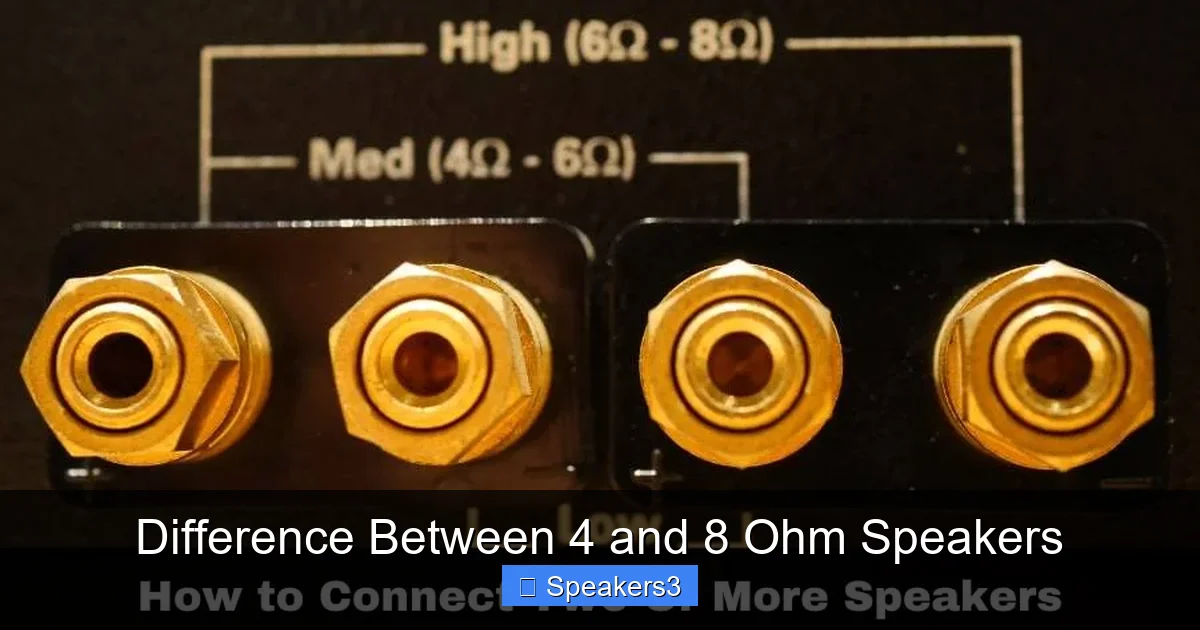
Connecting speakers in series adds their impedances together. Two 4 Ω speakers in series become an 8 Ω load—perfect for an amp that prefers 8 Ω. The total voltage divides across each speaker, so they receive the same current.
Visual guide about Difference Between 4 and 8 Ohm Speakers
Image source: enjoytechlife.com
For a deeper dive on series wiring, see our guide on 2 8 Ohm Speakers In Series.
Parallel Wiring
Parallel wiring divides the voltage but adds the reciprocals of the impedances: 1/Rtotal = 1/R1 + 1/R2. Two 8 Ω speakers in parallel become a 4 Ω load. This can be useful when you have a powerful car amp that loves low impedance.
Mixed Configurations
If you have a mix of 4 Ω and 8 Ω speakers, you can combine series and parallel sections to achieve a target load. For example, two 4 Ω speakers in parallel (resulting in 2 Ω) can be placed in series with an 8 Ω speaker, giving a total of 10 Ω—acceptable for many home amps.
Safety Check: Verify Total Load
Always calculate the final impedance before powering up. A quick online calculator or a spreadsheet can save you from a costly mistake.
4. Sound Characteristics: Does Impedance Change Tone?
Loudness and Dynamics
Because 4 Ω speakers draw more current, they can often produce higher SPL (sound pressure level) with the same amp. This makes them popular for bass‑heavy setups where you want that extra punch.
Clarity and Control
Higher‑impedance (8 Ω) speakers tend to be more forgiving. They place less stress on the amp, which can result in tighter control of the driver and smoother mids. If you value nuanced detail over sheer volume, 8 Ω may be the better choice.
Real‑World Listening Test
Take two identical bookshelf speakers, one wired as 4 Ω and the other as 8 Ω (using series/parallel tricks). Play the same track at a moderate volume. You’ll likely notice the 4 Ω version feels louder, especially in the low end, while the 8 Ω version sounds cleaner and less strained.
5. Common Mistakes and How to Avoid Them
Overloading the Amplifier
Feeding a 4 Ω load to an amp rated for 8 Ω is the most frequent error. The amp may overheat within minutes, triggering protection circuits or, worse, burning out the output transistors.
Ignoring Speaker Power Ratings
Even if the impedance matches, using an under‑powered amp can cause clipping, which harms the speaker’s voice coil. Match RMS power, not just peak power.
Neglecting Cable Gauge
Low‑impedance setups draw more current, so thin speaker wire can add resistance, effectively raising the load and reducing performance. Use at least 16‑gauge wire for runs under 25 ft; go to 14‑gauge for longer runs or 4 Ω loads.
Practical Tip: Check for Crackling
If you hear crackling or intermittent sound, it could be a sign of poor connections or an overloaded amp. Read more about troubleshooting speaker issues in our article Why Do My Speakers Crackle.
6. Making the Right Choice for Your Setup
Home Theater & Hi‑Fi
Most AV receivers are designed for 8 Ω speakers. If you already own a quality 4 Ω pair, consider wiring them in series or adding a matching 4 Ω speaker to keep the load at 8 Ω.
Car Audio
Car amps love low impedance because they can push more current for higher SPL. Pair 4 Ω speakers directly, or wire two 8 Ω speakers in parallel to achieve a 4 Ω load.
Desktop or Portable Setups
Powered monitors often have built‑in amps optimized for 8 Ω. If you’re adding passive speakers, stick to 8 Ω to avoid over‑driving the monitor’s output stage.
Future‑Proofing
If you plan to upgrade your amp later, buying 8 Ω speakers gives you more flexibility. You can always wire 8 Ω speakers in parallel to create a 4 Ω load if a new amp demands it.
Conclusion
The difference between 4 and 8 ohm speakers isn’t just a number on a spec sheet—it dictates how much current flows, how loud the speakers can get, and how hard your amplifier has to work. By matching impedance to your amp’s capabilities, using proper wiring techniques, and paying attention to power ratings, you can enjoy loud, clean sound without risking equipment failure. Remember to calculate total load, choose the right gauge wire, and always double‑check manufacturer recommendations. With these guidelines, you’ll be confident whether to go low‑impedance for punch or high‑impedance for smooth, reliable performance.
Frequently Asked Questions
What happens if I connect a 4 Ω speaker to an amp rated for 8 Ω?
The amp will have to supply twice the current for the same volume, which can cause overheating, distortion, or permanent damage if the amp isn’t designed for that load.
Can I safely combine 4 Ω and 8 Ω speakers in the same system?
Yes, by using series and parallel wiring you can create a total impedance that matches your amp’s rating. Calculating the final load is essential.
Do 4 Ω speakers always sound louder than 8 Ω speakers?
Generally they can produce higher SPL because they draw more power, but loudness also depends on the amp’s capability and the speaker’s efficiency.
Is there a preferred impedance for car audio versus home audio?
Car audio amps often favor 4 Ω (or even 2 Ω) for higher power output, while home receivers are typically optimized for 8 Ω loads.
How does speaker wire gauge affect low‑impedance setups?
Thinner wire adds resistance, which can reduce power delivery and raise the effective impedance. Use at least 16‑gauge wire for 4 Ω speakers, and thicker gauge for longer runs.
Where can I learn more about wiring speakers to an amp?
Our step‑by‑step guide How To Wire Speakers To Amp covers connection methods, safety checks, and troubleshooting tips.