Choosing between 2 Ω and 4 Ω speakers can dramatically change how your system sounds and performs. This guide breaks down the electrical basics, power handling, and real‑world pairing tips so you can match the right impedance to your amp and enjoy louder, cleaner audio.
Key Takeaways
- Impedance defines load: 2 Ω speakers draw more current than 4 Ω speakers at the same voltage.
- Amplifier compatibility matters: Not all amps can safely drive 2 Ω loads; check the specs.
- Power handling differs: Lower‑impedance speakers often receive more wattage, which can boost volume.
- Series vs. parallel wiring: Combining speakers changes the overall impedance and must be planned carefully.
- Sound quality impact: Impedance influences damping factor, affecting bass response and control.
- Heat and efficiency: 2 Ω speakers may run hotter; proper ventilation is essential.
- Practical tip: Use a multimeter to verify speaker impedance before installation.
📑 Table of Contents
Introduction: Why Impedance Matters
When you shop for new speakers, you’ll often see numbers like 2 Ω, 4 Ω, 8 Ω, or even 16 Ω printed on the back. Those numbers are the speaker’s impedance, a measure of how much the speaker resists the flow of electrical current from your amplifier. While the difference may look small on paper, it has a big impact on how loud the speakers can get, how clean the sound is, and whether your amp will stay happy.
In this article we’ll walk you through the core concepts, compare 2 Ω and 4 Ω speakers side by side, and give you actionable advice for wiring, amp selection, and troubleshooting. By the end, you’ll know exactly which impedance fits your car, home theater, or portable setup best.
1. The Basics of Impedance
What Is Impedance?
Impedance (measured in ohms, Ω) is the combined resistance to alternating current (AC) in a speaker’s voice coil. Unlike simple resistance, impedance varies with frequency, but manufacturers give a single “nominal” value for simplicity.
Visual guide about Difference Between 2 and 4 Ohm Speakers
Image source: images.universal-music.de
Ohm’s Law in Audio
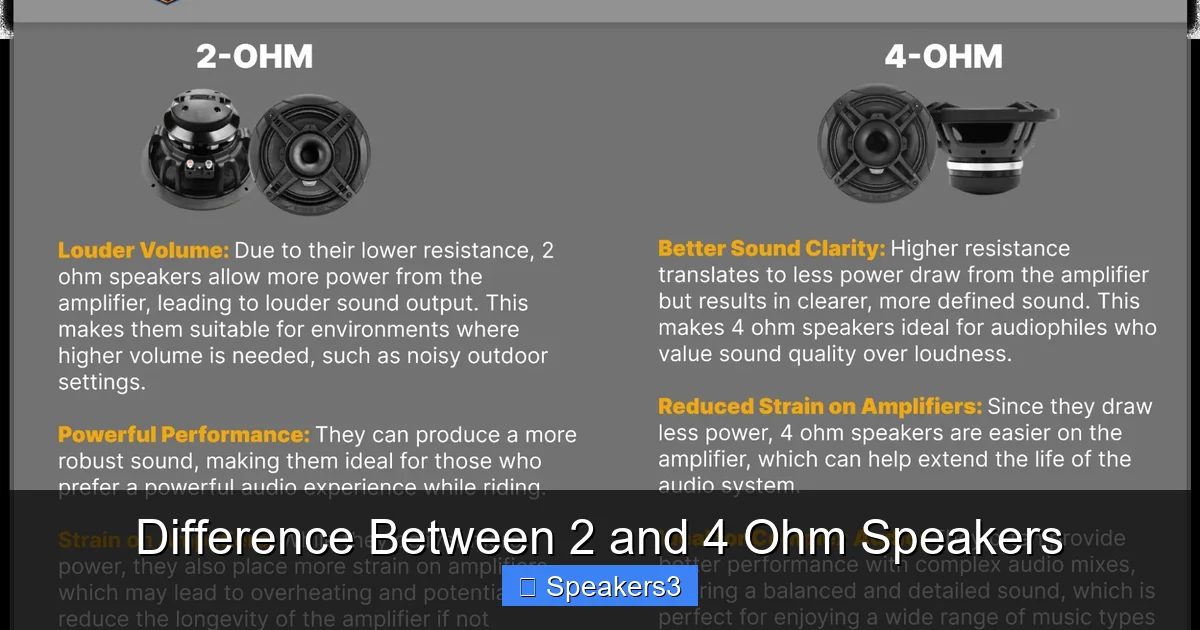
Ohm’s Law—V = I × R—still applies. For a given voltage (V) from the amp, a lower‑impedance speaker (2 Ω) will draw more current (I) than a higher‑impedance one (4 Ω). More current means more power can be delivered, but it also means the amp works harder.
Power Equation
The power a speaker receives is calculated as P = V² / R. If the amp supplies the same voltage, a 2 Ω speaker gets roughly twice the power of a 4 Ω speaker.
2. How Impedance Affects Power and Volume
Wattage and Loudness
Because power is directly tied to loudness, a 2 Ω speaker can often be driven louder than a 4 Ω speaker with the same amp. This is why many high‑performance car audio systems favor 2 Ω components—they want maximum SPL (sound pressure level) without adding extra amps.
Amplifier Ratings
Manufacturers list the minimum load an amp can safely handle, e.g., “stable at 2 Ω” or “minimum 4 Ω”. If you connect a 2 Ω speaker to an amp rated for 4 Ω minimum, the amp may overheat, distort, or even fail.
Real‑World Example
Imagine a 50 W RMS amp that is rated for 4 Ω loads. At 4 Ω it delivers 50 W. If you connect a 2 Ω speaker, the same amp might try to push 100 W, exceeding its design and causing thermal shutdown.
3. Sound Quality Considerations
Damping Factor
The damping factor is the ratio of the amp’s output impedance to the speaker’s impedance. Lower‑impedance speakers (2 Ω) give the amp a higher damping factor, which can improve control over the speaker cone, especially in the bass region.
Visual guide about Difference Between 2 and 4 Ohm Speakers
Image source: cdn.shopify.com
Transient Response
Because 2 Ω speakers can receive more current quickly, they often have a tighter transient response—better for punchy bass and fast‑moving music.
Potential Downsides
More current also means more heat. If the speaker’s voice coil overheats, it can distort or fail. Good ventilation and quality construction are essential for 2 Ω models.
4. Wiring Options: Series, Parallel, and Mixed Loads
Series Wiring
When you wire speakers in series, you add their impedances together. Two 2 Ω speakers in series become a 4 Ω load—perfect for an amp that can’t handle 2 Ω directly.
Parallel Wiring
Parallel wiring divides the voltage across each speaker, lowering the total impedance. Two 4 Ω speakers in parallel become a 2 Ω load, which can be risky if your amp isn’t rated for that.
Practical Example
Suppose you have a four‑speaker car system and an amp that’s stable at 2 Ω. You could wire two pairs of 4 Ω speakers in parallel (each pair = 2 Ω) and then connect the pairs in series to stay at 4 Ω overall, balancing power and safety.
For a deeper dive on series wiring, see our guide on 2 8 Ohm Speakers In Series.
5. Choosing the Right Amplifier
Check the Specs
Always read the amp’s “minimum load” rating. If it says “2 Ω stable”, you can safely pair it with 2 Ω speakers. If it only lists “4 Ω”, stick with 4 Ω speakers or use series wiring to raise the load.
Headroom and Clip Prevention
Headroom is the extra power an amp can deliver without clipping. A 2 Ω speaker will demand more headroom, so choose an amp with a higher RMS rating than you think you need.
Real‑World Pairing
A popular combo for car audio enthusiasts is a 4 Ω subwoofer paired with a 2 Ω tweeter. The amp can be set to 2 Ω for the tweeter (high current, quick response) and 4 Ω for the sub (more power, deeper bass).
Our review of 6 3 4 Car Speakers shows how manufacturers balance impedance across different drivers for optimal performance.
6. Installation Tips and Common Pitfalls
Measure Before You Connect
Use a multimeter to verify the speaker’s actual impedance. Tolerances can vary, and some “4 Ω” speakers measure closer to 3.5 Ω.
Watch the Heat
Feel the speaker’s voice coil after a long listening session. If it’s hot to the touch, consider adding a heatsink or switching to a higher‑impedance model.
Avoid Mismatched Loads
Never connect a 2 Ω speaker to an amp that only lists 4 Ω as its minimum. The result is likely distortion, overheating, and possible damage to both components.
Use Quality Wiring
Thicker gauge wire (e.g., 12‑AWG for car installs) reduces resistance, ensuring the amp sees the intended load.
Example Fix
If you accidentally wired two 4 Ω speakers in parallel and your amp began to overheat, rewire them in series to achieve a 8 Ω load, then add a second amp channel or a resistor network to balance the system.
For a broader look at unconventional speaker setups, check out our article on 5 And A Quarter Speakers.
Conclusion: Making the Right Choice
The difference between 2 Ω and 4 Ω speakers boils down to current draw, power handling, and how well they match your amplifier. If you need maximum volume, tight bass, and have an amp that’s stable at low impedances, 2 Ω speakers are a solid choice. If you prefer a simpler, more forgiving setup with less risk of overheating, 4 Ω speakers are the safer bet.
Always start by checking your amp’s specifications, plan your wiring carefully, and keep an eye on heat. With the right combination, you’ll enjoy clean, powerful sound without stressing your equipment.
Frequently Asked Questions
What happens if I connect a 2 Ω speaker to an amp rated for 4 Ω minimum?
The amp will try to deliver more current than it’s designed for, which can cause overheating, distortion, and possible failure of the amp.
Can I use a 4 Ω speaker in a system designed for 2 Ω loads?
Yes, but the speaker will receive less power and may not reach the same volume level as a true 2 Ω speaker.
How can I safely combine 2 Ω and 4 Ω speakers in the same system?
Use series wiring to raise the overall impedance or add a dedicated crossover/amp channel for each impedance type.
Is there a noticeable sound quality difference between 2 Ω and 4 Ω speakers?
2 Ω speakers often deliver tighter bass and higher SPL because they receive more current, but they can run hotter. 4 Ω speakers tend to be more stable and easier on the amp.
Do I need special wiring for 2 Ω speakers?
Thicker gauge wire (lower AWG number) is recommended to handle the higher current without added resistance.
How do I measure speaker impedance at home?
Set a multimeter to the resistance (Ω) setting, disconnect the speaker from any amp, and place the probes on the speaker terminals. The reading will be close to the nominal impedance.