How Many Saas Companies in the World
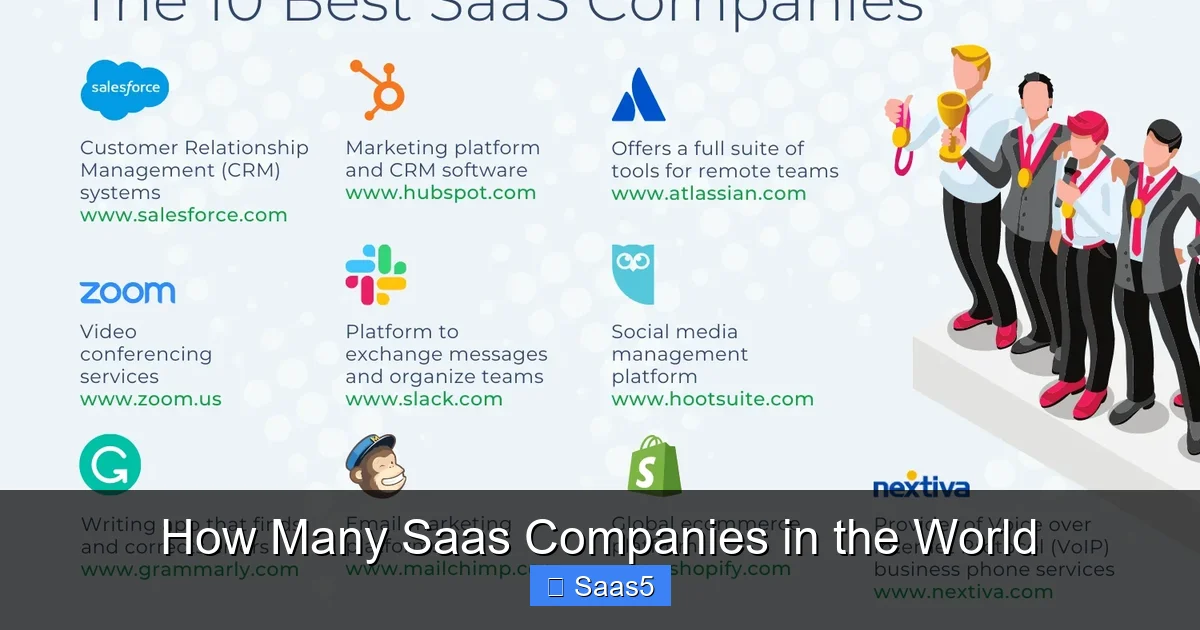
The number of SaaS companies globally has exploded, with estimates suggesting over 25,000 active providers as of 2023. This massive ecosystem, driven by digital transformation and cloud adoption, spans every industry but is heavily concentrated in North America and specific verticals. However, defining and counting “SaaS” remains a challenge due to the model’s fluid nature and the rise of micro-SaaS and bootstrapped ventures.
You use them every day. You might even pay for a handful without really thinking about it. They’re the apps and platforms that power your work, your marketing, your accounting, and even your Netflix recommendations. We’re talking about SaaS—Software as a Service. But have you ever stopped to wonder, just how many of these companies are actually out there? The answer isn’t as simple as you might think, and the number tells a fascinating story about the modern economy, technology, and entrepreneurship.
As an expert who’s tracked this space for years, I can tell you that pinning down an exact figure is like trying to count every fish in the ocean. The moment you think you have a number, a new one spawns somewhere. That’s the beauty and chaos of the SaaS model. It’s democratized software creation. Instead of needing a massive sales force and complex on-premise installations, a small team can build a powerful tool and deliver it instantly to anyone, anywhere, via the internet. This has led to an unprecedented proliferation of software businesses. In this article, we’re going to dive deep into the estimates, the methodologies, the geographic hotspots, and what the sheer volume of SaaS companies means for the future of business and technology.
Key Takeaways
- The count is fluid and debated: There is no single authoritative source, and estimates vary widely (from 10,000 to 30,000+) based on definition and methodology.
- Growth has been exponential: The number of SaaS companies has surged from a few thousand in the early 2010s to tens of thousands today, fueled by lower barriers to entry and cloud infrastructure.
- The U.S. is the undisputed leader: It hosts approximately 50-60% of all known SaaS companies, with hubs in Silicon Valley, New York, and Austin.
- Market saturation is segmented: Saturation is high in broad categories (CRM, project management), but deep opportunities remain in specialized verticals and industry-specific workflows.
- Micro-SaaS and bootstrapping are major trends: A significant portion of new SaaS companies are small, founder-funded, and target niche markets with lean teams.
- Consolidation is inevitable: As the market matures, M&A activity will increase, with large platforms acquiring niche players to expand their ecosystems.
📑 Table of Contents
- Defining the Beast: What Exactly *Is* a SaaS Company?
- The Explosive Growth Trajectory: From Thousands to Tens of Thousands
- A Geographic Breakdown: Where Are All These Companies?
- Market Saturation vs. Opportunity: Is There Room for New Players?
- The Future Landscape: What’s Next for the SaaS Universe?
- Conclusion: A Living, Breathing Ecosystem
Defining the Beast: What Exactly *Is* a SaaS Company?
Before we can count them, we need to agree on what we’re counting. This is the first and biggest point of contention. At its core, a SaaS company delivers software applications over the internet on a subscription basis. Users access the software via a web browser or a lightweight app, and all data and processing happen on the provider’s servers (the cloud). Key characteristics include:
- Subscription Pricing: Recurring revenue (monthly/annual) instead of a one-time license fee.
- Centralized Hosting: The provider manages the infrastructure, security, and updates.
- Multi-Tenant Architecture: A single instance of the software serves all customers (though variations exist).
- Accessibility: Available from any device with an internet connection.
But the lines blur. Is a company that offers a free web app with a paid upgrade SaaS? Yes. What about a traditional software company that added a cloud-hosted subscription tier last year? Probably. Does a consultancy that builds and hosts a custom software solution for a single client count? Most analysts would say no, as it lacks the scalable, multi-tenant product model. The most inclusive definitions capture everything from giant corporations like Salesforce and Adobe to a two-person team selling a $10/month plugin for Trello. The most restrictive definitions might only count companies with a certain scale (e.g., $1M+ ARR). This definitional spectrum is why counts vary so dramatically.
The “Official” Counts and Their Flaws
So, where do the numbers come from? We rely on business intelligence platforms, analyst reports, and curated lists. Each has its biases.
- Crunchbase & PitchBook: These databases track startups and funding. They’re excellent for finding venture-backed or notable companies but miss the vast universe of bootstrapped, profitable, and under-the-radar businesses. A micro-SaaS making $5k/month from a bedroom in Prague might never appear here.
- Gartner & Forrester: These analyst firms publish market size reports, often focusing on revenue rather than company count. They might estimate the number of “players” in a specific sector (e.g., “CRM SaaS providers”) but not a global total.
- SaaS Capital & OpenView: These SaaS-focused investment firms and VC funds publish annual reports based on their portfolios and surveys. Their data is high-quality but skewed toward growth-stage companies seeking investment.
- Curated Lists (e.g., SaaStr Annual, SaaS 1000): These are great for discovering companies but are inherently selective and incomplete.
The most cited “big number” often comes from aggregating multiple sources and applying a broad definition. A widely referenced figure from a few years ago was “over 10,000 SaaS companies.” Today, most industry insiders and updated aggregations place the number between 25,000 and 35,000 active, revenue-generating SaaS companies globally. This includes everything from giants like Microsoft (with its massive cloud suite) to the smallest niche operators.
The Explosive Growth Trajectory: From Thousands to Tens of Thousands
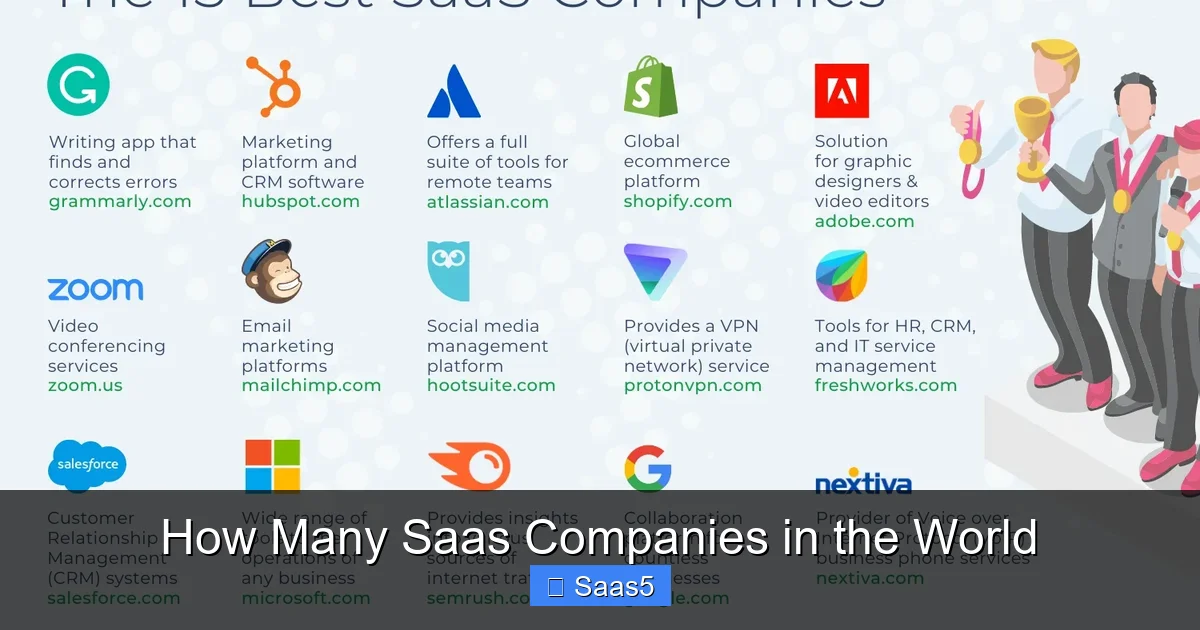
The growth isn’t linear; it’s exponential. To understand how we got to 25,000+, let’s rewind. The term “SaaS” gained traction in the early 2000s with pioneers like Salesforce (founded 1999) and Concur (founded 1993, but popularized the travel expense model). For a decade, it was a novel model for niche business apps. The real inflection point was the late 2000s and early 2010s, driven by three concurrent revolutions:
Visual guide about How Many Saas Companies in the World
Image source: pakwired.com
1. The Cloud Infrastructure Boom
Amazon Web Services (AWS) launched its core infrastructure services (EC2, S3) in 2006. Microsoft Azure followed, and Google Cloud entered. This was the game-changer. Previously, starting a software company meant buying servers, leasing data center space, and hiring sysadmins. The cloud turned fixed, massive capital costs into variable, pay-as-you-go operational expenses. A founder could spin up a global-scale application for pennies an hour. This dramatically lowered the barrier to entry and experimentation.
2. The API Economy & Developer Tools
Why build everything from scratch? The rise of APIs (Application Programming Interfaces) and platforms like Stripe (payments), Twilio (communications), SendGrid (email), and Auth0 (identity) meant a small team could integrate world-class, complex functionality into their app in days, not years. You no longer needed to build a payment processor or a text-messaging engine. You could focus on your unique value proposition and “plug in” the rest. This supercharged development speed and reduced time-to-market.
3. The Remote Work & Digital Transformation Catalyst
While trends were already moving this way, the COVID-19 pandemic acted as a massive, global forcing function. Businesses of all sizes, from local retailers to Fortune 500 companies, were forced to adopt cloud-based tools for collaboration, sales, and operations almost overnight. This accelerated the addressable market for SaaS by years. The “why” for buying SaaS shifted from “efficiency” to “survival.” The market validated itself on a universal scale.
A Geographic Breakdown: Where Are All These Companies?
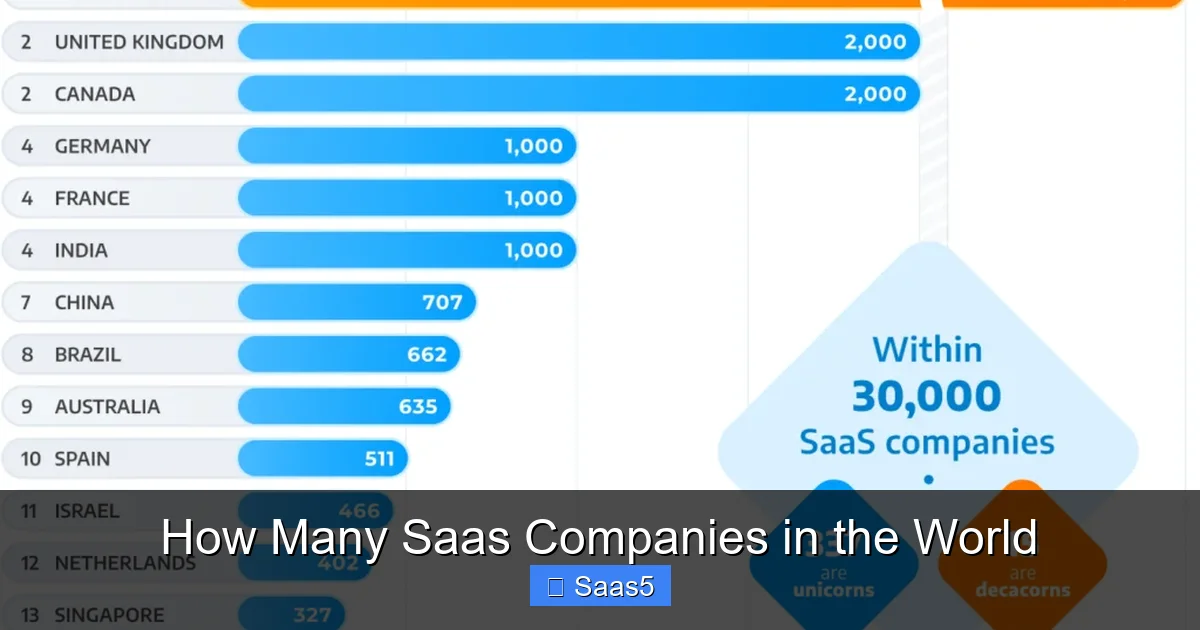
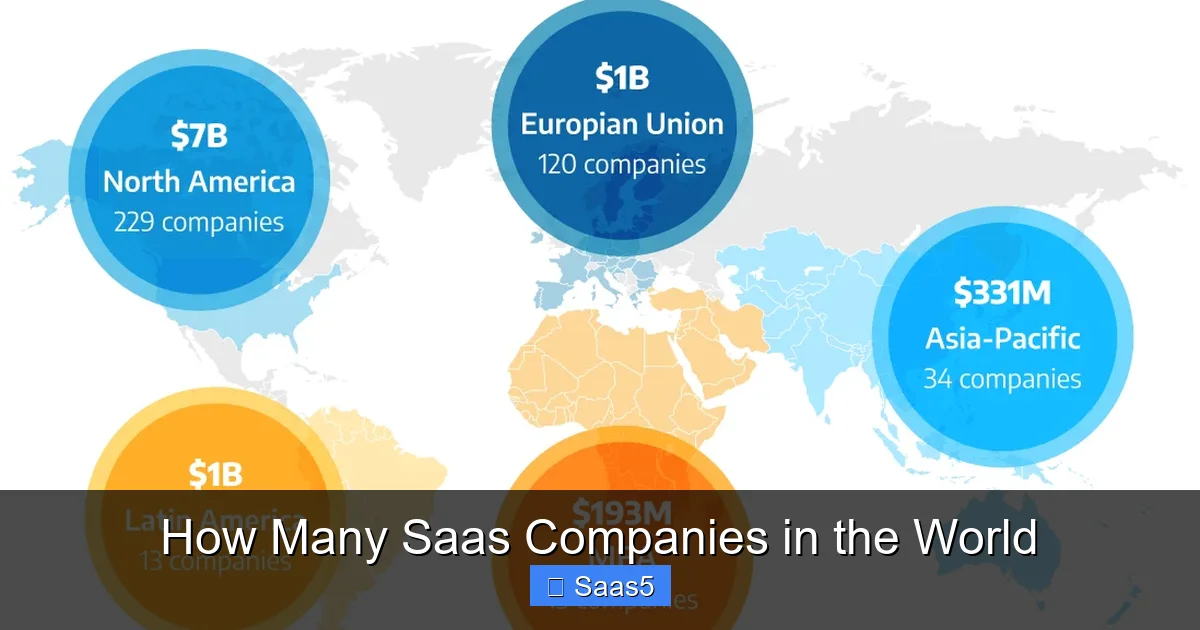
SaaS is a global phenomenon, but its distribution is highly uneven. Talent pools, venture capital ecosystems, and early market adoption create powerful clusters.
Visual guide about How Many Saas Companies in the World
Image source: ascendixtech.com
The Undisputed King: United States
By most estimates, the U.S. is home to 50-60% of all known SaaS companies. This dominance is structural:
- Silicon Valley & San Francisco: The historic epicenter, with unparalleled access to VC, talent, and a culture of software innovation. It birthed the archetypes: Salesforce, Workday, ServiceNow.
- New York City: A powerhouse for SaaS in media, advertising, finance, and verticals like real estate (Compass) and legal tech.
- Austin & Denver: Rising hubs with strong talent inflows, lower costs than the coasts, and vibrant startup scenes (e.g., Indeed, Athenahealth origins).
- Boston & Seattle: Strong in enterprise SaaS (Boston) and cloud-infrastructure-linked SaaS (Seattle, thanks to Amazon and Microsoft).
The U.S. benefits from a massive domestic market, a culture that celebrates risk-taking, and the deepest pools of venture capital globally.
The European Contender
Europe is the second-largest ecosystem, with an estimated 15-20% of global SaaS companies. It’s a diverse landscape:
- London: The historic European fintech and SaaS capital, though Brexit has created some uncertainty and dispersion.
- Berlin, Amsterdam, Paris: Thriving hubs with strong engineering talent, government support, and a focus on B2B SaaS for European markets (e.g., UiPath in Bucharest/Romania, but often grouped with EU).
- Nordic Region: Punching far above its weight with companies like Spotify (though consumer-focused, it’s SaaS-like), Klarna, and Zendesk.
European SaaS often has a strong privacy and compliance focus (GDPR), a tendency towards earlier profitability, and sometimes a more horizontal, pan-European ambition versus a purely domestic U.S. focus.
The Rising Giant: Asia-Pacific
APAC is the fastest-growing region, though its SaaS culture differs. The sheer population and rapid digitization of economies like India, Southeast Asia, and China create enormous opportunities.
- India: A massive talent engine and growing domestic market. Companies like Zoho and Freshworks have achieved global scale from India, proving the model can work. The “India Stack” of digital infrastructure is fueling SaaS for the local SMB market.
- China: A unique beast. It has world-leading SaaS companies in specific verticals (e.g., Ping An Good Doctor in health), but the market is dominated by giant “super-app” ecosystems (WeChat, Alibaba) that bundle services. Pure-play SaaS is less common than in the West.
- Southeast Asia & Australia: Vibrant, mobile-first SaaS scenes solving problems for a fragmented, diverse region (e.g., Grab for logistics, Atlassian from Australia).
APAC’s growth is fueled by mobile penetration, a young population, and governments pushing digital agendas.
The Rest of the World
Significant SaaS activity exists in Latin America (Brazil, Mexico) and the Middle East (Israel, UAE), often focused on solving regional challenges in finance, logistics, and government. Israel, in particular, is a renowned “Startup Nation” with a high concentration of cybersecurity and enterprise SaaS per capita.
Market Saturation vs. Opportunity: Is There Room for New Players?
With 25,000+ companies, a natural question arises: is the market saturated? The answer is a firm “yes and no.” It depends entirely on the segment.
Visual guide about How Many Saas Companies in the World
Image source: ascendixtech.com
The “Red Ocean” Categories
In the most publicized categories—CRM (Salesforce, HubSpot), project management (Asana, Monday.com, ClickUp), video conferencing (Zoom, Teams), and basic marketing automation (Mailchimp, ActiveCampaign)—the competition is fierce. These are low-friction ideas that many founders have pursued. Breaking in requires:
- Unparalleled Product-Market Fit: Solving a specific pain point 10x better than the incumbent.
- Brilliant Go-To-Market: A novel distribution channel, viral loop, or community-led growth strategy.
- Deep Differentiation: Not just a feature clone, but a fundamentally different architecture or user experience.
For a new, generalist CRM targeting all businesses? The odds are terrible. For a CRM built exclusively for veterinary clinics with integrated medical record handling? That’s a viable “blue ocean” niche.
The Endless “Blue Oceans”
The real opportunity lies in vertical SaaS and micro-SaaS. Every industry—from agriculture and construction to legaltech and mental health—has unique workflows, regulations, and legacy systems. There is a SaaS company waiting to be built for every specialized profession.
- Vertical SaaS: Building software *for* a specific industry, often with deep integrations to industry-specific hardware or data sources. Examples: Procore (construction), Mindbody (fitness & wellness), Toast (restaurants). These companies understand the jargon, the compliance needs, and the daily rhythms of their users.
- Micro-SaaS: Tiny, often solo-founded businesses targeting a hyper-specific problem. A $29/month plugin for Shopify store owners that automates a single tedious task. A niche analytics tool for Etsy sellers. These companies have tiny addressable markets but near-zero overhead and can be highly profitable lifestyle businesses. Platforms like the Shopify App Store, WordPress plugin directory, and Chrome Web Store are full of them.
The explosion of no-code/low-code tools (Bubble, Softr, Webflow) is further fueling the micro-SaaS movement, allowing non-technical founders to build and launch.
The Future Landscape: What’s Next for the SaaS Universe?
The next decade will see the current 25,000+ companies evolve, consolidate, and be joined by new waves. Key trends will define the future count and structure of the industry.
1. The AI-Native Wave
We are at the beginning of the AI-Native SaaS wave. These aren’t just SaaS companies that “use AI” as a feature. They are built from the ground up with AI as the core engine, reimagining workflows entirely. Think of a legal research tool that is a conversational AI, not a database with a search box. Or a design tool that generates complete mockups from a text prompt. The barrier to entry for *basic* SaaS is low; the barrier for *sophisticated, defensible AI-Native SaaS* is currently high (cost of compute, talent, data). This could temporarily slow the raw count of new companies but will create a new, high-value tier. Expect thousands of new AI-Native micro-SaaS to emerge on platforms like OpenAI’s GPT Store.
2. The “Verticalization” of Horizontal Giants
The large horizontal platforms (Salesforce, Microsoft, Adobe, ServiceNow) cannot be everything to everyone. Their strategy will be to become “platform companies” that acquire or partner with the best vertical SaaS players. We’ll see more acquisitions like Salesforce buying Slack (a horizontal collaboration tool) and Vlocity (a vertical industry cloud). This consolidation will reduce the raw count of *independent* companies but embed them within larger ecosystems.
3. The Profitability & Efficiency Mandate
The era of “growth at all costs” with negative unit economics is over for most. Rising interest rates and public market scrutiny have shifted the focus to efficient growth and profitability. This will favor bootstrapped and leanly-funded micro-SaaS and put pressure on capital-intensive, high-burn SaaS companies. The “count” of truly sustainable, growing SaaS companies may grow more slowly, but their quality and resilience will increase.
4. The Death of the “One-Size-Fits-All” Product
The future is personalized and composable. Instead of buying a massive, monolithic ERP system, businesses will assemble a “best-of-breed” stack from dozens of specialized SaaS tools that integrate seamlessly via APIs. This trend actually *increases* the number of viable SaaS companies, as it rewards specialists over generalists. Your accounting stack might be QuickBooks + Deel (payroll) + Expensify + a niche tax compliance tool for your country.
Conclusion: A Living, Breathing Ecosystem
So, how many SaaS companies are in the world? The most credible answer today is somewhere between 25,000 and 35,000, with the number growing by thousands annually. But the number itself is almost a distraction. The more important story is the structure of that number. It’s an ecosystem dominated by a few giants, supported by thousands of mid-market specialists, and fueled by tens of thousands of agile, niche micro-SaaS ventures. It’s a global phenomenon, but one with powerful regional engines.
For an entrepreneur, the takeaway is clear: the time of building a generic “better Trello” is likely past. The golden age is now for deeply understanding a specific audience—be it “HR managers at biotech startups” or “owners of independent coffee shops”—and building a beautiful, indispensable tool just for them. The infrastructure to do so has never been cheaper or more powerful. The market has never been more accepting of subscription software. The competition is fierce, but the addressable universe of unsolved problems is infinite.
The next time you log into your project management tool or send an invoice through your accounting software, remember: you’re interacting with one thread in a vast, dynamic, and still-expanding tapestry of global innovation. The count will change tomorrow. But the underlying force—the relentless drive to solve problems with elegant, cloud-based software—is here to stay.
Frequently Asked Questions
What is the most accurate count of global SaaS companies?
There is no single “accurate” count. The number depends on the definition used. Broad definitions that include small, bootstrapped, and niche operators estimate between 25,000 and 35,000 active companies as of 2023. More restrictive lists focusing on funded or high-growth companies show significantly lower numbers.
Why has the number of SaaS companies grown so rapidly?
Three main factors: the advent of cloud infrastructure (like AWS) removed huge upfront costs, the rise of APIs and developer tools allowed small teams to build complex features quickly, and the global shift to remote work and digital operations (accelerated by COVID-19) massively expanded the total addressable market for cloud-based tools.
Which country has the most SaaS companies?
The United States is the clear leader, hosting an estimated 50-60% of all known SaaS companies. This is due to its large domestic market, deep venture capital pools, and historical culture of tech innovation centered in hubs like Silicon Valley, New York, and Austin.
Is the SaaS market oversaturated?
It is saturated in broad, horizontal categories like generic project management or email marketing. However, vast opportunities remain in vertical SaaS (industry-specific software) and micro-SaaS (tiny tools for niche audiences). The market is shifting from “one-size-fits-all” to “best-of-breed” stacks, which actually creates more room for specialists.
Will AI increase or decrease the number of SaaS companies?
It will likely do both in the short term. AI will lower the barrier to creating basic SaaS applications, leading to a surge in micro-SaaS and AI-native tools. However, building sophisticated, defensible AI-SaaS requires significant resources, which may concentrate success among well-funded players and potentially slow the growth of mid-tier companies in the long run.
What makes counting SaaS companies so difficult?
Counting is hard due to a fluid definition (what counts as SaaS?), the vast number of small, bootstrapped, and non-English-speaking companies that fly under the radar of major databases, and the constant churn—new companies launching daily while others shut down, get acquired, or pivot away from the SaaS model. No single database captures them all.