What Is Better Tft or Lcd
TFT and LCD are not the same thing, even though they overlap. LCD is the broader screen technology, while TFT is a specific type of LCD that uses thin film transistors. Understanding the difference helps you pick the right display for gaming, work, or casual use.
When you are shopping for a new screen, you have probably seen the terms TFT and LCD thrown around. They sound similar, but they are not the same thing. Many people wonder what is better TFT or LCD for their setup, and the answer is not as simple as picking one over the other.
TFT stands for Thin Film Transistor, and it is actually a specific type of LCD technology. LCD stands for Liquid Crystal Display, and it is the broader category that includes many different screen types. Think of it this way: every TFT screen is an LCD, but not every LCD screen is a TFT. This distinction matters a lot when you are choosing a display for gaming, work, or casual use.
In this guide, we break down the differences between these two display technologies in plain language. You will learn how each one works, where they shine, and where they fall short. By the end, you will know exactly which screen type fits your needs best.
Key Takeaways
- TFT is a type of LCD: TFT stands for Thin Film Transistor, which is a specific kind of liquid crystal display technology.
- LCD is the umbrella term: All TFT screens are LCDs, but not all LCDs are TFT screens.
- TFT offers faster response times: The transistor-backed pixels change color quicker than standard LCD panels.
- LCD is more affordable: Basic LCD screens cost less and work great for everyday tasks.
- Your use case matters most: Gaming and creative work benefit from TFT, while basic browsing suits standard LCD.
- Both have improved over time: Modern versions of both technologies deliver excellent screen quality.
📑 Table of Contents
What Is LCD?
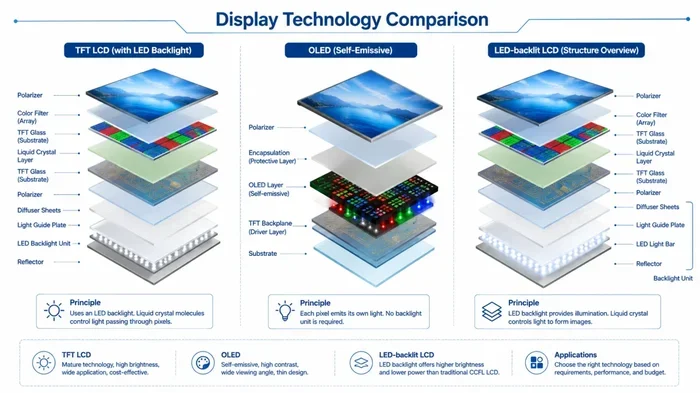
LCD stands for Liquid Crystal Display. It is one of the most widely used display technologies in the world. You will find LCD screens in TVs, monitors, laptops, phones, and even digital cameras. The technology uses liquid crystals that change shape when electricity passes through them. These crystals control how light passes through each pixel on your screen.
LCD screens need a backlight because the liquid crystals themselves do not produce light. Most LCD panels use LED backlights today, which is why you often hear the term LED-LCD. The backlight shines through the crystal layer, and the colors you see are the result of how those crystals rotate and filter the light.
How LCD Screens Work
Each pixel on an LCD screen has three sub-pixels: red, green, and blue. The liquid crystals act like tiny shutters. They open and close to let more or less light through each color filter. When all three sub-pixels are fully open, you see white. When they are all closed, you see black.
LCD technology has been around for decades. It started in watches and calculators and has grown to dominate the display market. Today, LCD screens come in many forms, including standard LCD, IPS LCD, and VA LCD panels. Each type handles color accuracy, viewing angles, and contrast ratio a little differently.
Strengths of LCD Technology
- Affordable pricing: LCD screens are budget-friendly and widely available.
- Good color reproduction: Modern LCD panels produce vibrant and accurate colors.
- Energy efficient: LED-backlit LCD screens use less power than older display types.
- Wide availability: You can find LCD screens in almost every size and shape.
- No burn-in risk: LCD panels do not suffer from static image burn-in like some other technologies.
Weaknesses of LCD Technology
- Slower pixel response: Standard LCD panels can lag during fast-moving scenes.
- Limited contrast: Blacks on LCD screens often look grayish because of the backlight bleed.
- Narrow viewing angles: Some LCD types lose color and brightness when you look from the side.
- Lower refresh rate options: Basic LCD panels may not support high refresh rates for gaming.
What Is TFT?
TFT stands for Thin Film Transistor. It is a specific type of LCD technology that adds a transistor behind each pixel. This transistor acts like a switch that controls the current to each pixel individually. The result is a much more precise and faster screen compared to standard LCD panels.
TFT screens are often called TFT-LCD panels. The transistor layer gives the display better image clarity and response speed. Most modern smartphones, tablets, and computer monitors use some form of TFT technology under the hood.
How TFT Screens Work
In a standard LCD panel, all pixels share a common electrical connection. This means changing one pixel can slightly affect its neighbors. In a TFT screen, each pixel has its own dedicated transistor. This means each pixel gets its own precise electrical signal. The result is faster switching, sharper images, and better overall screen quality.
Think of it like a light switch in your house. A standard LCD is like a power strip where one switch controls many lights. A TFT screen is like having a separate switch for every single light. You get much more control and precision.
Types of TFT Technology
Not all TFT screens are the same. There are several variations, and each one handles display comparison metrics differently:
- a-Si TFT (Amorphous Silicon): The most common type used in laptops and TVs. It offers solid performance at a reasonable cost.
- LTPS TFT (Low-Temperature Polycrystalline Silicon): Used in high-end phones and smartwatches. It delivers faster response times and sharper images.
- IPS TFT (In-Plane Switching): A popular variant known for wide viewing angles and excellent color accuracy. Many professionals prefer IPS screens.
- OLED TFT: Some OLED panels use TFT backplanes to control each pixel. OLED screens offer perfect blacks and infinite contrast.
Strengths of TFT Technology
- Faster pixel response: The transistor-backed design allows quicker color changes.
- Better image sharpness: Each pixel is controlled independently for crisper visuals.
- Higher refresh rates: TFT panels often support smoother motion for gaming and video.
- Wider viewing angles: TFT variants like IPS maintain color accuracy from almost any angle.
- Improved color vibrancy: TFT screens tend to produce richer and more lifelike colors.
Weaknesses of TFT Technology
- Higher cost: TFT screens are generally more expensive than basic LCD panels.
- More complex manufacturing: The extra transistor layer adds production costs.
- Power consumption: Some TFT variants draw more power than standard LCD screens.
- Can still suffer from backlight bleed: Like all LCD-based tech, TFT panels are not immune to this issue.
TFT vs LCD: Key Differences
Now that you understand what each technology is, let us compare them side by side. This display comparison will help you see where each one excels and where it falls behind.
Response Time: TFT screens have a clear edge here. The dedicated transistor for each pixel means faster switching. If you are a gamer or watch a lot of action content, this matters. Standard LCD panels can appear blurry during fast motion because their pixels change speed more slowly.
Color Accuracy: Both technologies have improved a lot over the years. However, TFT variants like IPS TFT offer superior color accuracy and consistency. Standard LCD panels may shift colors when viewed from different angles.
Power Consumption: Basic LCD screens tend to use less power. TFT screens, especially high-performance variants, can draw more electricity. If you are watching battery life on a laptop or portable device, this is worth considering.
Cost: LCD panels win on price. They are simpler to manufacture and widely available at budget-friendly prices. TFT screens cost more because of the extra transistor layer and more advanced manufacturing process.
Image Sharpness: TFT screens produce sharper images because each pixel is individually controlled. Standard LCD panels may show slight color bleeding between adjacent pixels.
Quick Comparison Table
- Feature: TFT is faster, LCD is slower
- Feature: TFT has better color accuracy, LCD has good but limited color
- Feature: TFT costs more, LCD is more affordable
- Feature: TFT uses more power, LCD is more energy efficient
- Feature: TFT has sharper images, LCD can show slight color bleeding
- Feature: TFT supports higher refresh rates, LCD has limited refresh rate options
Which One Is Better For You?
The answer to what is better TFT or LCD depends entirely on what you plan to do with your screen. There is no single winner. Let us look at different use cases to help you decide.
For Gaming
If you play games on your computer or console, a TFT display is the better choice. The faster pixel response times and higher refresh rates make a real difference. You will notice smoother motion and less blurring during fast-paced action. Many gaming monitors today use TFT-based panels, especially IPS or VA TFT variants.
When you are choosing a gaming screen, look for terms like “TFT-LCD” or “IPS TFT” on the specs. These labels tell you the panel uses thin film transistor technology for better performance.
For Office Work and Browsing
If you mainly use your screen for email, web browsing, and document editing, a standard LCD panel works perfectly fine. You do not need the extra speed and precision of a TFT screen for these tasks. A basic LCD monitor or laptop screen will give you clear text, good colors, and save you money.
Many budget laptops and monitors use standard LCD panels. They are reliable, energy efficient, and more than capable for everyday use.
For Creative Work
Photographers, video editors, and graphic designers need accurate colors. A high-quality TFT panel, especially an IPS TFT screen, is the way to go. The wider viewing angles and better color accuracy help you see your work as it truly is. If color precision matters to your workflow, investing in a TFT display pays off.
For Casual Media Consumption
Watching movies or YouTube videos on a standard LCD screen is perfectly fine for most people. You do not need a TFT panel for casual viewing. However, if you want a more immersive experience with better blacks and wider viewing angles, a TFT-based screen will enhance your enjoyment.
For Camera and Surveillance Displays
Many security and surveillance devices use LCD or TFT screens for monitoring. For example, a gully camera relies on a clear LCD or TFT display to show live footage. Similarly, a fleet safety camera uses display technology to show drivers real-time road conditions. The choice between TFT and LCD in these devices depends on the need for fast response and image clarity.
Even in smartphone cameras, the screen you use to frame your shot matters. A iPhone camera uses a TFT-based display to give you a bright, responsive preview when taking photos and videos.
Common Mistakes When Choosing Between TFT and LCD
Many buyers make avoidable mistakes when picking between these two display types. Here are the most common ones and how to dodge them.
Assuming TFT and LCD Are Completely Different
The biggest mistake is treating TFT and LCD as entirely separate technologies. Remember, TFT is a type of LCD. When a salesperson says a screen is “TFT,” they are really talking about a specific kind of LCD panel. Do not let the jargon confuse you into paying more than you need to.
Ignoring Your Actual Needs
Some people buy expensive TFT monitors for basic office work. Others buy budget LCD screens for competitive gaming. Both are wrong for the task. Think about what you actually do on your screen and match the technology to your use case.
Overlooking Panel Variants
Not all TFT panels are the same. An IPS TFT screen behaves very differently from a TN TFT screen. Similarly, not all LCD panels are equal. IPS LCD and VA LCD panels offer different strengths. Always check the specific panel type before buying.
Focusing Only on Price
While cost matters, it should not be the only factor. A slightly more expensive TFT screen can save you eye strain and frustration over months of daily use. Consider the long-term value, not just the upfront price tag.
Neglecting to Check Refresh Rate and Response Time
Even if you pick the right type, the specific specs matter. A high refresh rate and fast pixel response time make a huge difference in real-world use. Always check these numbers before you buy, regardless of whether you choose TFT or LCD.
Expert Insights on Display Technology
Display technology has come a long way in the last decade. Both TFT and LCD panels have improved significantly. Modern TFT screens offer excellent display brightness and wide color gamuts. Even budget LCD panels today deliver surprisingly good screen quality.
Industry experts agree that the line between TFT and LCD continues to blur. Many modern panels combine elements of both technologies to deliver the best of each world. When you see terms like QLED, Mini-LED, or MicroLED, these are all advanced forms of LCD technology that may or may not use TFT backplanes.
The trend in the industry is moving toward higher resolution, faster response times, and better energy efficiency. Whether you choose TFT or LCD, you are getting a display that is far superior to what was available even five years ago.
If you are still unsure, ask yourself one simple question: do you need speed and precision, or do you need affordability and simplicity? That answer will guide you to the right choice.
Final Thoughts
So, what is better TFT or LCD? The honest answer is that both have their place. TFT screens offer speed, precision, and better image quality. They are ideal for gaming, creative work, and anyone who wants a premium visual experience. LCD screens offer affordability, energy efficiency, and solid everyday performance. They are perfect for office work, casual use, and budget-conscious buyers.
The key is to match the technology to your needs. Do not get caught up in marketing jargon or brand names. Look at the actual specs, read reviews, and test the screen if you can. The best display is the one that works for you.
Whether you go with a TFT or an LCD panel, you are choosing from proven, reliable display technologies. Both will serve you well for years to come. The right choice is the one that fits your wallet and your workflow.
Frequently Asked Questions
Is TFT the same as LCD?
No, TFT is a type of LCD. LCD stands for Liquid Crystal Display, and TFT stands for Thin Film Transistor. Every TFT screen is an LCD, but not every LCD screen uses TFT technology. Think of TFT as a specific version of LCD with better control over each pixel.
Which is better for gaming, TFT or LCD?
TFT is better for gaming because it offers faster pixel response times and higher refresh rates. The transistor-backed pixels change color more quickly, which reduces motion blur during fast-paced games. If you are a serious gamer, a TFT-based monitor is the way to go.
Can I use an LCD monitor for professional design work?
Yes, but a high-quality TFT panel, especially an IPS TFT screen, will give you better color accuracy and wider viewing angles. For professional creative work, the extra investment in a TFT display is usually worth it for the improved precision.
Do TFT screens use more power than LCD screens?
Generally yes. TFT screens have more complex circuitry with a transistor for each pixel, which can draw more power. However, the difference is not huge, and many modern TFT panels are designed to be energy efficient.
Are there any burn-in risks with TFT or LCD screens?
LCD and TFT screens have very low burn-in risk compared to older display technologies like plasma or OLED. However, prolonged display of static images can still cause temporary image retention. This usually fades after a few minutes.
How do I know if my screen is TFT or LCD?
Check your device specs or manual. If it says TFT, TFT-LCD, IPS, or AMOLED, it uses thin film transistor technology. If it just says LCD without TFT, it is likely a standard LCD panel without the transistor layer. You can also look at the pixel response time in the specs, which is usually faster on TFT screens.