What Is the History of the Smart Board
The smart board has come a long way since its invention in the 1990s. It started as a simple interactive whiteboard and grew into a powerful touch-sensitive tool used in classrooms and boardrooms worldwide. Understanding the history of the smart board helps us appreciate how far educational technology has come.
Key Takeaways
- Smart boards began in the 1990s: The first interactive whiteboard was developed by SMART Technologies, changing how people present and learn.
- Early models used projector-based technology: These boards relied on projectors and special pens to create interactive displays on a white surface.
- Touch-sensitive boards replaced older models: Infrared and resistive touch screens made smart boards more intuitive and easier to use.
- Smart boards now support collaborative learning: Modern boards allow multiple users to interact at once, boosting engagement in classrooms and offices.
- The future looks bright: AI integration, cloud connectivity, and 4K displays are shaping the next generation of smart board technology.
📑 Table of Contents
The Early Beginnings Of Interactive Display Technology
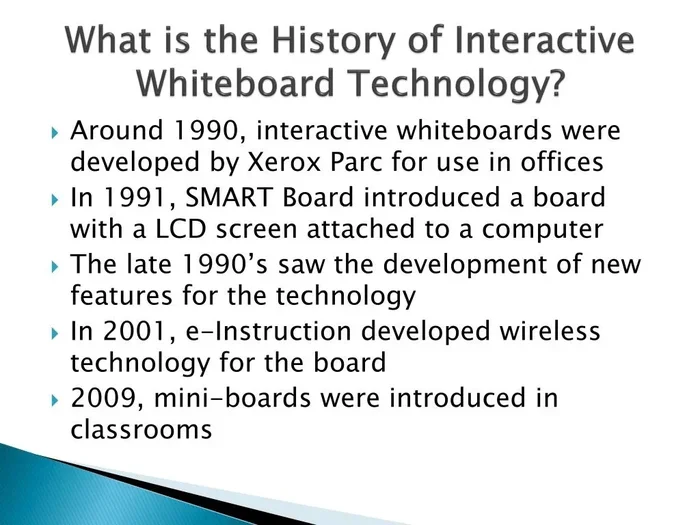
The story of the smart board starts way back in the early 1990s. Before smart boards existed, teachers and presenters relied on chalkboards and overhead projectors. These tools worked, but they were limited. You could only display static content, and updating information meant erasing and rewriting.
A company called SMART Technologies saw an opportunity. They wanted to create a device that combined a whiteboard with a computer. The result was the first interactive whiteboard. This early smart board used a projector to display a computer screen onto a white surface. Users could then interact with the content using a special pen.
This was a big deal at the time. For the first time, you could write on a board and save your notes digitally. You could also pull up websites, videos, and presentations right from the board. The idea of interactive learning was born.
How The First Smart Board Worked
The original smart board used a simple setup. A projector cast the computer image onto a whiteboard surface. The board had sensors that detected where the pen touched. When you wrote or clicked, the board sent that input back to the computer.
These early systems were not perfect. The image quality depended heavily on the projector. If the room was too bright, the display was hard to see. The pens also needed special replacement tips. But despite these flaws, the concept caught on fast.
Schools loved the idea. Teachers could now make lessons more engaging. Instead of just talking at students, they could show dynamic content. Students could come to the board and interact with lessons directly. This was a huge step forward in educational technology.
How Smart Boards Changed Education
By the early 2000s, smart boards were showing up in classrooms across the world. The rise of the smart board in education was nothing short of revolutionary. Teachers no longer had to rely solely on textbooks. They could use videos, animations, and real-time web content to explain complex topics.
One of the biggest wins was collaborative learning. Multiple students could gather around the smart board and work on a problem together. This made lessons more interactive and fun. Students who struggled with traditional lectures suddenly found it easier to engage.
Smart boards also helped with accessibility. Teachers could save notes and share them with students who missed class. Students with disabilities could benefit from visual and interactive content. The smart board became more than just a fancy whiteboard. It became a tool for inclusion.
The Role Of Smart Boards In Language Learning
Language classes were among the biggest beneficiaries of smart board technology. Teachers could display pronunciation guides, play native speaker audio, and show cultural images in real time. Students could practice writing characters or words directly on the board.
For example, a Spanish class could use the smart board to explore what is the easiest language to learn for Spanish speakers. Interactive quizzes and drag-and-drop exercises made language practice feel like a game. This kind of hands-on learning simply was not possible with a traditional chalkboard.
The Technology Behind Smart Boards
Understanding how a smart board works helps you appreciate its evolution. Early smart boards used a technology called resistive touch. This meant that pressure from a pen or finger registered as input on the board. The surface had two thin layers that touched when pressed, completing a circuit.
Over time, newer models switched to infrared touch technology. This used invisible light beams to detect finger or pen position. Infrared touch was more durable and responsive. It also allowed for multi-touch, meaning multiple users could interact with the board at the same time.
Modern smart boards also use high-definition displays. Many now come with built-in Android operating systems. You do not even need a separate computer in some cases. The board itself is a fully functional device.
From Projector-Based To Flat Panel Displays
One of the biggest shifts in smart board history was moving from projector-based models to flat panel displays. Early projector boards had several downsides. The projector bulb needed frequent replacement. Shadows and glare were constant problems. And image quality degraded over time.
Flat panel smart boards solved these issues. They use LED or LCD screens that produce bright, clear images. There are no bulbs to replace. The display stays consistent even in bright rooms. This made smart boards much more practical for everyday use.
Today, you can find smart boards with 4K resolution. The colors are vivid, and the touch response is nearly instant. Some models even include built-in speakers with solid RMS power, so you do not need external audio equipment for most lessons.
Smart Boards In The Modern Era
The smart board has evolved into much more than a classroom tool. Today, businesses use smart boards for meetings, training sessions, and presentations. Remote teams can collaborate on a smart board in real time, even when they are in different cities.
Modern smart boards also integrate with cloud services. You can save your work to the cloud and access it from any device. This is especially useful for hybrid work environments where some team members are in the office and others are working from home.
Another exciting development is the use of smart boards with emulation software. Teachers and IT professionals can run different operating systems on a smart board for demonstrations. For instance, you might use the best emulator for PC 2026 to show students how software behaves on different platforms, all from the smart board interface.
Smart Boards And The Laptop Connection
Smart boards and laptops work hand in hand in modern classrooms. Teachers use laptops to control the smart board, and students can mirror their laptop screens to the board. This seamless connection makes lessons more dynamic and interactive.
If you are setting up a classroom or office with a smart board, it helps to understand the basics of your laptop setup. For example, knowing about the ram of a laptop can help you ensure your device runs smart board software smoothly. A laptop with enough memory will handle multitasking between the smart board app, video playback, and web browsing without any lag.
Many schools also invest in smart boards as part of a broader technology upgrade. When you pair a smart board with a reliable laptop, you create a powerful learning station. It is one of the best investments you can make for long-term use, much like choosing the right upgrade path for your overall setup.
The Future Of Smart Board Technology
What does the future hold for the smart board? The answer is exciting. Artificial intelligence is already starting to play a role in smart board functionality. AI-powered smart boards can recognize handwriting, translate languages in real time, and even suggest lesson activities based on student performance.
Augmented reality is another frontier. Imagine pointing the smart board at a textbook and seeing a 3D model pop up on the display. Students could explore the solar system or the human body in incredible detail, all from their classroom.
Cloud connectivity will also continue to grow. Future smart boards may rely less on local hardware and more on cloud-based processing. This means lower costs and easier maintenance for schools and businesses alike.
Sustainability And Smart Boards
Smart boards also contribute to sustainability efforts. By replacing paper-based materials, they help reduce waste. Digital notes and assignments mean fewer printed handouts. Over time, this adds up to a significant environmental benefit.
Energy efficiency is another consideration. Modern LED smart boards use much less power than older projector models. Some even feature automatic brightness adjustment to save energy when the room is empty.
As technology continues to advance, the smart board will only become more essential. It is no longer just a fancy whiteboard. It is a central hub for interactive learning and collaboration.
Final Thoughts
The history of the smart board is a story of innovation and transformation. From its humble beginnings as a projector-based interactive whiteboard to today’s sleek, touch-sensitive flat panels, the smart board has changed the way we teach, learn, and collaborate.
Whether you are a teacher, a business professional, or simply curious about educational technology, understanding the smart board’s journey gives you a deeper appreciation for the tools we use every day. The smart board is not just a piece of equipment. It is a window into how technology shapes human connection and learning.
As we look ahead, the possibilities are endless. AI, augmented reality, and cloud computing will push smart boards even further. One thing is certain: the smart board will continue to be a cornerstone of interactive displays for years to come.
Frequently Asked Questions
What is a smart board and how does it work?
A smart board is an interactive display that combines a whiteboard with a computer. It uses touch-sensitive technology to let users interact with digital content directly on the board’s surface. You can write, draw, and navigate using your finger or a special pen.
When was the first smart board invented?
The first smart board was developed in the early 1990s by SMART Technologies. It used a projector to display computer content on a whiteboard surface and a special pen for input. This invention launched the interactive whiteboard revolution.
How have smart boards changed over the years?
Smart boards have evolved from projector-based models to sleek flat panel displays. Modern boards feature infrared touch, 4K resolution, built-in operating systems, and cloud connectivity. They are now used in both classrooms and business settings.
Are smart boards still used in schools today?
Yes, smart boards are widely used in schools around the world. They have become essential tools for interactive learning, allowing teachers to present dynamic content and engage students in collaborative activities. Many schools consider them a core part of classroom technology.
What is the difference between a smart board and a regular whiteboard?
A regular whiteboard is a static surface for writing with dry-erase markers. A smart board is an interactive digital display that connects to a computer and allows users to manipulate digital content. Smart boards also save and share notes electronically.
What does the future hold for smart board technology?
The future of smart boards includes AI integration, augmented reality, and cloud-based processing. These advancements will make smart boards even more interactive, affordable, and accessible. They will continue to transform education and business collaboration.