2 Speakers on One Channel

Connecting 2 speakers on one channel lets you fill a room with richer, fuller sound without buying a new amp. Learn the wiring basics, impedance tricks, and practical tips to get the best performance while keeping your gear safe.
Key Takeaways
- Impedance matters: Pairing two 8 Ω speakers in parallel results in a 4 Ω load, which most modern amps can handle.
- Series vs. parallel: Series wiring keeps total impedance high, while parallel lowers it—choose based on your amp’s specs.
- Power distribution: The amp splits power evenly, so matching speaker sensitivity helps maintain balance.
- Safety first: Never exceed the amp’s minimum impedance rating; use a resistor or a dedicated multi‑zone controller if needed.
- Room acoustics count: Positioning two speakers on the same channel can improve stereo imaging when placed correctly.
- Upgrade path: Adding a speaker selector switch lets you expand later without rewiring.
- DIY friendliness: With a few tools and simple math, most hobbyists can wire 2 speakers on one channel safely.
📑 Table of Contents
- Introduction: Why Think About 2 Speakers on One Channel?
- Understanding Impedance: The Heartbeat of Your Audio System
- Wiring Options: Parallel vs. Series
- Step‑by‑Step Guide: Wiring 2 Speakers on One Channel
- Real‑World Scenarios: When 2 Speakers on One Channel Shine
- Common Mistakes and How to Avoid Them
- Advanced Tips: Getting the Most Out of Your Dual‑Speaker Setup
- Conclusion: Is Wiring 2 Speakers on One Channel Right for You?
Introduction: Why Think About 2 Speakers on One Channel?
Imagine watching a movie in your living room and feeling like the sound is coming from every corner. You don’t need a massive home‑theater system to get there—just two extra speakers hooked to the same amp channel. This trick is popular among DIY audiophiles because it’s cheap, easy, and can dramatically improve the sense of space.
In this guide we’ll walk through the science behind speaker impedance, the wiring options (series vs. parallel), and step‑by‑step instructions for wiring 2 speakers on one channel. We’ll also cover common mistakes, safety checks, and a few real‑world examples so you can decide whether this setup fits your listening room.
Understanding Impedance: The Heartbeat of Your Audio System
What Is Impedance?
Impedance, measured in ohms (Ω), is the resistance a speaker offers to the flow of alternating current from your amplifier. Most home speakers are rated at 4 Ω or 8 Ω. Your amp also lists a “minimum impedance” – the lowest load it can safely drive.

Visual guide about 2 Speakers on One Channel
Image source: img.alicdn.com
How Impedance Changes When You Add a Second Speaker
When you connect two speakers to the same channel, the total load changes depending on how you wire them:
- Parallel wiring: Total impedance = (Speaker Ω ÷ 2). Two 8 Ω speakers become 4 Ω.
- Series wiring: Total impedance = (Speaker Ω × 2). Two 8 Ω speakers become 16 Ω.
Most modern amps can handle 4 Ω, but older or budget units may only guarantee stability at 8 Ω. Knowing your amp’s rating is the first step before you start plugging in speakers.
Practical Example: Matching a 4 Ω Amp
If your receiver is rated for a minimum of 4 Ω, you can safely wire two 8 Ω speakers in parallel. The amp will see a 4 Ω load and deliver its full power to both speakers, splitting the wattage roughly evenly.
Wiring Options: Parallel vs. Series
Parallel Wiring – The Most Common Choice
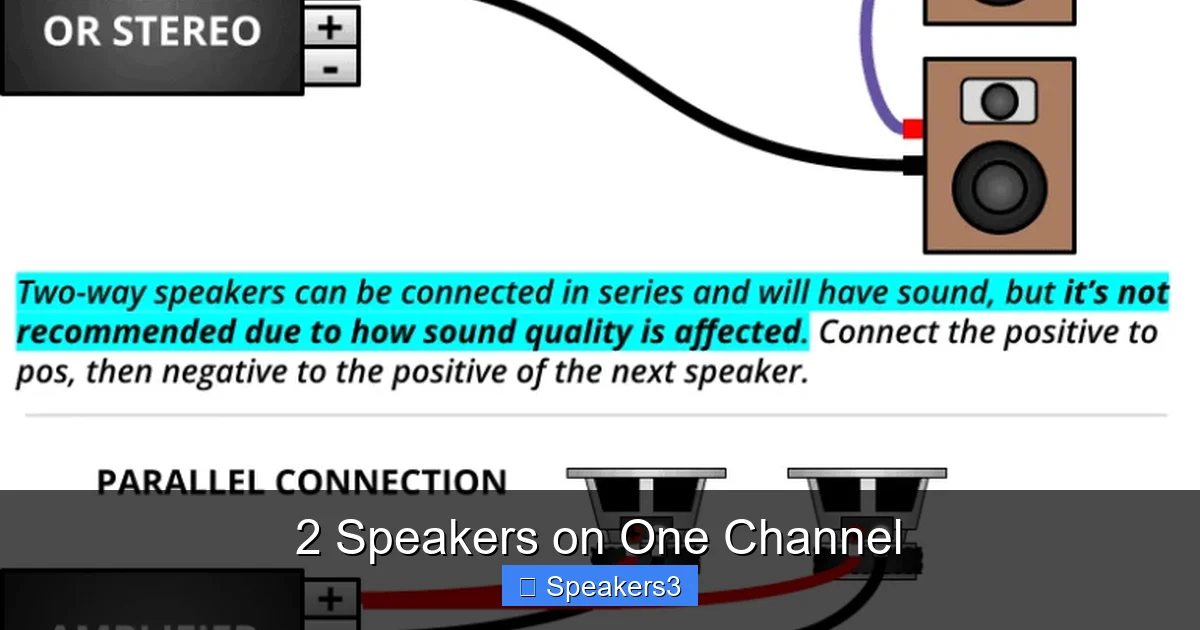
Parallel wiring gives you a lower total impedance, which generally means more power to each speaker. Here’s how to do it:
Visual guide about 2 Speakers on One Channel
Image source: soundcertified.com
- Identify the positive (+) and negative (–) terminals on both speakers.
- Connect the amp’s positive output to the positive terminals of both speakers using a “Y” splitter or a piece of speaker wire that branches.
- Do the same for the negative side.
Result: Two speakers share the same channel, each receiving half the voltage but the full current the amp can supply at the lower impedance.
Series Wiring – When You Need Higher Impedance
If your amp can’t go below 8 Ω, series wiring is the safe route. The steps are similar, but you connect the speakers end‑to‑end:
- Connect the amp’s positive output to the positive terminal of the first speaker.
- Link the negative terminal of the first speaker to the positive terminal of the second speaker.
- Finally, connect the negative terminal of the second speaker back to the amp’s negative output.
The total impedance adds up, keeping the load safe for the amp, but the power each speaker receives is slightly less than in the parallel case.
Choosing the Right Method for Your Setup
Use parallel wiring when your amp’s minimum impedance is 4 Ω or lower. Choose series wiring if the amp’s rating is 8 Ω or higher. If you’re unsure, consult the amp’s manual or look for a speaker selector switch that automatically handles impedance matching.
Step‑by‑Step Guide: Wiring 2 Speakers on One Channel
Tools You’ll Need
- Wire stripper/cutter
- Speaker gauge wire (16‑18 AWG is typical)
- Heat‑shrink tubing or electrical tape
- Screwdriver (flat‑head or Phillips, depending on terminals)
- Multimeter (optional, for checking continuity)
Step 1: Verify Your Amp’s Impedance Rating
Locate the specification sheet or the label on the back of the receiver. Look for “Speaker Impedance: 4 Ω minimum.” If you can’t find it, a quick online search of the model number will usually turn up the data.

Visual guide about 2 Speakers on One Channel
Image source: livedoor.blogimg.jp
Step 2: Measure Your Speakers’ Impedance
Most speakers have the rating printed on the back. If it’s missing, use a multimeter set to the “Ω” range, place the probes on the terminals, and read the value.
Step 3: Decide Parallel or Series
Based on the numbers you gathered, pick the wiring method that keeps the total load above the amp’s minimum. For example, two 8 Ω speakers on a 4 Ω‑rated amp = parallel (4 Ω total). Two 8 Ω speakers on an 8 Ω‑rated amp = series (16 Ω total).
Step 4: Cut and Strip the Wire
Measure the distance from the amp to each speaker, add a few extra inches for slack, and cut two lengths for each polarity. Strip about ½ inch of insulation from each end.
Step 5: Make the Connections
Follow the wiring diagram for your chosen method. Tighten the terminal screws firmly, but avoid over‑tightening which can strip the metal.
Step 6: Test the System
Turn the amp on at a low volume. Play a familiar track and listen for balanced sound from both speakers. If one is quieter, double‑check the polarity and wiring continuity.
Step 7: Secure and Tidy Up
Wrap any exposed connections with heat‑shrink tubing or electrical tape. Use zip ties to bundle excess wire and keep the installation neat.
Real‑World Scenarios: When 2 Speakers on One Channel Shine
Home Theater Fill‑In
Many people add a pair of bookshelf speakers to the front left and right channels of a 5.1 system to boost dialogue clarity. Wiring them in parallel to the existing front speakers creates a richer front soundstage without needing a separate AV receiver.
Outdoor Patio Audio
Running two weather‑rated speakers from a single amp channel can cover a larger patio area. Because outdoor speakers are often 8 Ω, parallel wiring to a 4 Ω‑capable amp works well and provides enough power to cut through ambient noise.
Budget Multi‑Room Setup
If you have a single stereo amp and want sound in two rooms, you can wire a pair of speakers in each room to the same channel using a long speaker cable run. Series wiring keeps the load safe on older amps while still delivering decent volume.
Common Mistakes and How to Avoid Them
Ignoring Impedance Limits
Connecting two 8 Ω speakers in parallel to an amp that only supports 8 Ω minimum will drop the load to 4 Ω and may overheat the amp. Always check the spec first.
Mismatched Sensitivity
Speaker sensitivity (measured in dB SPL @ 1 W/1 m) determines how loud a speaker gets for a given power. Pairing a 92 dB speaker with an 86 dB one can make the quieter unit sound lost. Choose speakers with similar sensitivity or use an external crossover.
Polarity Errors
Reversed polarity on one speaker causes phase cancellation, making the sound feel thin or “hollow.” Always double‑check that the + and – connections match on both speakers.
Using Inadequate Wire Gauge
Thin wire (higher gauge number) adds resistance, especially over long runs, reducing power delivery. For runs under 50 ft, 16 AWG is safe; for longer distances, step up to 14 AWG.
Advanced Tips: Getting the Most Out of Your Dual‑Speaker Setup
Employ a Speaker Selector Switch
A speaker selector with built‑in impedance protection lets you add more speakers without recalculating loads each time. It’s a great upgrade if you plan to expand further.
Use a Passive Crossover
If you’re pairing a tweeter‑focused bookshelf speaker with a larger floor‑standing unit, a simple passive crossover can direct high frequencies to the smaller driver and low frequencies to the larger one, improving clarity.
Fine‑Tune with an Equalizer
After wiring, a room EQ can balance the frequency response between the two speakers, especially when they’re of different brands or models.
Consider Bi‑Amping (for the ambitious)
Some enthusiasts split the signal into separate high‑ and low‑frequency amps, then feed each to a dedicated driver. While beyond the scope of a basic “2 speakers on one channel” guide, it shows the potential for future upgrades.
Conclusion: Is Wiring 2 Speakers on One Channel Right for You?
Adding a second speaker to an existing channel is a straightforward, cost‑effective way to broaden your soundstage, increase volume, and make your listening space feel more immersive. By respecting impedance, matching speaker sensitivity, and following safe wiring practices, you can enjoy richer audio without investing in a new amplifier.
Take the time to measure, plan, and test—your ears will thank you. And remember, if you ever need to expand further, a speaker selector switch or an upgrade to a multi‑zone amp will keep your system flexible for years to come.
Frequently Asked Questions
Can I connect any two speakers together on one channel?
Yes, as long as the combined impedance stays above the amp’s minimum rating and the speakers have similar sensitivity, you can wire almost any pair together.
What happens if I wire two 4 Ω speakers in parallel?
Parallel wiring would drop the load to 2 Ω, which most consumer amps cannot handle and could cause overheating or shutdown.
Is it better to use series or parallel wiring?
Parallel gives more power and louder sound but lowers impedance; series keeps impedance high but reduces power. Choose based on your amp’s specifications.
Do I need a special cable to connect two speakers?
No special cable is required; standard speaker‑grade wire (16‑18 AWG) works fine. Just make sure the gauge is appropriate for the length of the run.
Can I add a third speaker to the same channel?
Yes, but the math gets more complex. You must ensure the total impedance remains within the amp’s safe range, often using a selector switch or additional resistors.
Will wiring two speakers on one channel affect stereo imaging?
It can improve front‑stage imaging if the speakers are placed correctly, but if they’re too close together the sound may become less distinct. Position them at ear level and spaced apart for the best effect.