3 Way Crossover for Speakers
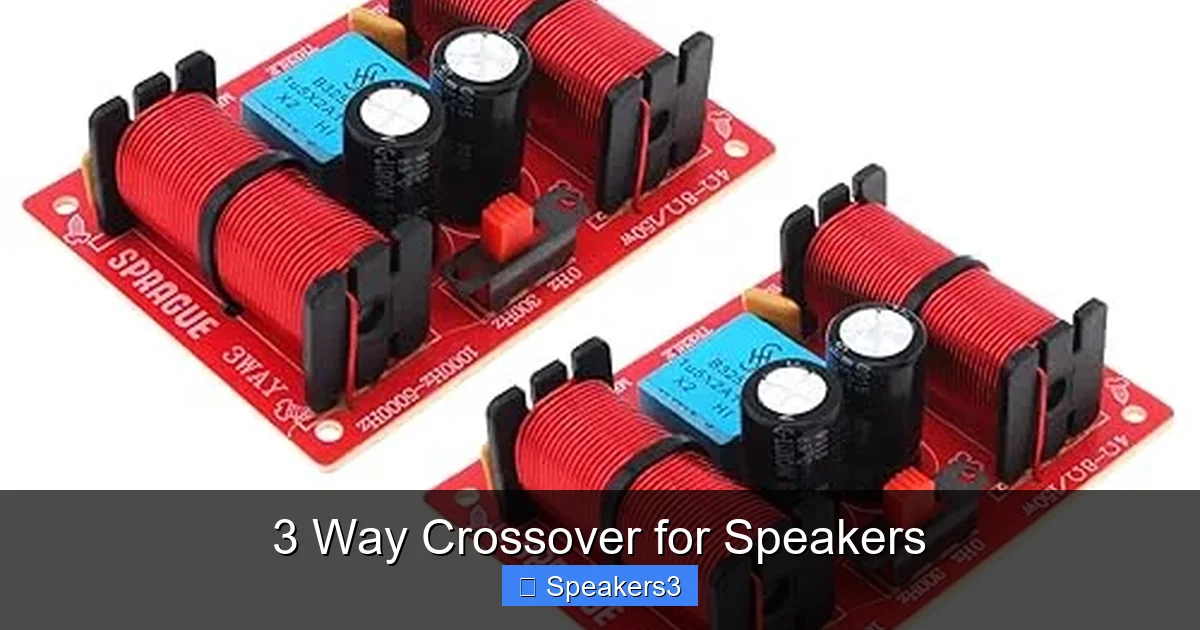
A 3-way crossover is the essential electronic circuit that precisely splits your audio signal into three distinct frequency bands, sending lows to the woofer, mids to the midrange driver, and highs to the tweeter. This optimizes each driver’s performance by allowing it to handle only its intended range, drastically reducing distortion and unlocking a fuller, more detailed, and crystal-clear acoustic experience.
3 Way Crossover for Speakers
Have you ever cranked up your favorite album, only to be met with a harsh, muddy mess instead of crystal-clear highs and punchy lows? You might have a fantastic amplifier and gorgeous speaker cabinets, but if the traffic cop inside your speaker is asleep at the wheel, the whole system suffers. That traffic cop is the crossover network, and for many high-performance speakers, the 3 way crossover for speakers is the sophisticated brain that makes everything sing in harmony. It’s the unsung hero of audio fidelity, and understanding it can completely transform how you appreciate sound, whether you’re a DIY builder, a serious audiophile, or just someone tired of subpar audio.
Think of a 3 way crossover as a highly skilled air traffic controller for your speaker drivers. Instead of letting a massive woofer try to reproduce a cymbal crash (it can’t) or forcing a tiny tweeter to handle a bass guitar note (it will explode), the crossover meticulously splits the full-range audio signal into three distinct frequency bands. It sends the deep, powerful lows to the woofer, the rich, detailed mids to the midrange driver, and the sparkling, airy highs to the tweeter. Each driver does what it was designed to do, and the result is a seamless, full, and incredibly detailed soundstage. Getting this split right is an art form, and that’s what we’re diving into today.
Key Takeaways
- Split audio precisely: A 3-way crossover divides signals into low, mid, and high frequencies for dedicated drivers.
- Choose quality components: Use high-grade capacitors and inductors to minimize signal loss and distortion.
- Align driver phases: Ensure all drivers are in-phase to prevent frequency cancellation and muddy sound.
- Set crossover slopes: Select slopes (e.g., 12dB/octave) to control driver blending and protect tweeters.
- Match impedance correctly: Design for your system’s total impedance to avoid amplifier strain and poor performance.
- Tune frequencies for your room: Adjust crossover points based on speaker specs and room acoustics for balanced sound.
- Measure and verify: Use measurement tools like a microphone and software to confirm your crossover’s real-world performance.
📑 Table of Contents
- What Exactly Is a Crossover, and Why Do You Need One?
- How a 3-Way Crossover Works: The Magic of Filters
- Types of 3-Way Crossover Designs and Their Personalities
- Building vs. Buying: Your 3-Way Crossover Options
- Critical Design Considerations and Common Pitfalls
- Common Crossover Points and Slope Recommendations
- Advanced Topics: Bi-Amping, Phase, and Time Alignment
- Conclusion: The Heart of the Matter
What Exactly Is a Crossover, and Why Do You Need One?
At its heart, a crossover is an electronic circuit. Its sole job is to filter an audio signal. In a 3 way speaker system, you have three separate drivers: a woofer (low frequencies), a midrange (middle frequencies), and a tweeter (high frequencies). Each driver has a specific frequency range where it performs efficiently and safely. A crossover prevents each driver from receiving frequencies outside its optimal range.
The Problem Without a Crossover
Imagine asking a marathon runner to also do weightlifting and ballet in the same performance. They’d be overworked, inefficient, and likely get hurt. Similarly, a large woofer is physically incapable of moving fast enough to create detailed high frequencies, leading to distortion and a “veiled” sound. A tiny tweeter, if sent low frequencies, will be forced to move with such extreme excursion that it will overheat and tear itself apart—a literal blowout. The crossover protects your investment and ensures each driver operates within its “sweet spot.”
Passive vs. Active Crossovers
This is a crucial distinction. A passive crossover sits between your amplifier and the drivers, inside the speaker cabinet. It uses resistors, capacitors, and inductors (coils) to filter the signal after amplification. It’s simple, cost-effective, and what you’ll find in almost all commercial speakers. An active crossover sits before the amplifier. It splits the signal at line level, and then you need separate amplifiers for each driver type (a 3-way system needs three amp channels). Active crossovers offer more precise control, adjustment, and often better performance but at a higher cost and complexity. Most discussions about a “3 way crossover for speakers” refer to the passive type built into the cabinet.
How a 3-Way Crossover Works: The Magic of Filters
A 3 way crossover doesn’t just chop the sound into three blocks. It uses filters with specific “slopes” to create overlapping transition zones. This overlap is critical for a smooth, coherent sound. The two main filters are high-pass and low-pass. A third, the band-pass, is essentially a combination used for the midrange driver.
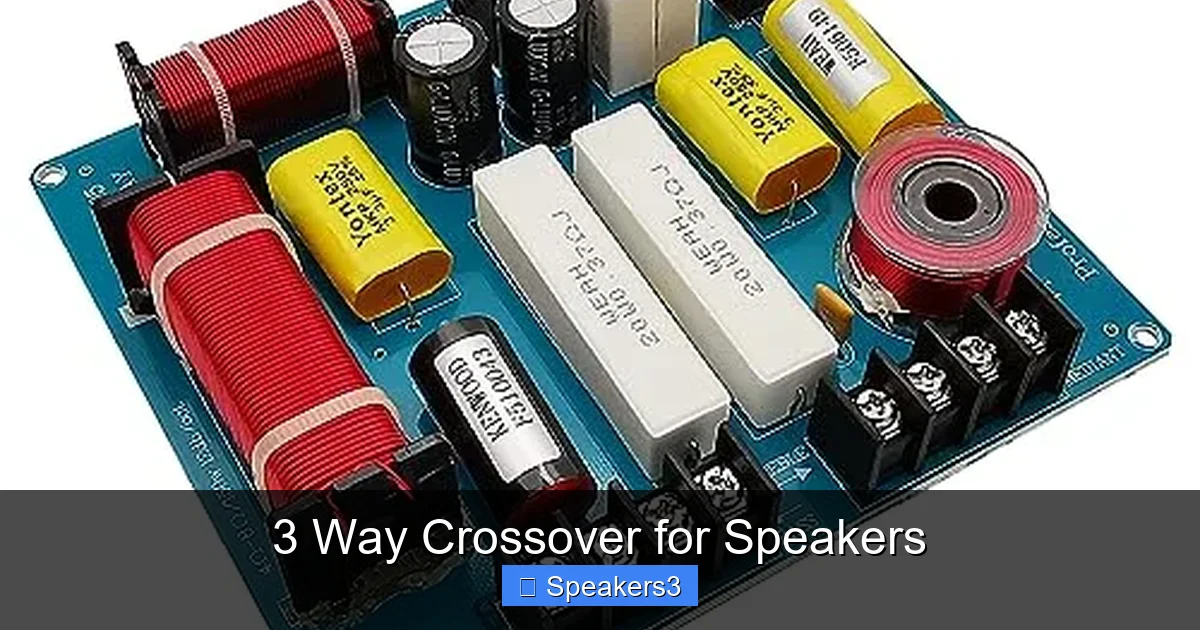
Visual guide about 3 Way Crossover for Speakers
Image source: m.media-amazon.com
Filter Order and Slope: The dB/Octave Story
You’ll hear terms like “12dB/octave” or “24dB/octave.” This describes the filter’s steepness. An octave is a doubling of frequency. A 12dB/octave (2nd order) filter reduces the signal by 12 decibels for every octave you move away from the cutoff frequency. A 24dB/octave (4th order) is twice as steep.
- 12dB/octave (2nd Order): The most common, gentle slope. It provides a good balance of phase coherence and complexity. The drivers overlap significantly, which can make phase alignment easier but requires very careful driver selection.
- 18dB/octave (3rd Order): A steeper, sharper cutoff. It’s very popular in professional audio and high-end home audio. It offers better separation between drivers, reducing intermodulation distortion, but introduces more phase shift that must be managed.
- 24dB/octave (4th Order): Extremely steep. Used when driver placement forces very different acoustic centers or in extremely high-power applications. It has significant phase implications and is less common in two-way home speakers but can be found in complex three-way designs.
Crossover Frequencies: Where to Split the Signal
This is the million-dollar question in crossover design. There’s no single “correct” frequency. It depends entirely on your drivers’ capabilities. A typical 3 way crossover might have:
- Woofer-to-Midrange Crossover: Often between 500Hz and 1,500Hz. The woofer handles the bass and lower mids; the midrange takes over the critical vocal and instrument midrange.
- Midrange-to-Tweeter Crossover: Typically between 2,500Hz and 5,000Hz. This gets the midrange out of the way for the tweeter to handle the highest frequencies with ease.
These points are chosen so that each driver is operating in the region where its frequency response is the most linear and its distortion is the lowest. A poorly chosen crossover point, even with a perfect filter, will sound bad because one driver is struggling at the transition.
Types of 3-Way Crossover Designs and Their Personalities
Not all 3 way crossovers are created equal. The design topology significantly influences the sound. Two main families dominate.
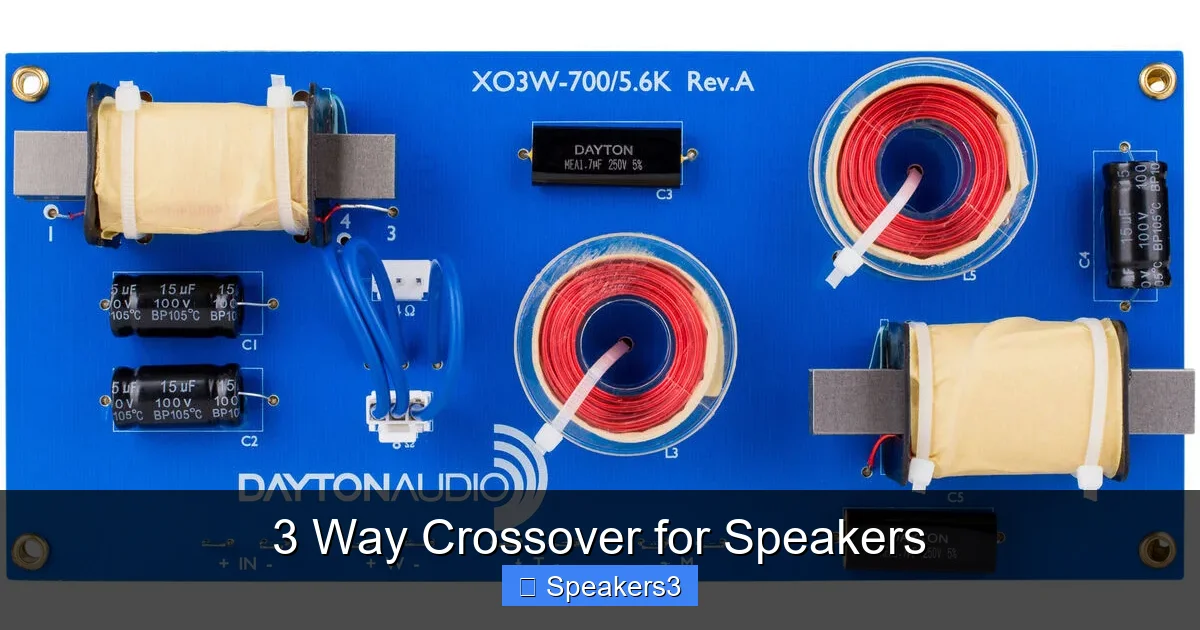
Visual guide about 3 Way Crossover for Speakers
Image source: simplyspeakers.com
Butterworth vs. Linkwitz-Riley: The Phase Factor
These aren’t filter slopes; they are overall alignment philosophies that determine how the outputs from multiple filters sum acoustically.
- Butterworth Alignment: Aims for a maximally flat magnitude response in the passband. When two Butterworth filters (e.g., a high-pass and low-pass) are summed, they can produce a peak or dip at the crossover frequency if not perfectly aligned in time/phase. It’s a classic, often “euphonic” sound but requires precise driver time alignment (physical offset) to avoid lobing issues.
- Linkwitz-Riley (LR) Alignment: The most common in modern speaker design. An LR4 (24dB/octave) filter pair is created by cascading two Butterworth filters. Its magic is that the acoustic sum of the two drivers at the crossover frequency is also a Butterworth response—in-phase and flat in magnitude. It’s inherently more phase-coherent and less sensitive to small driver misalignments, making it a very robust and popular choice for 3 way crossover networks.
Series vs. Parallel Crossovers
This refers to how the components are connected to the drivers.
- Parallel (Most Common): The filter for each driver is connected between the amplifier’s positive terminal and that driver. It’s the standard, efficient design used in nearly all commercial speakers.
- Series (Less Common): The filter components are placed in series with the driver itself. This can offer some benefits in impedance stabilization and can be simpler for certain designs, but it’s less common in multi-way speakers due to power division and damping factor considerations.
Building vs. Buying: Your 3-Way Crossover Options
So, where does this leave you? You have three main paths when dealing with a 3 way crossover for speakers.
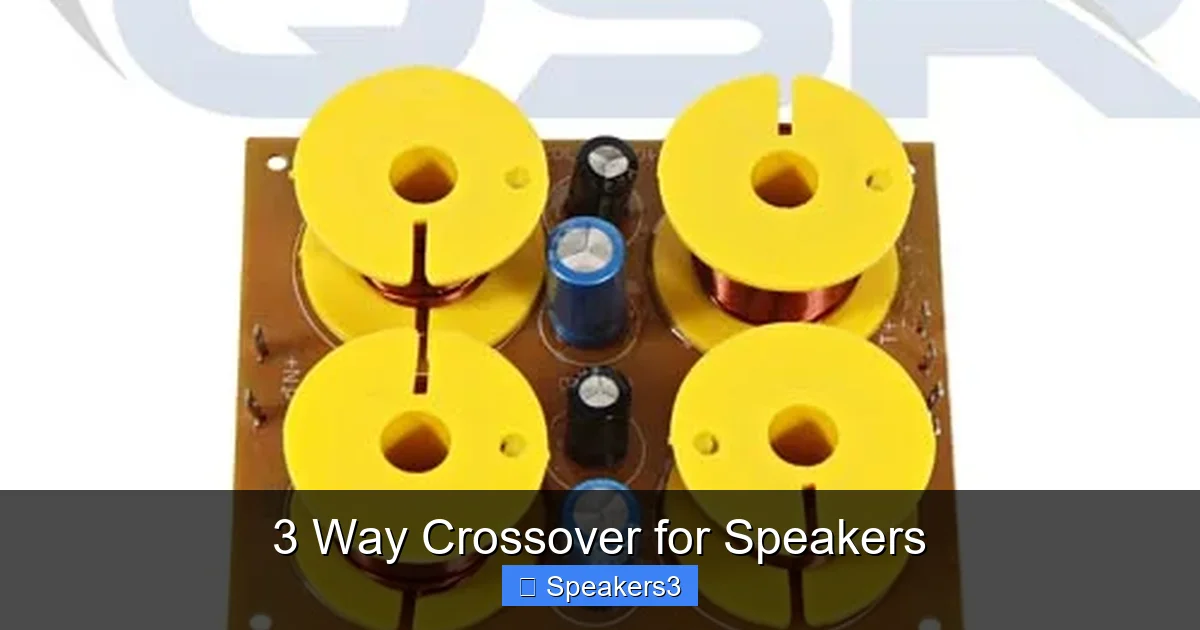
Visual guide about 3 Way Crossover for Speakers
Image source: qsr.net.au
1. Buying a Pre-Designed Commercial Speaker
This is the easiest path. The manufacturer has done all the hard work—driver selection, measurement, crossover design, and voicing. You just buy the finished product. The quality of the included 3 way crossover is directly tied to the price and engineering prowess of the brand. A well-regarded brand like KEF, Bowers & Wilkins, or Paradigm invests thousands in R&D for their crossovers. You get a guaranteed, cohesive sound. Tip: When shopping, don’t just look at the drivers. Research the brand’s reputation for crossover design. A great driver with a poor crossover is a wasted opportunity.
2. Buying a DIY Crossover Kit or Design
This is where the hobbyist lives. Companies like Parts Express, Madisound, or Meniscus Audio sell complete crossover kits with all components (coils, capacitors, resistors) and detailed plans for specific driver combinations. You solder it yourself and install it in your cabinet. The joy here is customization and education. You can tweak component values slightly to “voic” the speaker to your taste. Example: I once built a pair of three-way towers using a Seas Excel woofer, a Scan-Speak midrange, and a Neotech tweeter. The crossover kit was meticulously designed. The process of soldering those large, high-quality inductors and hearing the system come together for the first time was immensely rewarding. The sound was transparent and dynamic, a direct result of the thoughtful 3 way crossover design.
3. Designing Your Own From Scratch
This is the expert level. It requires a measurement microphone, software like VituixCAD, ARTA, or REW, and a deep understanding of filter theory and driver behavior. You measure each driver’s frequency and phase response in the intended cabinet, then simulate crossover networks until you achieve a flat, phase-coherent sum. It’s a long, iterative process of trial, error, and measurement. For 99% of people, this is not the starting point. But for the true audio tinkerer, it’s the ultimate form of expression. Tip: Start with a known, successful driver combination from a DIY audio forum. Replicate a proven design first to learn the process before attempting your own.
Critical Design Considerations and Common Pitfalls
Even with a perfect filter on paper, real-world 3 way crossover implementation is fraught with challenges.
Driver Selection is 80% of the Battle
You cannot design a good crossover for mismatched drivers. The woofer must have a clean, low-distortion response up to the chosen crossover point. The midrange must be smooth through its band and roll off naturally where the tweeter takes over. Their sensitivity (dB SPL at 1W/1m) must be closely matched, or you’ll need to add attenuating resistors (L-pads) which waste power and can affect damping. Practical Tip: Always check the published frequency response and impedance graphs of your chosen drivers. Look for smooth, gradual roll-offs, not sharp cliffs or severe bumps right at your intended crossover frequencies.
The Impedance Conundrum
Drivers are not perfect resistors; their impedance (measured in ohms) changes with frequency. A 3 way crossover must be designed to present a stable, manageable load to the amplifier across the entire audio band. A poorly designed network can cause the impedance to dip dangerously low (straining the amp) or spike to very high levels (making the amp sound weak and distorted). This is why pre-designed kits are so valuable—their impedance curves have been modeled and tested.
Component Quality and Non-Idealities
In an ideal world, an inductor is a perfect coil, and a capacitor is a perfect capacitor. In reality, inductors have resistance (DCR) that dampens the driver and reduces efficiency. Capacitors have equivalent series resistance (ESR) and inductance (ESL). For a 3 way crossover, especially in the signal path to the sensitive tweeter, high-quality components (air-core inductors, polypropylene or film capacitors, non-inductive resistors) make a measurable and audible difference in clarity and detail. Skimping here is a false economy.
Common Crossover Points and Slope Recommendations
While every design is unique, industry trends and driver technology provide helpful starting points. This table outlines typical crossover ranges for a well-matched three-way system.
| Driver Pair | Typical Crossover Frequency Range | Recommended Starting Slope | Key Reason |
|---|---|---|---|
| Woofer / Midrange | 800 Hz – 1,500 Hz | 12dB or 18dB/octave | Midrange drivers excel in vocal range; keep woofer out of complex midrange. |
| Midrange / Tweeter | 2,500 Hz – 4,000 Hz | 18dB/octave (LR4) | Steep slope protects tweeter, reduces beaming from midrange at high frequencies. |
Important Caveat: These are starting points. A soft-dome tweeter with a natural roll-off at 3kHz might cross over at 2.5kHz. A horn-loaded compression driver tweeter that is flat to 5kHz might cross at 4kHz. The 3 way crossover must be tailored to the specific drivers’ measured responses.
Advanced Topics: Bi-Amping, Phase, and Time Alignment
Once you grasp the basics, deeper layers of control emerge.
Bi-Amping and Tri-Amping: Active Crossovers in Disguise
You might have heard of “bi-amping.” In a 3 way system, “tri-amping” is the ultimate. This is where you use an active crossover (either a standalone unit or a modern AV receiver with pre-outs) to split the signal before amplification, and then power each driver type (woofer, mid, tweeter) with its own dedicated amplifier channel. This eliminates the passive crossover’s interaction with the driver’s impedance and the amplifier’s output. It’s more expensive but offers superior dynamics, control, and the ability to perfectly level-match and even adjust crossover points on the fly. Many high-end studio monitors and audiophile systems use this approach.
Phase and Polarity: The Invisible Hand
When two drivers play the same frequency (in the overlap region), their sound waves must arrive at your ear in phase—their compressions and rarefactions must align. If they are out of phase, they cancel each other, creating a hole in the response at the crossover frequency. A 3 way crossover design inherently introduces phase shift. Designers account for this by reversing the polarity (wiring) of one driver (usually the tweeter) relative to the others. This is why you sometimes see a switch on a crossover board labeled “Tweeter Polarity.” Getting this right is non-negotiable for a coherent soundstage. Measurements with a microphone are the only way to be sure.
Time Alignment: The Physical Offset
Drivers are mounted at different depths in a cabinet. The tweeter’s sound will reach your ear microseconds before the woofer’s sound, even if they are playing the same frequency. This is a time alignment issue. Designers solve this in two ways: 1) Physically offsetting drivers (sloping the baffle, like in many KEF speakers), or 2) Using all-pass filters in the electronic crossover to delay the signal to the front-most driver. This is a critical part of 3 way crossover design that happens behind the scenes.
Conclusion: The Heart of the Matter
The 3 way crossover for speakers is far more than a collection of coils and capacitors. It is the fundamental architecture that defines a speaker’s character. It’s where engineering meets art—a delicate balance of filter theory, driver mechanics, and psychoacoustics. A poorly executed crossover, even with the most exotic drivers, will yield a disjointed, fatiguing listening experience. A masterfully designed one, however, can make even modest drivers sound coherent, dynamic, and surprisingly deep.
For the end-user, the takeaway is this: value the crossover. When evaluating speakers, consider the brand’s engineering reputation as much as the driver specs. For the DIY enthusiast, respect the process. Start with a proven kit, learn to measure, and understand that the crossover is not an afterthought—it is the central blueprint. Whether you’re buying or building, a well-executed 3 way crossover is what transforms a box of parts into a musical instrument that can move you. It’s the silent conductor ensuring every note, from the deepest organ pedal to the highest flute trill, arrives exactly as the artist intended. That’s the power and the beauty of getting the crossover right.
Frequently Asked Questions
What is a 3 way crossover for speakers?
A 3-way crossover is an electronic circuit that splits an audio signal into three separate frequency bands, directing low frequencies to a woofer, mid-range frequencies to a mid driver, and high frequencies to a tweeter. This allows each driver to reproduce only the sounds it’s designed for, resulting in clearer, more efficient, and dynamic sound. It’s essential for multi-driver speaker systems to prevent distortion and damage.
How does a 3-way crossover work?
It uses a series of capacitors and inductors (filters) to route specific frequency ranges. A high-pass filter sends treble to the tweeter, a band-pass filter sends mids to the mid-range driver, and a low-pass filter sends bass to the woofer. The crossover point frequencies are carefully chosen to ensure a smooth, seamless blend between all three drivers for a cohesive sound.
Do I need a 3-way crossover for my speakers?
You only need a 3-way crossover if your speaker cabinet uses three separate drivers: a woofer, a mid-range, and a tweeter. If your speaker is a simple 2-way design with just a woofer and tweeter, it will have a 2-way crossover instead. The crossover is built into the speaker’s internal wiring or is part of an external active crossover system for powered setups.
What are the typical crossover frequencies for a 3-way system?
Common crossover points are often around 500Hz between the woofer and mid-range, and 3,000Hz to 5,000Hz between the mid-range and tweeter. However, the ideal frequencies depend entirely on the specific drivers’ capabilities and the speaker’s design goals. These points should be set by the manufacturer or carefully calibrated during system design for optimal performance.
Can I install a 3-way crossover myself?
Yes, DIY installation is possible for hobbyists, but it requires careful matching of crossover components to your specific drivers’ impedance and sensitivity. You must solder connections correctly and ensure proper polarity. For best results and to avoid damaging drivers, it’s often recommended to use a pre-designed crossover from your speaker’s manufacturer or consult with an expert.
What’s the difference between passive and active 3-way crossovers?
A passive crossover sits between the amplifier and the speakers, using components to filter the signal after amplification. An active crossover splits the signal before the amplifier, requiring separate amp channels for each driver. Active crossovers offer more precise control, efficiency, and flexibility, while passive crossovers are simpler and common in most home speakers. The choice depends on your system’s complexity and goals.