English Grammar for Spanish Speakers

Learning English grammar for Spanish speakers can feel tricky at first, but small daily habits make a big difference. This guide breaks down the hardest rules, shows common mistakes, and gives you simple practice steps. You will learn how to fix verb tense confusion, avoid false friends, and build clear sentences. With steady practice, you can speak with more confidence and fewer errors.
Many Spanish speakers start learning English with strong motivation, but grammar can feel like a wall at first. The good news is that you do not need to memorize every rule at once. You only need clear patterns, steady practice, and a few smart habits. English grammar for Spanish speakers becomes much easier when you compare the two languages and notice where they differ.
You may already know many English words from music, movies, or travel. Still, putting those words into correct sentences can be hard. Small mistakes with verb forms, word order, or articles can make your meaning less clear. This guide will help you fix those pain points without overwhelm. You will get practical examples, simple drills, and easy ways to practice every day.
If you want to improve faster, think in chunks instead of isolated rules. Learn a phrase, use it, and repeat it in real conversations. Over time, your brain starts to feel what sounds right. That natural sense matters just as much as formal grammar knowledge.
Key Takeaways
- Focus on word order: English usually places the subject first, then the verb, then the object.
- Practice verb tenses daily: Start with present simple, past simple, and future forms before moving to perfect tenses.
- Watch false cognates: Words that look similar may have very different meanings in English.
- Use articles carefully: English uses a, an, and the in ways that Spanish does not always match.
- Build vocabulary in context: Learn whole phrases, not just single words, to sound more natural.
- Speak and write often: Real use helps your brain remember grammar patterns faster than memorization alone.
- Get gentle feedback: A teacher, partner, or app can help you spot repeated errors early.
📑 Table of Contents
- Why English Grammar for Spanish Speakers Feels Different
- Verb Tenses That Cause the Most Trouble
- Articles, Nouns, and Gender-Free Thinking
- False Friends and Vocabulary Traps
- Common Grammar Mistakes and How to Fix Them
- Daily Practice Plan That Actually Works
- Quick Tips for Faster Progress
- Expert Insights: What Strong Learners Do Differently
- Final Thoughts on English Grammar for Spanish Speakers
Why English Grammar for Spanish Speakers Feels Different
Spanish and English share some roots, but they behave very differently in daily use. Spanish often drops the subject because the verb ending already shows who is speaking. English usually keeps the subject visible. That small difference can make Spanish speakers sound incomplete in English if they forget the subject pronoun.
Another big difference is sentence rhythm. Spanish often uses longer, flowing sentences with many clauses. English tends to prefer shorter, clearer statements. When you write or speak in English, it helps to break ideas into smaller pieces. This makes your message easier to follow.
English also uses more fixed expressions than Spanish. You cannot always translate word for word. A direct translation may sound awkward or even confusing. Learning common phrases as whole units helps you avoid that trap.
Subject Pronouns Matter More in English
In Spanish, you can often say “Tengo sueño” without saying “Yo.” In English, you usually need to say “I am tired.” If you leave out the subject, the sentence may feel unfinished. This is one of the most common early mistakes in English grammar for Spanish speakers.
Try this quick habit: before every sentence, ask yourself, “Who is doing the action?” Then say that subject out loud. It may feel repetitive at first, but it builds a strong habit. Soon, subject pronouns will come naturally.
Word Order Changes the Meaning
English usually follows a subject-verb-object pattern. Spanish can be more flexible. If you move words around too much in English, the meaning may change or become unclear. For example, “The dog chased the cat” is different from “The cat chased the dog.”
A simple way to stay accurate is to place the main actor first, then the action, then the receiver. This keeps your sentence clear. It also helps you avoid confusion when you speak quickly.
Verb Tenses That Cause the Most Trouble
Verb tenses are often the hardest part of English grammar for Spanish speakers. Spanish has many verb forms, but English uses time markers in a very specific way. The challenge is not only knowing the form, but also knowing when to use it.
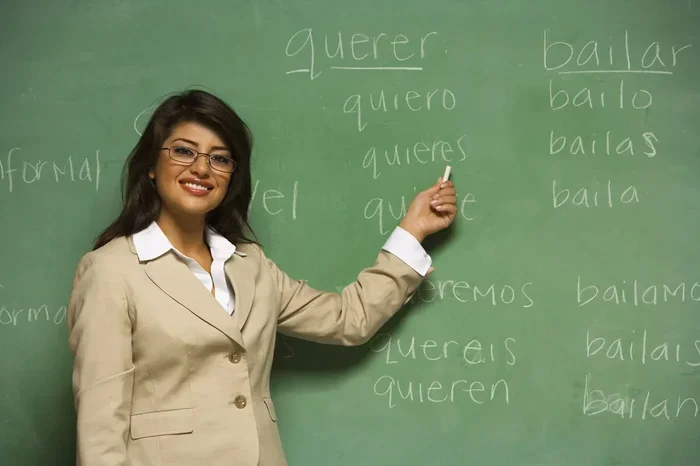
Visual guide about Spanish teacher explaining grammar
Image source: thoughtco.com
Start with the three most useful tenses: present simple, past simple, and future with “will” or “going to.” These cover many everyday situations. Once you feel comfortable there, you can move to continuous and perfect forms.
Present Simple and Present Continuous
Use the present simple for habits, facts, and repeated actions. Use the present continuous for actions happening now or temporary situations. Spanish speakers sometimes mix these up because the difference is not always the same in Spanish.
For example, say “I work every day” for a routine. Say “I am working now” for an action in progress. If you want more practice with tricky usage, you can also review hardest words to pronounce in English for Spanish speakers, since clear pronunciation often supports better grammar practice too.
Past Simple and Present Perfect
This is a major pain point. The past simple talks about a finished time. The present perfect connects the past to now. In Spanish, the connection between these ideas can feel different, so English usage may seem strange at first.
Say “I visited Mexico last year” when the time is finished. Say “I have visited Mexico” when the exact time does not matter and the experience matters now. A good rule is to look for time words. If you see “yesterday,” “last week,” or a specific date, past simple is usually safer.
Future Forms Made Simple
English has several future forms, but you do not need all of them right away. “Will” works for quick decisions, predictions, and promises. “Going to” works for plans and intentions. If you keep it simple, you will sound clear and natural.
Try this practice tip: write three sentences about tomorrow using “going to,” and three predictions using “will.” Keep them short. Short sentences are easier to review and correct.
Articles, Nouns, and Gender-Free Thinking
One of the biggest mindset shifts in English grammar for Spanish speakers is learning that English nouns do not have gender. You do not need to decide whether a table is masculine or feminine. That part is easier. The harder part is learning when to use “a,” “an,” and “the.”
Spanish speakers often use articles differently because Spanish relies on them in many contexts where English does not. Sometimes English uses no article at all. That can feel strange if you are used to article-heavy patterns.
When to Use A, An, and The
Use “a” or “an” for one non-specific thing. Use “the” when the listener knows which thing you mean. If you are introducing something new, “a” is usually the safer choice. If you are pointing to something already known, use “the.”
For example, say “I saw a dog” when the dog is new information. Say “The dog was friendly” after the dog has already been mentioned. This simple pattern helps your writing feel organized.
Countable and Uncountable Nouns
English divides nouns into countable and uncountable groups. You can count “apple” and “book,” so you can say “one apple” or “three books.” You usually cannot count “water,” “advice,” or “information” in the same way. This often surprises Spanish speakers.
If a noun is uncountable, do not add an “s” to make it plural. Also, use singular verb forms. For example, say “The advice was helpful,” not “The advices were helpful.” These small fixes make your English sound much more natural.
False Friends and Vocabulary Traps
Vocabulary can trick you even when your grammar is strong. Some English words look or sound like Spanish words, but they mean something different. These are called false friends, and they can create funny or confusing mistakes.
For example, “actually” does not mean “en este momento.” It means “in fact.” “Embarrassed” does not mean “embarazada.” It means “avergonzado.” These differences matter because they change your meaning fast.
If you want a deeper list of confusing terms, you may find it useful to study hard words in English for Spanish speakers alongside this grammar guide. Vocabulary and grammar work best when you learn them together.
Build Phrases Instead of Single Words
A smart way to avoid mistakes is to learn whole phrases. If you learn “make a decision,” you are less likely to say “do a decision.” If you learn “take a break,” you will not say “make a break” by accident. Phrases give you ready-made grammar patterns.
Try keeping a small notebook of three phrases each day. Write the phrase, the meaning, and one example sentence. Review it out loud. Speaking the phrase helps your mouth and brain remember it together.
Use Context to Guess Meaning
When you meet a new word, do not stop to translate immediately. Look at the whole sentence. Ask what makes sense in that situation. Context often gives you the correct meaning faster than a dictionary.
This habit also improves your reading fluency. You start to understand English in English, which is a major step toward confidence.
Common Grammar Mistakes and How to Fix Them
Even advanced learners repeat the same mistakes sometimes. That is normal. The goal is not perfection. The goal is steady improvement. Below are some common problems in English grammar for Spanish speakers and simple ways to correct them.
Subject-Verb Agreement
English changes the verb for third person singular in the present tense. You say “he works,” not “he work.” Spanish speakers sometimes forget the “s” because the change feels small. It is small, but it matters.
A quick fix is to listen for the ending when you practice. Read your sentences aloud. If you say “she work” out loud, you may hear that it sounds off. That ear training is very useful.
Prepositions Are Not Always Logical
Prepositions are hard because they often follow convention, not strict logic. You wait “for” a bus, but you wait “at” a bus stop. You are “in” a team, but you are “on” a committee. These choices take time to learn.
Do not try to memorize every preposition in one day. Learn them inside common phrases. That way, the preposition comes with the verb or noun automatically.
Too Much Translation in Your Head
If you translate every sentence from Spanish before speaking, your English may sound slow or unnatural. Translation also increases the chance of grammar errors. It is better to think in simple English patterns, even if your sentences are short.
Start by describing what you see around you in basic English. Keep the sentences short. Short, correct sentences are better than long, uncertain ones.
Daily Practice Plan That Actually Works
Grammar improves fastest when practice is frequent and realistic. You do not need long study sessions. You need regular contact with the language. A simple routine can help you make English grammar for Spanish speakers feel much more manageable.
Try this easy weekly plan:
- Day 1: Review one verb tense and write five example sentences.
- Day 2: Read a short article and underline subject-verb pairs.
- Day 3: Practice articles by rewriting three paragraphs with a, an, and the.
- Day 4: Learn five useful phrases with prepositions.
- Day 5: Record yourself speaking for one minute about your day.
- Day 6: Review mistakes from the week and correct them.
- Day 7: Rest, or enjoy English through a song, video, or podcast.
This plan keeps study light but consistent. Consistency matters more than intensity. A small daily habit beats a huge weekly crash course.
Speak Before You Feel Ready
Many learners wait until they feel perfect before speaking. That delay slows progress. Speaking early helps you discover which grammar points you really need. It also builds confidence fast.
You can talk to yourself, describe your plans, or send voice messages to a friend. The goal is to use English, not just study it. Real use turns rules into habits.
Get Feedback Without Fear
Feedback helps you notice blind spots. Ask a teacher, language partner, or app to correct only a few important errors at a time. If you get too much correction at once, it can feel discouraging.
Focus on one issue each week. Maybe this week you work on third person “s.” Next week you work on articles. Narrow focus makes improvement easier to measure.
Quick Tips for Faster Progress
If you want results without burnout, keep your practice simple and practical. Here are a few high-value habits that support English grammar for Spanish speakers:
- Write short journal entries in English three times a week.
- Read one page daily and notice sentence structure.
- Learn verbs with their common prepositions.
- Review your own mistakes instead of only studying new rules.
- Use voice notes to practice speaking when you are alone.
- Keep sentences short until your confidence grows.
- Celebrate small wins so motivation stays strong.
These habits are easy to maintain. They also create real repetition, which is the engine of language learning.
Expert Insights: What Strong Learners Do Differently
Strong learners usually do not know more rules than beginners. They simply use English more often and notice patterns more carefully. They pay attention to what sounds natural. They also accept that mistakes are part of learning.
One useful insight is this: accuracy grows through repetition, not just explanation. You can understand a rule and still forget it in conversation. But if you use the rule many times, it becomes easier to access. That is why speaking and writing matter so much.
Another helpful insight is to study grammar in context. A grammar chart can be useful, but a real sentence shows you how the rule lives in daily communication. When possible, learn grammar from real conversations, stories, emails, or articles.
Final Thoughts on English Grammar for Spanish Speakers
Improving English grammar for Spanish speakers is not about memorizing endless rules. It is about noticing the biggest differences, practicing them often, and using English in real situations. When you focus on subjects, verb tenses, articles, and common mistakes, your confidence grows quickly.
Keep your sentences clear. Learn phrases, not just words. Review your errors without frustration. And most of all, keep going. Small steps every day create strong results over time. If you stay consistent, English grammar will feel less like a barrier and more like a tool you can use with ease.
Frequently Asked Questions
What is the hardest part of English grammar for Spanish speakers?
Many Spanish speakers struggle most with verb tenses, articles, and subject pronouns because English uses them differently. The good news is that these patterns become easier with regular practice and simple examples.
How can I stop translating from Spanish when I speak English?
Try to think in short English phrases instead of full Spanish sentences. Describe what you see, what you do, and what you plan to do using basic English. Over time, this reduces mental translation and improves fluency.
Should I learn all English verb tenses at once?
No, it is better to start with the most useful tenses first. Focus on present simple, past simple, and a simple future form before moving to perfect or continuous tenses. A step-by-step approach is less overwhelming and more effective.
Why do English articles feel so difficult?
English articles follow usage patterns that do not always match Spanish. The best way to learn them is to notice how “a,” “an,” and “the” appear in real sentences. Practice with short writing tasks and pay attention to what feels specific or general.
How do I know if I am making the same grammar mistake repeatedly?
Record your speaking or save your writing and review it after a few days. You will often spot repeated issues more easily when you look at your own work. Asking for focused feedback can also help you catch patterns early.
What is the fastest way to improve English grammar for Spanish speakers?
The fastest way is steady practice with real use, not just studying rules. Write a little, speak a little, and review your mistakes regularly. If you combine grammar practice with vocabulary and pronunciation, your progress will feel more natural and lasting.