4 4ohm Speakers in Parallel

Connecting four 4 ohm speakers in parallel can double your system’s power handling while keeping the load at a safe 1 ohm. This guide walks you through the math, wiring methods, and practical tips to get the best sound without hurting your amp.
Key Takeaways
- Impedance math is simple: Four 4 ohm speakers in parallel equal 1 ohm total load.
- Check amp ratings: Your amplifier must safely drive a 1 ohm load.
- Use proper gauge wire: Thicker wire reduces resistance and heat.
- Series‑parallel combos can help: If 1 ohm is too low, mix series and parallel wiring.
- Protect your gear: Fuses, resistors, or a dedicated speaker selector keep things safe.
- Placement matters: Even spacing and proper mounting improve sound quality.
- Test before final install: Verify polarity and listen for distortion.
📑 Table of Contents
Introduction: Why Four 4 ohm Speakers?
Imagine you have a small car audio system with a 50‑watt amp, but you want more volume and richer bass. Adding more speakers is a quick fix, but the wiring method matters. When you wire four 4 ohm speakers in parallel, the total impedance drops to 1 ohm, letting the amp deliver more current and, therefore, more power.
That sounds great, right? Not so fast. Not every amp can handle a 1 ohm load. If you push too much current, the amp can overheat, distort, or even burn out. This article breaks down the theory, shows you step‑by‑step wiring diagrams, and gives practical tips so you can enjoy louder, cleaner sound without risking your equipment.
Understanding Impedance and Parallel Wiring
What Is Impedance?
Impedance, measured in ohms (Ω), is the resistance a speaker offers to alternating current. A lower impedance means the speaker draws more current from the amp. Most car and home audio amps are designed for 4 Ω or 8 Ω loads, but many can also tolerate 2 Ω or 1 Ω if they are built for it.
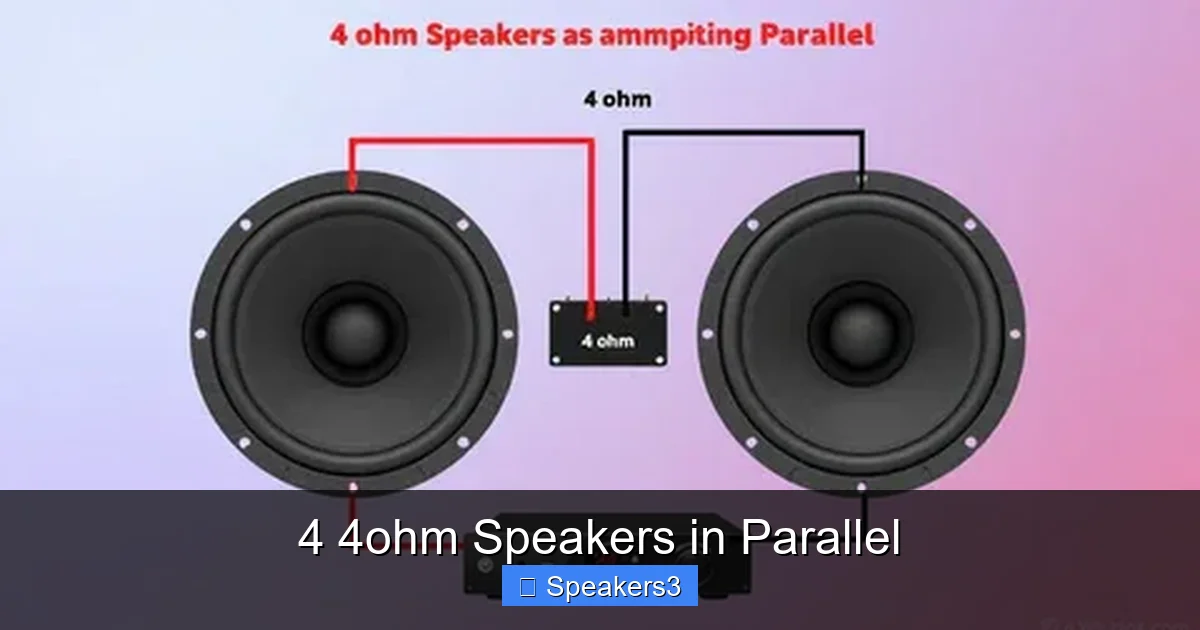
Visual guide about 4 4ohm Speakers in Parallel
Image source: cdn.shopify.com
How Parallel Wiring Affects Impedance
When speakers are wired in parallel, the total impedance (Ztotal) is calculated with the formula:
Ztotal = 1 ÷ (1/Z₁ + 1/Z₂ + … + 1/Zₙ)
For four identical 4 Ω speakers, the math looks like this:
- 1/Z₁ = 1/4 = 0.25
- Four speakers: 0.25 × 4 = 1.00
- Ztotal = 1 ÷ 1 = 1 Ω
So, four 4 ohm speakers in parallel present a 1 ohm load to the amplifier.
Why You Might Choose Parallel Over Series
Series wiring adds the impedances together (4 Ω + 4 Ω + 4 Ω + 4 Ω = 16 Ω), which usually makes the load too high for the amp to reach its power potential. Parallel wiring, on the other hand, lowers the impedance, allowing the amp to push more current and produce louder sound—provided the amp can handle it.
Preparing Your Equipment
Check Your Amplifier’s Specifications
Before you connect anything, read the amp’s manual. Look for a line that says “Minimum Load Impedance” or “Stable Load.” If it lists 1 Ω as a safe minimum, you’re good to go. If it only mentions 2 Ω, consider a series‑parallel hybrid (explained later) or a different amp.

Visual guide about 4 4ohm Speakers in Parallel
Image source: auctions.c.yimg.jp
Select the Right Wire Gauge
Lower impedance means higher current, so you need thicker wire to prevent voltage drop and heat. A good rule of thumb:
- Up to 2 Ω loads: 12‑ gauge (AWG) copper wire
- For longer runs (over 5 ft): consider 10‑ gauge
Using thin speaker wire can cause resistance that reduces power and may overheat the wire.
Gather the Tools
You’ll need:
- Wire cutters/strippers
- Soldering iron and heat‑shrink tubing (optional but gives solid connections)
- Multimeter (to verify continuity and polarity)
- Fuse holder and appropriate fuse (protects the amp)
Step‑by‑Step Wiring Guide
Method 1: Straight Parallel Wiring
This is the simplest layout. All positive terminals connect together, and all negatives connect together.

Visual guide about 4 4ohm Speakers in Parallel
Image source: cetu110.com
- Strip about ½ inch of insulation from each speaker wire.
- Twist all positive (+) leads together. Do the same with all negative (–) leads.
- Attach the combined positive bundle to the amp’s positive output terminal.
- Attach the combined negative bundle to the amp’s negative output terminal.
- Install a fuse (e.g., 30 A) on the positive lead near the amp for protection.
Now you have four 4 ohm speakers in parallel, presenting a 1 Ω load.
Method 2: Series‑Parallel Hybrid (If 1 Ω Is Too Low)
If your amp’s minimum is 2 Ω, pair the speakers in two series groups, then wire those groups in parallel.
- Connect Speaker 1 (+) to Speaker 2 (–). This creates a 8 Ω series pair.
- Do the same with Speaker 3 (+) and Speaker 4 (–). You now have two 8 Ω pairs.
- Wire the two pairs in parallel: combine the free (+) leads and the free (–) leads.
- The resulting load is 4 Ω, safe for most amps.
This hybrid approach keeps the wiring simple while staying within safe impedance limits.
Testing Your Connections
Before you power up, use a multimeter to check resistance between the amp’s output terminals. You should read close to 1 Ω (or 4 Ω for the hybrid). Also, verify that all speakers are wired with the same polarity; reversed wires cause phase cancellation and thin sound.
Practical Tips for Optimal Performance
Use a Speaker Selector Switch
If you want flexibility—sometimes run all four speakers, other times only two—a speaker selector lets you switch configurations without rewiring. Look for a model that can handle low‑impedance loads.
Mind the Power Ratings
Each speaker’s wattage rating should exceed the power it will receive. For a 50‑watt amp driving a 1 Ω load, each speaker could see up to 25 W on average, but peaks can be higher. Choose speakers with a higher RMS rating for safety.
Placement and Enclosure Considerations
Even spacing reduces interference and creates a balanced soundstage. If you’re installing them in a car, secure them with proper brackets—see speaker stands for surround speakers for ideas on mounting.
Addressing Potential Distortion
If you notice crackling or distortion, first check the connections for loose wires or poor solder joints. Also, verify that the amp isn’t hitting its current limit. For more on why speakers crackle, read why do my speakers crackle.
Heat Management
Running low‑impedance loads generates more heat in the amp. Ensure the amp has adequate ventilation—mount it in a location with airflow, and consider adding a small fan if the enclosure is tight.
Common Mistakes and How to Avoid Them
Forgetting Polarity
One reversed speaker flips the phase, canceling out bass and making the sound thin. Double‑check with a battery or multimeter that all positives are together and all negatives are together.
Using Undersized Wire
Thin wire adds resistance, which can lower volume and overheat. Always follow the gauge recommendations above.
Overloading the Amplifier
Even if the amp says 1 Ω is OK, keep the volume moderate during the first few minutes. Let the amp warm up, then gradually increase the level while listening for any signs of strain.
Skipping the Fuse
A fuse protects both the amp and speakers from a short circuit. It’s a cheap insurance policy you shouldn’t ignore.
Advanced Topics: Bi‑amping and Crossover Networks
What Is Bi‑amping?
Bi‑amping uses separate amplifiers for the low‑frequency (woofer) and high‑frequency (tweeter) sections of a speaker. If your four 4 Ω speakers are part of a component system with separate drivers, you can wire the woofers in parallel and the tweeters in parallel, then feed each group to its own amp channel.
Using Passive Crossovers
Passive crossovers split the audio signal so each driver receives the correct frequency range. When wiring multiple speakers, place the crossover before the parallel network to ensure each driver gets the right signal.
Conclusion: Get Loud, Stay Safe
Wiring four 4 ohm speakers in parallel is a powerful way to boost your system’s output, but it requires careful planning. Verify your amp’s impedance rating, use proper gauge wire, protect the circuit with a fuse, and test every connection. By following the steps and tips in this guide, you’ll enjoy louder, clearer sound without the risk of blowing your gear.
Ready to start wiring? Grab your tools, double‑check the specs, and let the music play!
Frequently Asked Questions
Can I connect four 4 ohm speakers in parallel to any amplifier?
No. The amp must be rated to handle a 1 Ω load. Check the manual or manufacturer’s specs before wiring.
What happens if I use thin speaker wire with a 1 Ω load?
Thin wire adds resistance, causing power loss and heat buildup, which can lead to distortion or even a fire hazard.
Is a series‑parallel wiring method safer for low‑impedance amps?
Yes. Pairing speakers in series and then wiring those pairs in parallel raises the total impedance, often to 4 Ω, which many amps can handle safely.
Do I need a fuse when wiring speakers in parallel?
Absolutely. A fuse protects both the amplifier and speakers from short circuits and overloads.
How can I tell if my speakers are out of phase?
Play a bass‑heavy track and listen for thin or weak low frequencies. Swapping the polarity of one speaker will usually fix the issue.
Can I use a speaker selector switch with a 1 Ω load?
Only if the selector is rated for low‑impedance loads. Otherwise it may overheat or cause signal loss.