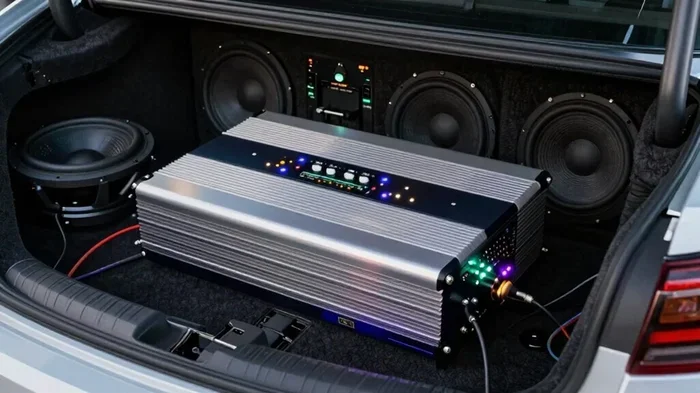
4 Speakers on 2 Channel Amp
Want to run four speakers from a two‑channel amplifier without losing power or sound quality? We break down wiring methods, impedance matching, and practical tips so you can enjoy big‑room sound on a modest amp. Follow our step‑by‑step guide and start hearing the difference today.
Key Takeaways
- Parallel vs. series wiring: Choose the right method to keep total impedance within your amp’s safe range.
- Use a line‑level converter: It lets you feed a two‑channel amp from a head unit that only has pre‑outs for two channels.
- Bi‑amping tricks: Split frequencies between speaker pairs for clearer highs and deeper lows.
- Power handling matters: Match speaker RMS ratings to amp output to avoid clipping or distortion.
- Quality wiring counts: Proper gauge and secure connections prevent signal loss.
- Safety first: Always check amp specifications and fuse ratings before installation.
- Test and tweak: Use a multimeter and listening tests to fine‑tune crossover settings and balance.
📑 Table of Contents
- Introduction: Why Run 4 Speakers on a 2‑Channel Amp?
- Understanding Impedance and Power Matching
- Wiring Four Speakers to Two Channels
- Using a Line‑Level Converter (LLC) for Better Control
- Optimizing Sound Quality: Bi‑amping and Crossovers
- Practical Installation Tips
- Choosing the Right Amp for Four Speakers
- Conclusion: Get Bigger Sound From a Small Amp
Introduction: Why Run 4 Speakers on a 2‑Channel Amp?
Imagine you’ve just upgraded your car’s audio system or upgraded a small home theater. You’ve bought a sleek two‑channel amplifier because it fits your budget and space, but now you’re staring at four great‑looking speakers and wondering, “Can I hook them all up?” The short answer is yes—if you understand how impedance works, how to wire correctly, and what the amp can safely deliver.
Running four speakers on a two‑channel amp is a popular trick among DIY enthusiasts. It lets you get a fuller soundstage without spending extra cash on a bigger amp. In this guide we’ll walk through the theory, the wiring options, and the practical steps you need to pull this off without blowing any components.
Understanding Impedance and Power Matching
What is Impedance?
Impedance, measured in ohms (Ω), is the resistance a speaker offers to the flow of alternating current. Most car speakers are 4 Ω or 8 Ω. Your amp will list a “stable impedance” range—commonly 2 Ω to 8 Ω per channel. Staying inside that range prevents the amp from overheating or entering protection mode.

Visual guide about 4 Speakers on 2 Channel Amp
Image source: i.pinimg.com
Why Total Impedance Matters
When you wire speakers together, the total load seen by the amp changes. Two 4 Ω speakers in parallel become a 2 Ω load. Two 8 Ω speakers in series become a 16 Ω load, which most amps can’t drive properly. The goal is to keep the combined impedance of each channel between the amp’s specified limits.
Matching Power Ratings
Each speaker has an RMS (continuous) power rating, often 30‑50 W for small coaxials and 70‑100 W for mids. Your amp’s RMS output per channel should be close to the speaker’s rating. Too much power leads to clipping; too little leaves you with weak bass.
Wiring Four Speakers to Two Channels
Parallel Wiring (Most Common)
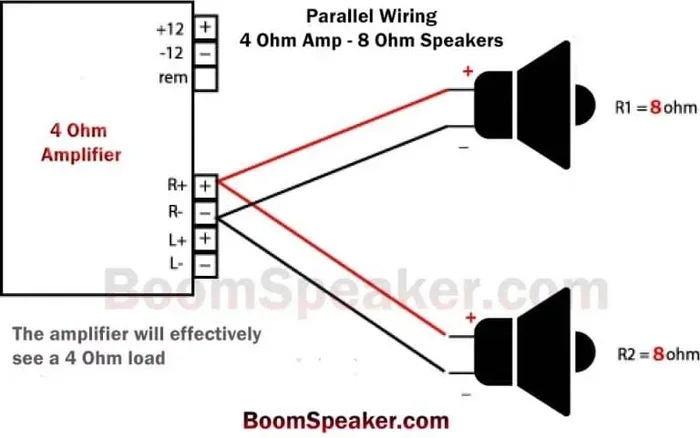
Parallel wiring connects the positive terminals of two speakers together and the negative terminals together, then runs each pair to one amp channel. This halves the total impedance:

Visual guide about 4 Speakers on 2 Channel Amp
Image source: i0.wp.com
- Two 4 Ω speakers → 2 Ω per channel.
- Two 8 Ω speakers → 4 Ω per channel.
If your amp is stable down to 2 Ω, you can safely run two 4 Ω speakers per channel. This gives you a louder, more dynamic sound because the amp can deliver more current.
Series Wiring (When Impedance Is Too Low)
Series wiring stacks the speakers end‑to‑end: the positive of the first speaker to the amp, its negative to the positive of the second speaker, and the second speaker’s negative back to the amp. The total impedance adds up:
- Two 4 Ω speakers → 8 Ω per channel.
- Two 8 Ω speakers → 16 Ω per channel (usually too high).
If your amp cannot handle 2 Ω, you might need to wire two 4 Ω speakers in series to stay at 8 Ω. For more detail on series wiring, see our article on 2 8 Ohm Speakers In Series.
Hybrid (Series‑Parallel) Wiring
When you have a mix of 4 Ω and 8 Ω speakers, you can combine series and parallel methods to hit a target impedance. For example, pair a 4 Ω and an 8 Ω speaker in series (12 Ω), then put two such pairs in parallel → 6 Ω per channel. This is a good compromise if your amp is stable down to 4 Ω but not 2 Ω.
Practical Example: Four 4 Ω Coaxial Speakers
Assume you have four 4 Ω coaxial speakers and a 2‑channel amp rated 2‑8 Ω per channel, 50 W RMS each. Here’s a step‑by‑step plan:
- Wire the front left and rear left speakers in parallel to the amp’s left channel.
- Wire the front right and rear right speakers in parallel to the amp’s right channel.
- Resulting load: 2 Ω per channel—perfect for the amp.
- Set the amp gain so the output peaks at about 45‑48 W RMS (a little below speaker rating).
- Fine‑tune the head‑unit’s EQ for a balanced sound.
Using a Line‑Level Converter (LLC) for Better Control
Why an LLC Helps
Many factory head units output only speaker‑level signals, which can cause the amp to receive too much voltage, especially when you’re sharing channels. A line‑level converter steps the signal down to a safe line‑level (RCA) output, giving you cleaner control over gain and crossover.
Visual guide about 4 Speakers on 2 Channel Amp
Image source: gd-hbimg.huaban.com
Installing the LLC
1. Locate the speaker wires that go to the front left and right speakers.
2. Connect those wires to the input side of the LLC.
3. Run RCA cables from the LLC’s output to the amp’s input.
4. Power the LLC with a fused 12 V source.
This setup isolates the amp from the head unit’s high‑level output and lets you adjust gain without risking distortion.
Optimizing Sound Quality: Bi‑amping and Crossovers
What Is Bi‑amping?
Bi‑amping splits a speaker’s frequency range into two parts—typically highs and mids/bass—using separate amplifiers. With only a two‑channel amp you can simulate a simple bi‑amp by assigning two speakers (e.g., front left and right) to handle mids, while the rear pair handles highs via a passive crossover network.
Choosing the Right Crossover
Passive crossovers are cheap and easy. A 2‑way 3 kHz crossover will send frequencies below 3 kHz to the rear speakers (often better for bass) and above 3 kHz to the front speakers (better for clarity). If you want more control, a digital signal processor (DSP) can replace the passive crossover and let you set exact slopes and delays.
Practical Installation Tips
Wire Gauge and Length
Use 16‑gauge speaker wire for runs under 10 ft, and 14‑gauge for longer runs or higher power. Thicker wire reduces resistance, preserving signal strength.
Secure Connections
Always strip the wire cleanly, twist the strands, and use crimp connectors or solder for a solid bond. Loose connections cause crackle and intermittent loss of sound.
Fuse Protection
Place an inline fuse (rated 1.5× the amp’s maximum current draw) on the power lead close to the battery. This protects both the amp and your vehicle’s wiring in case of a short.
Testing Before Final Mount
Power up the system with the vehicle off (or the power supply off) and use a multimeter to verify that each channel sees the expected impedance. Then play music at low volume and gradually increase while listening for distortion.
Reference Installation Guide
For a step‑by‑step wiring walkthrough, check out our detailed guide on How To Wire Speakers To Amp. It covers everything from stripping wires to routing them safely through the chassis.
Choosing the Right Amp for Four Speakers
Key Specs to Look For
- Power Output: Aim for 50‑80 W RMS per channel for most 4 Ω speakers.
- Impedance Stability: Ensure the amp lists 2 Ω as a stable load if you plan parallel wiring.
- Adjustable Gain: Allows you to match the amp’s output to speaker RMS.
- Built‑in Crossover: Some two‑channel amps include a high‑pass/low‑pass switch, simplifying bi‑amp setups.
Popular Choices
Brands like Alpine, Rockford Fosgate, and Pioneer offer compact 2‑channel amps that meet these criteria. If you’re unsure, read reviews and compare specs on a site like Recommended Car Amp For 6 Speakers for guidance on power handling and reliability.
Conclusion: Get Bigger Sound From a Small Amp
Running four speakers on a two‑channel amplifier is entirely doable and can deliver impressive audio performance when you respect impedance limits, use proper wiring, and fine‑tune gain and crossover settings. Whether you’re upgrading a car, a boat, or a modest home theater, the steps outlined here give you a solid roadmap. Remember to double‑check your amp’s specifications, use quality wire, and protect the system with fuses. With a little patience, you’ll hear a richer, fuller sound that far exceeds what a single‑channel setup could provide.
Frequently Asked Questions
Can I connect four 8 Ω speakers to a 2‑channel amp?
Yes, but you’ll need to wire them in series (or use a series‑parallel hybrid) so each channel sees an 8 Ω load, which most amps can handle safely.
Will wiring speakers in parallel damage my amp?
If the resulting impedance drops below the amp’s minimum rating (often 2 Ω), the amp may overheat or go into protection mode. Always check the amp’s spec sheet first.
Do I need a crossover when using four speakers on a 2‑channel amp?
A crossover isn’t strictly required, but it helps separate bass from treble, improving clarity and preventing the amp from trying to reproduce frequencies it’s not optimized for.
How do I know which speaker should go on which channel?
Place the speakers that handle mids and lows on one channel and the ones handling highs on the other, or simply pair left‑side speakers together and right‑side speakers together for a balanced stereo image.
Is a line‑level converter necessary?
It’s highly recommended when the head unit only provides speaker‑level outputs. An LLC protects the amp and gives you cleaner gain control.
What gauge wire should I use for a 4‑speaker setup?
Use 16‑gauge wire for short runs (<10 ft) and 14‑gauge for longer runs or higher power levels to minimize resistance and signal loss.