JL Audio Marine 7.7 speakers deliver concert‑level sound on the water while standing up to splashes, sun, and salt. Designed with marine‑grade components, they offer crisp highs, deep mids, and punchy bass that transform any boat ride into a private concert.
Key Takeaways
- Marine‑grade durability: UV‑resistant cones and rust‑proof hardware keep the speakers safe in harsh water environments.
- Power handling: 120 W RMS (300 W peak) gives clean volume without distortion.
- Versatile mounting: Brackets fit most boat decks, from pontoons to sport‑fishing vessels.
- Easy wiring: Compatible with 4‑ohm and 8‑ohm systems; wiring tips help avoid common mistakes.
- Sound quality: Three‑way design with separate tweeter, mid‑range, and woofer delivers balanced audio.
- Value proposition: While premium‑priced, the longevity and performance often outweigh the cost.
- Installation tips: Proper sealing, amp matching, and placement are key for optimal performance.
📑 Table of Contents
- Introduction: Why Marine Audio Matters
- 1. Understanding the JL Audio Marine 7.7 Series
- 2. Real‑World Performance: Sound Quality on the Water
- 3. Installation Guide: Getting the 7.7 On Your Boat
- 4. Maintenance and Longevity
- 5. Value Assessment: Are the JL Audio Marine 7.7 Worth It?
- 6. Practical Tips for Getting the Most Out of Your 7.7 Speakers
- Conclusion
Introduction: Why Marine Audio Matters
Imagine cruising on a sunny lake, the wind in your hair, and your favorite playlist blasting crystal‑clear sound across the water. A great soundtrack can turn a simple boat ride into a memorable experience. But the marine environment is unforgiving—salt, humidity, and constant vibration can quickly ruin ordinary speakers.
That’s where JL Audio steps in with the Marine 7.7 series. These speakers are engineered specifically for boats, combining robust construction with high‑fidelity sound. In this guide we’ll unpack every detail you need to decide if the JL Audio Marine 7.7 speakers are right for your vessel, from technical specs to real‑world installation tips.
1. Understanding the JL Audio Marine 7.7 Series
1.1. What Sets the 7.7 Apart?
The “7.7” name refers to the speaker’s size: 7‑inch woofer paired with a 0.75‑inch (¾”) tweeter. JL Audio bundles these in a three‑way configuration, meaning each frequency range gets its own dedicated driver. This separation reduces distortion and delivers clearer highs, tighter mids, and punchier bass compared to two‑way designs.
1.2. Core Specifications
- Woofer: 7 in. polypropylene cone with a rubber surround for flexibility.
- Tweeter: ¾ in. silk dome, UV‑coated for sun resistance.
- Power handling: 120 W RMS, 300 W peak.
- Impedance: 4 Ω (compatible with 8 Ω in series/parallel setups).
- Frequency response: 55 Hz – 22 kHz.
- Sensitivity: 90 dB SPL @ 2.83 V/1 m.
- Water resistance: IPX7 rating (immersible up to 1 m for 30 min).
1.3. How It Compares to Other JL Audio Marine Models
If you’ve looked at JL Audio’s 6‑5 marine speakers, you’ll notice the 7.7 offers a larger woofer for deeper bass and a slightly higher sensitivity, meaning you can get louder sound with the same amp power. Both models share the same marine‑grade materials, but the 7.7 is better suited for larger boats or anyone who wants a richer low‑end response.
2. Real‑World Performance: Sound Quality on the Water
2.1. Clarity and Balance
The separate tweeter and mid‑range driver give the 7.7 a clean, airy top end that cuts through wind noise. Meanwhile, the 7‑inch woofer provides enough punch to feel the beat without muddying the mids. Listeners often compare the sound to “a small concert hall on deck.”
Visual guide about Jl Audio Marine 7.7 Speakers
Image source: img.alicdn.com
2.2. Bass Response
Marine speakers usually struggle with low frequencies because water dampens vibrations. JL Audio’s patented “Vented Cone” design helps the woofer move air efficiently, delivering a surprisingly tight bass that you can feel even at moderate volumes.
2.3. Volume Capability
With 120 W RMS handling, the 7.7 can comfortably drive a 200‑watt marine amplifier. You’ll get clean sound up to about 90 dB SPL, which is loud enough for most recreational boats. Pushing beyond peak power may cause distortion, so matching the amp correctly is crucial.
3. Installation Guide: Getting the 7.7 On Your Boat
3.1. Choosing the Right Location
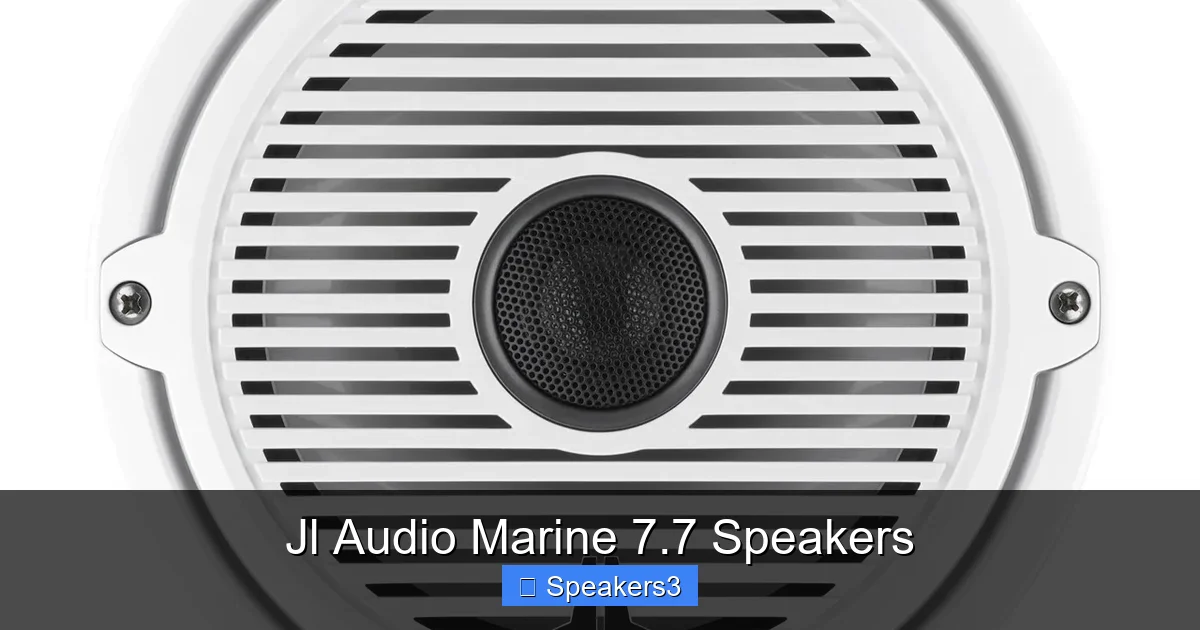
Placement matters. For optimal imaging, mount the speakers symmetrically on either side of the helm. Keep them at ear level when seated, and avoid direct exposure to spray nozzles if possible.
Visual guide about Jl Audio Marine 7.7 Speakers
Image source: audiojamonline.com
3.2. Mounting Hardware
JL Audio includes stainless‑steel brackets designed for both flat decks and curved surfaces. Use marine‑grade silicone sealant around the mounting holes to prevent water ingress.
3.3. Wiring Tips
Because the 7.7 is a 4‑ohm speaker, you can wire two speakers in series to achieve an 8‑ohm load if your amp prefers higher impedance. For a quick refresher on series wiring, see our article on 2 8 Ohm Speakers In Series. Use 12‑gauge marine‑rated wire, and always double‑check polarity to keep the phase correct.
3.4. Weather‑Proofing
Even though the speakers are IPX7 rated, extra protection never hurts. Run the speaker wire through a conduit, and apply a thin layer of marine sealant over the speaker terminals after wiring.
3.5. Matching the Amplifier
Does wattage matter for marine setups? Absolutely. Our guide on Does Wattage Matter For Car Speakers explains why you should pair the 7.7 with an amp that can deliver at least 100 W RMS per channel at 4 Ω. This ensures clean headroom and protects the speakers from clipping.
4. Maintenance and Longevity
4.1. Routine Checks
Every few months, inspect the speaker grills for salt buildup. Rinse with fresh water and dry with a soft cloth. Check the mounting bolts for tightness, especially after long trips.
4.2. Dealing with Corrosion
If you notice any rust on the hardware, remove it with a marine‑grade rust remover and re‑apply a protective coating. The speakers themselves are coated with a UV‑resistant polymer that resists fading.
4.3. When to Replace
Even the toughest marine speakers have a lifespan. If you hear persistent distortion at low volumes or the woofer feels loose, it may be time to replace the unit. Because the 7.7 uses a modular design, you can often replace just the damaged driver instead of the entire speaker.
5. Value Assessment: Are the JL Audio Marine 7.7 Worth It?
5.1. Cost vs. Benefit
The 7.7 sits in the premium bracket, typically priced around $250‑$300 per pair. Compared to budget marine speakers, the price difference is notable, but you gain superior sound, durability, and a longer warranty (usually 3‑years).
5.2. Customer Feedback
Most owners praise the clarity and bass depth, especially after a few weeks of seasoning. A common complaint is the need for a solid amp to unlock the full potential—something to keep in mind if you’re on a tight budget.
5.3. Alternatives to Consider
If you’re looking for a slightly smaller footprint, the JL Audio 6‑5 marine speakers (see Jl Audio 6 5 Marine Speakers) are a solid option. For even more power, pairing the 7.7 with a dedicated marine amplifier like the JL Audio RD1000/2 will push the performance further.
6. Practical Tips for Getting the Most Out of Your 7.7 Speakers
6.1. Use a Dedicated Marine Equalizer
Marine environments often dampen certain frequencies. A simple 3‑band EQ (bass, mid, treble) can compensate for the loss and keep the music balanced.
6.2. Optimize Speaker Angle
Tilting the speakers slightly inward (about 10‑15 degrees) creates a focused soundstage that reaches every seat on the boat.
6.3. Pair with Quality Audio Sources
Even the best speakers can’t fix a low‑bitrate MP3 file. Use FLAC or high‑resolution streams for the clearest audio.
6.4. Keep the Amplifier Cool
Marine amps can overheat under direct sun. Mount the amp in a ventilated compartment and consider a small fan if you’re in a hot climate.
Conclusion
The JL Audio Marine 7.7 speakers are a standout choice for anyone serious about boat audio. Their marine‑grade construction, three‑way design, and robust power handling deliver a listening experience that rivals land‑based systems. While the upfront cost is higher than some entry‑level options, the combination of durability, sound quality, and warranty makes them a smart long‑term investment.
By following the installation and maintenance tips outlined above—and pairing the speakers with a suitable amplifier—you’ll enjoy rich, immersive sound on every voyage. Whether you’re cruising the coast or fishing on a lake, the JL Audio Marine 7.7 speakers will make every trip sound better.
Frequently Asked Questions
What is the IP rating of JL Audio Marine 7.7 speakers?
The speakers are rated IPX7, meaning they can be immersed in up to 1 meter of water for 30 minutes without damage.
Can I use the 7.7 speakers with a 2‑channel marine amp?
Yes, as long as the amp can deliver at least 100 W RMS per channel at 4 Ω, the speakers will perform optimally.
Do I need to wire the speakers in series or parallel?
Both options work. Wiring two 4‑Ω speakers in series creates an 8‑Ω load, which some amplifiers prefer. See our guide on 2 8 Ohm Speakers In Series for details.
How often should I inspect the mounting hardware?
Check the bolts and brackets every 3‑4 months, especially after long trips in salty water, to ensure they remain tight.
Will the speakers affect my boat’s fuel efficiency?
No. The speakers are passive devices and draw power only from the amp; they don’t impact the engine or fuel consumption.
Are there any warranty considerations?
JL Audio typically offers a 3‑year limited warranty on marine speakers, covering defects in materials and workmanship.