How Much Does It Cost to Start a Saas
The cost to start a SaaS business varies wildly, typically ranging from $5,000 for a solo founder’s bare-bones MVP to over $500,000 for a well-funded team launching a complex product. The single biggest factor is your team’s composition—hiring developers, designers, and marketers dramatically increases burn rate. Key expenses include product development (the largest chunk), legal/compliance, cloud infrastructure, and sales/marketing. Most founders significantly underestimate ongoing operational costs like support, security, and third-party tool subscriptions. A phased approach, starting with a minimal viable product (MVP) to validate demand before heavy investment, is the most financially prudent strategy.
Key Takeaways
- The cost range is enormous: You can technically start for under $10k if you’re a technical founder working solo, but a realistic, competitive launch with a small team often requires $50k-$150k+.
- Product development is the #1 expense: Hiring engineers and designers to build a reliable, scalable product consumes 50-70% of an initial budget. A simple MVP is far cheaper than a feature-rich v1.0.
- Hidden costs are budget killers: Legal entity setup, trademarks, data privacy compliance (GDPR, CCPA), payment processor fees, and customer support tools add up quickly and are often forgotten in initial plans.
- Your team model dictates cost: A fully remote, outsourced dev team from Eastern Europe costs less than a local team in San Francisco, but may introduce communication and IP challenges.
- Marketing & Sales is a separate, massive budget: Building the product is only half the battle. Acquiring customers (CAC) can easily exceed development costs, requiring dedicated funds for content, ads, or sales hires.
- Bootstrapping vs. Funding changes the equation: Bootstrappers must prioritize extreme cost-control and revenue from day one. Funded startups can invest heavily in growth but face investor pressure and dilution.
- Plan for the long runway: Your initial capital must cover 12-18 months of *total* operating expenses (salary, hosting, tools, marketing) before expecting significant revenue, not just the build phase.
📑 Table of Contents
- So, You Want to Build a SaaS? Let’s Talk Real Money.
- Breaking Down the Beast: The Major Cost Categories of a SaaS Startup
- Scenario Planning: Three Realistic Cost Models
- The Funding Source Dictates Your Strategy (And Your Cost Control)
- Where Founders Blow Their Budgets: The Top 5 Costly Mistakes
- The Bottom Line: Your Action Plan to Calculate *Your* Cost
- Conclusion: Start Small, Learn Fast, Spend Wisely
So, You Want to Build a SaaS? Let’s Talk Real Money.
You have a brilliant idea for a software tool that solves a painful problem. You’ve seen the success stories—companies that started in a garage and became unicorns. The natural first question, buzzing in your head like a persistent mosquito, is: “How much is this actually going to cost me?” It’s the most critical and most anxiety-inducing question for any aspiring SaaS founder. The short, frustrating answer is: it depends. wildly. The long, useful answer is what this entire guide is about. Think of this not as a single price tag, but as a menu of costs you’ll need to navigate, with your specific choices filling the final bill.
We’re going to dissect every major cost center, from the code on the screen to the lawyer’s retainer. We’ll look at the rock-bottom bootstrap scenario, the typical seed-stage startup, and everything in between. The goal isn’t to give you a fake, precise number, but to equip you with the framework to build a *realistic financial model* for your unique venture. Because in the world of SaaS, knowing your numbers isn’t just smart—it’s the difference between a sustainable business and a very expensive hobby.
Breaking Down the Beast: The Major Cost Categories of a SaaS Startup
Before we dive into dollar signs, we must categorize the beast. Your total startup cost is the sum of several distinct buckets. Understanding these buckets helps you prioritize and, crucially, identify where you can cut corners without breaking the product. The five primary pillars are: Product Development, Team & Operations, Legal & Administrative, Go-to-Market (GTM), and a Contingency Buffer. Neglecting any one of these is a classic founder mistake.

Visual guide about How Much Does It Cost to Start a Saas
Image source: dfysaas.com
1. The Product: Your Core Engine
This is the software itself—the thing users will log into and hopefully love. It’s also where most of your initial capital vanishes. Costs here are driven by complexity, technology choices, and who builds it.
- MVP (Minimum Viable Product) vs. v1.0: An MVP is the simplest, ugliest version that solves the core problem for early adopters. A v1.0 is polished, feature-complete, and ready for mass market. The cost difference can be 10x. An MVP might be one core workflow. v1.0 needs user management, billing, robust dashboards, integrations, and polish.
- Build vs. Buy vs. No-Code: Will you code from scratch? Use frameworks (like Next.js, Django, Ruby on Rails)? Leverage third-party APIs for complex functions (e.g., Stripe for payments, Twilio for messaging)? Or use no-code platforms like Bubble or Softr? Each path has a vastly different cost and scalability profile.
- In-house vs. Outsourced vs. Hybrid: Hiring a local, full-time CTO and dev team is the most expensive path. Hiring an agency or offshore development firm is often cheaper but can lead to quality and control issues. A hybrid model—a technical co-founder or lead dev managing a mix of in-house and contract talent—is common.
2. The Team: You Can’t Do It All (Even If You Think You Can)
Unless you are a unicorn-level full-stack wizard, designer, marketer, and support agent rolled into one, you need help. Salaries and contractor fees are the single largest recurring expense for most startups.
- Technical Talent: A mid-level software engineer in the US costs $100k-$150k+ annually in salary + benefits. A senior engineer is $150k-$250k+. Offshore rates (Eastern Europe, Latin America) can be $30k-$70k for comparable skill, but require strong management.
- Design & UX: A dedicated product designer is non-negotiable for a polished product. Freelance rates: $75-$150/hr. Full-time salary: $80k-$130k.
- The “Non-Tech” Crew: You’ll eventually need someone for marketing, sales, and customer support. Even part-time or fractional roles add up.
3. The Boring (But Essential) Stuff: Legal, Admin & Infrastructure
This is the “cost of doing business” that founders forget until they get a bill from a lawyer or their cloud provider spikes. It’s not sexy, but it’s vital.
- Legal & Entity Formation: Incorporating (LLC, C-Corp), drafting founder agreements, IP assignment, basic terms of service and privacy policy. A startup lawyer retainer can be $5k-$15k+ initially.
- Compliance & Security: SOC 2 audits (often required for enterprise sales), GDPR/CCPA compliance tools, security penetration testing. Can cost $10k-$50k+ annually.
- Cloud & Hosting (Your Utility Bill): AWS, Google Cloud, Azure, or Vercel/Netlify. Starts cheap ($50-$500/month) but scales linearly (or worse) with users and data. This is an operational expense, not a one-time cost.
- Software Tools: GitHub, Jira, Figma, Slack, Zoom, accounting software (QuickBooks), HR platforms. Budget $500-$2000/month for a small team.
4. Go-to-Market (GTM): The “If You Build It, They Might Not Come” Fund
This is the money you spend to find and convince customers. It’s often the second-largest bucket and has the highest variance. A viral, product-led growth (PLG) tool has different costs than a sales-assisted enterprise tool.
- Content & SEO: Blogging, content creation, SEO tools (Ahrefs, SEMrush). A sustainable, long-term play. Can be done cheaply in-house or cost $5k-$15k/month with an agency.
- Paid Advertising (PPC): Google Ads, LinkedIn Ads, Facebook Ads. Highly scalable but can burn cash fast with poor targeting. Test budgets start at $1k-$3k/month.
- Sales Team & Tools: Salaries for SDRs/AEs, CRM (Salesforce, HubSpot), sales engagement tools. A single sales rep with base + commission can cost $100k+ fully loaded.
- Brand & Launch: PR, launch campaigns, event sponsorships, swag. Can be minimal or a major line item.
5. The “Oh Crap” Fund: Contingency & Runway
Nothing goes exactly to plan. A key hire leaves. A core API you rely on changes pricing. Your first marketing channel flops. You need a buffer. Smart founders add a 20-30% contingency buffer to their total estimated cost. More importantly, you must calculate your Runway: the number of months your total cash will last at your projected monthly burn rate (total monthly expenses). Seed-stage investors typically want to see 12-18 months of runway post-funding. If your total monthly spend (team, hosting, tools, marketing) is $20k, you need $240k-$360k in the bank just to survive 12-18 months without a dime of revenue. Your initial capital must cover this runway, not just the build.
Scenario Planning: Three Realistic Cost Models
Abstract categories are useless without concrete numbers. Let’s model three common founder scenarios, focusing on the first 18 months (build + initial GTM + runway). These are estimates for a US-based operation; costs can be 30-50% lower with a fully remote, offshore team, but with trade-offs in time zones and management overhead.
Visual guide about How Much Does It Cost to Start a Saas
Image source: thesaasmonster.com
Scenario A: The Solo Technical Founder (Bootstrap Extreme)
Profile: You are a full-stack developer and do everything else (design, marketing, support) yourself. You live frugally. You build a simple, niche SaaS MVP in your nights/weekends, then try to get first 10 paying customers.
- Product Dev: $0 salary (your time is the cost, but no cash outlay). Tools: $500 (Figma, domain, basic hosting).
- Legal/Admin: $500 (DIY incorporation via Stripe Atlas/Clerky, generic legal templates).
- Infrastructure/Tools: $1,200 ($100/mo for 12 months for hosting, email, project tools).
- GTM: $1,000 (content creation, tiny ad tests).
- Contingency/Runway Buffer: $5,000 (personal living expenses buffer if you reduce hours at your day job).
- TOTAL CASH NEEDED: ~$8,200
Reality Check: This is the absolute floor. The product will be basic, growth will be slow (1-5 hours/day), and you’ll wear every hat. Success is possible but statistically unlikely for complex problems. The main cost is your time and opportunity cost.
Scenario B: The Small, Funded Seed Team (The “Typical” Startup)
Profile: 2-3 co-founders (1 technical, 1 business/marketing). Raise a $500k-$750k pre-seed/seed round. Hire 1-2 junior/mid-level engineers and a part-time designer. Aim to launch a solid v1.0 in 9-12 months and acquire 100-200 customers.
- Team Salaries (18 months): 4 people x avg $90k/year = $540k (this is the big one).
- Product Dev (Contractors/Consultants): $50k (for specialized work like complex integrations, security audit).
- Legal/Admin: $15k (proper incorporation, founder agreements, full ToS/Privacy Policy, initial IP work).
- Infrastructure/Tools: $18k ($1k/mo).
- GTM: $80k (content marketer salary/contractor, $3k/mo ad budget, CRM, launch events).
- Contingency (25% of total): ~$175k.
- TOTAL CASH NEEDED (18-month runway): ~$878,000
Reality Check: This is a common, credible path. It requires raising capital (dilution) and executing well. The burn rate is high (~$49k/month), so pressure to acquire customers and revenue is constant. The $500k-$1M range is a very common initial funding target for SaaS startups today.
Scenario C: The Enterprise-Focused, Heavily Funded Play
Profile: Experienced founders with a track record. Targeting large enterprises from day one. Requires SOC 2, complex security, on-premise options, and a sales team. Raise a $2M-$5M seed round.
- Team Salaries (18 months): 8-10 people (senior engineers, dedicated security/compliance officer, sales lead, customer success) x $120k avg = $1.44M+.
- Product Dev & Security: $200k+ (SOC 2 audit, penetration testing, dedicated infrastructure engineer).
- Legal/Admin: $40k+ (complex contracts, enterprise-level legal review).
- Infrastructure/Tools: $36k+ (high-reliability, multi-region hosting).
- GTM: $300k+ (hiring a sales rep with base+commission, expensive industry conference sponsorships, high-touch demo tools).
- Contingency: Built into the larger raise, but still a major factor.
- TOTAL CASH NEEDED (18-month runway): $2.5M – $4M+
Reality Check: This is a capital-intensive, high-risk, high-reward strategy. The sales cycles are long (6-18 months), so the runway must be long. The product must be exceptionally robust and secure from day one. This path is not for first-time founders without deep domain expertise or a massive network.
The Funding Source Dictates Your Strategy (And Your Cost Control)
Where your money comes from fundamentally changes how you spend it. This is a critical strategic decision, not just a financing one.
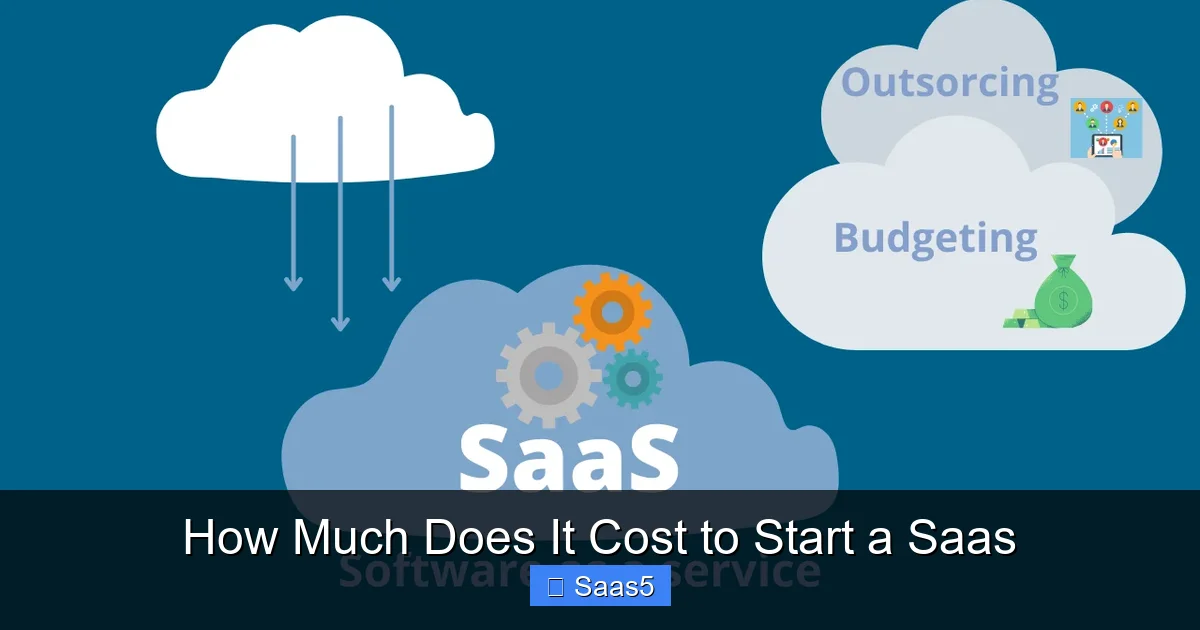
Visual guide about How Much Does It Cost to Start a Saas
Image source: thecodingbuddha.com
Bootstrapping: The Discipline Engine
Bootstrapping means using your own savings, revenue from early customers, or debt (like a Small Business Loan or revenue-based financing) to fund growth. The core rule: expenses must be covered by revenue, eventually. This forces incredible discipline. You will build an MVP with a no-code tool or a simple Rails app. You will do all support tickets yourself at 11 PM. You will measure CAC and LTV from day one. Your cost structure will look like Scenario A or a slightly scaled-up version. The advantage is 100% ownership and no pressure to grow at all costs. The disadvantage is speed—you will move slower than funded competitors. A hybrid model, “bootstrapping to a MVP,” then raising a small angel round to scale, is very popular and wise.
Angel & Seed VC: The Growth Fuel (With Strings)
Angel investors and seed VCs provide capital in exchange for equity (ownership). Their goal is rapid growth and a large exit. This changes your math. You are now optimizing for growth metrics (MRR, user growth) over immediate profitability. You can afford to hire a team, spend on marketing, and build a more robust product faster. However, your burn rate increases, and you are now on a clock. The investor’s 18-month runway expectation means you must either hit key milestones to raise the next round (Series A) or achieve profitability. Your cost model will resemble Scenario B. The key is to raise enough to hit your next *value-creating milestone* with a buffer. Under-raising is a death sentence.
Revenue-Based Financing & Grants: The Middle Path
These are less common but valuable options. Revenue-based financing (RBF) loans (from companies like Lighter Capital, Capchase) give you cash now in exchange for a percentage of future revenue. It’s not debt in the traditional sense, but a sell of future income. It’s more expensive than a bank loan but doesn’t require giving up equity or board seats. Grants (from government SBIR programs, specific tech grants) are free money but highly competitive and restrictive in use. They can perfectly fund R&D or compliance costs (like a SOC 2 audit) that VCs might be hesitant to finance directly.
Where Founders Blow Their Budgets: The Top 5 Costly Mistakes
Knowing the line items isn’t enough. You must avoid the psychological and operational traps that turn a $150k budget into a $300k burn with little to show.
Mistake 1: Over-Engineering the MVP
The siren song of “what if we just added this one feature?” is powerful. You’re building for your own imagined ideal user, not the desperate, problem-haunted early adopter who will use a clunky tool if it solves their #1 pain. Every feature beyond the core value proposition is a cost multiplier in development, testing, hosting, and future maintenance. Launch with one killer feature done well. Use spreadsheets, manual processes, or existing tools (Zapier) to handle the rest “behind the curtain” for your first 50 users. You can automate later with code.
Mistake 2: Hiring Too Early, or the Wrong People
The moment you raise a seed check, the urge to hire a “full team” is overwhelming. A junior developer you have to micromanage is a net negative on velocity and cash. A senior “rockstar” at a $180k salary may be overkill for building a simple CRUD app. Hire only for critical path bottlenecks you absolutely cannot do yourself. Use experts-for-hire (agencies, senior freelancers) for specific, time-boxed projects (e.g., “build the authentication system”). Delay full-time hires until you have clear, repeatable work for them and revenue to support them.
Mistake 3: Neglecting the “Boring” Costs Until It’s Too Late
You get your first enterprise customer. They ask for a SOC 2 report. You get a cease-and-desist from a company claiming you infringed on their trademark. Your cloud bill triples because you wrote an inefficient query. Build these costs into your budget from day one, even if you don’t spend the money immediately. Allocate 5-10% of your total budget for legal/compliance surprises. Have a conversation with a lawyer about your risks *before* you launch. Use cloud cost monitoring tools from the start. An ounce of prevention is worth a pound of cure, and in startup land, that pound can be your entire runway.
Mistake 4: Confusing “Marketing” with “Hope”
“We’ll just rely on word-of-mouth.” “Our product is so good it will sell itself.” These are famous last words. You must have a specific, funded, and measurable Go-to-Market plan attached to your budget. If your plan is “content marketing,” that means you’ve budgeted for a writer or your time, an SEO tool, and a 6-12 month horizon before seeing traction. If it’s “paid ads,” you have a testing budget and a target CAC. No plan = no customers = dead business. The GTM budget is not an optional extra; it is as core to your product as the code.
Mistake 5: Not Tracking Burn Rate & Runway Weekly
Your bank balance is a lagging indicator. By the time you see it dropping fast, it’s often too late. You must calculate your Net Burn Rate (total cash spent per month minus any revenue received) and Gross Burn Rate (total cash spent per month) every single week. Know your exact runway in days, not months. This discipline forces you to make constant, small trade-off decisions: “Can we postpone that new tool subscription?” “Should we hire that contractor next month instead of this month?” It keeps the financial reality front and center.
The Bottom Line: Your Action Plan to Calculate *Your* Cost
Stop looking for a single answer online. Your cost is unique. Here is your actionable, step-by-step plan to find it.
- Define Your MVP on Paper. Write down, in plain English, the single core problem you solve and the absolute minimum workflow to solve it. List every single feature required for that workflow. Nothing else. This is your scope.
- Get Real Quotes. Don’t guess. Talk to 3-5 developers (freelance, agency, or a technical advisor). Pitch them your MVP scope. Get a fixed-price quote or a detailed time estimate. Do this for design separately. This is your #1 data point.
- Model Your Team. Based on your skills (can you code? can you sell?), decide who you need *first*. A solo founder? Two co-founders? One contractor? Assign realistic salary or hourly rates. Build a 18-month headcount plan.
- Itemize the “Boring” Stuff. Use a template. List: Incorporation, legal docs, accounting setup, basic software tools (GitHub, Figma, G Suite), hosting estimate (use a calculator based on expected users/data), payment processor fees (Stripe is ~2.9% + $0.30), and a 20% contingency line.
- Force a GTM Plan. Answer: How will I get my first 10 customers? Be specific. “Cold email to 1000 prospects” = cost of email tool ($50/mo) + your time. “Content SEO” = cost of writer or your time + SEO tool ($100/mo). “Google Ads” = $200/mo test budget. Put a dollar amount on this first, small experiment.
- Add It All Up & Calculate Runway. Sum: Product Dev (quotes) + 18 months of Team Salaries + 18 months of OpEx (tools, hosting, legal) + 18 months of GTM Test Budget + 25% Contingency. Divide your total cash needed by your estimated monthly gross burn. That’s your runway. Is it 12+ months? If not, cut scope or plan to raise more.
This exercise is painful. It will make your dream feel smaller, more constrained. That’s good. A constrained, realistic plan is a million times more likely to succeed than a vague, grand vision with no numbers. Your goal is not to build the perfect product for the entire world on day one. Your goal is to spend the least amount of money possible to find a small group of people who love your product enough to pay you for it. Everything else is commentary.
Conclusion: Start Small, Learn Fast, Spend Wisely
The question “how much does it cost to start a SaaS?” doesn’t have a price tag. It has a process. The cost is the output of your decisions about scope, team, location, and funding strategy. The most successful founders are not the ones with the biggest initial budgets; they are the ones with the clearest understanding of their unit economics, the tightest control over their burn rate, and the discipline to spend money only on things that directly validate their business model or remove a critical risk.
Start with the $8,200 solo plan if you have to. Prove there’s a market. Get 10 paying customers. Then, with real revenue and data, you can confidently raise a $500k round to build what the market actually demands, not what you imagine. That is the true, sustainable path. The cost of starting isn’t just cash—it’s your time, your focus, and your willingness to learn from every dollar spent. Now, go build your spreadsheet, get those quotes, and face the numbers. Your future, funded self will thank you.
Frequently Asked Questions
What is the absolute minimum viable cost to start a SaaS?
For a technically skilled solo founder, the bare minimum cash cost can be under $2,000 for domain, basic hosting, no-code builder subscription, and legal templates. However, this assumes you trade your time for all other work and have no living expenses covered. A more realistic minimum for someone needing to pay basic bills while building is $5,000-$10,000 for a 6-12 month runway of ultra-low living costs and tool subscriptions.
What is typically the most expensive part of starting a SaaS?
Without exception, personnel costs (salaries for engineers, designers, and product managers) are the largest and most persistent expense, consuming 50-70% of a seed-stage budget. A single senior software engineer’s fully loaded salary can exceed $150,000 annually. Product development is a people business, and talent is the primary cost driver.
Can I start a SaaS with no money?
In pure cash terms, yes, if you possess all the required skills (full-stack dev, UI/UX design, marketing, sales, support) and can live on savings or another income source. You would use free tiers of cloud services, open-source tools, and DIY legal work. This is “bootstrapping with sweat equity.” The cost is your time and the opportunity cost of not earning a salary elsewhere. It’s extremely difficult but a valid path.
How long should my initial funding last (runway)?
You should plan for a minimum of 12-18 months of runway after your initial funding (whether from savings, bootstrapping, or an investment round). This gives you enough time to build, launch, acquire early customers, learn, and either achieve product-market fit or raise your next round without running out of cash. A shorter runway (<12 months) creates desperate, short-term decision-making.
When will my SaaS become profitable?
True profitability (Revenue > Total Costs) often takes 3-5 years for SaaS businesses due to high upfront customer acquisition costs (CAC) and the need to fund product development. The key early metric is LTV:CAC ratio (Lifetime Value of a customer to Customer Acquisition Cost). A healthy SaaS business eventually targets an LTV:CAC of 3:1 or higher. Focus on reaching a point where the revenue from a customer pays back their acquisition cost within 12 months (CAC Payback Period).
What is the most common financial mistake new SaaS founders make?
Underestimating the cost and time required for go-to-market (sales & marketing). Founders often pour 80% of their budget into product development, assuming a great product will sell itself. They then run out of money before acquiring enough customers to sustain the business. A balanced budget allocates significant funds (often 30-50% of post-build budget) to marketing and sales experiments from the very beginning.