Build Saas Product Without Coding
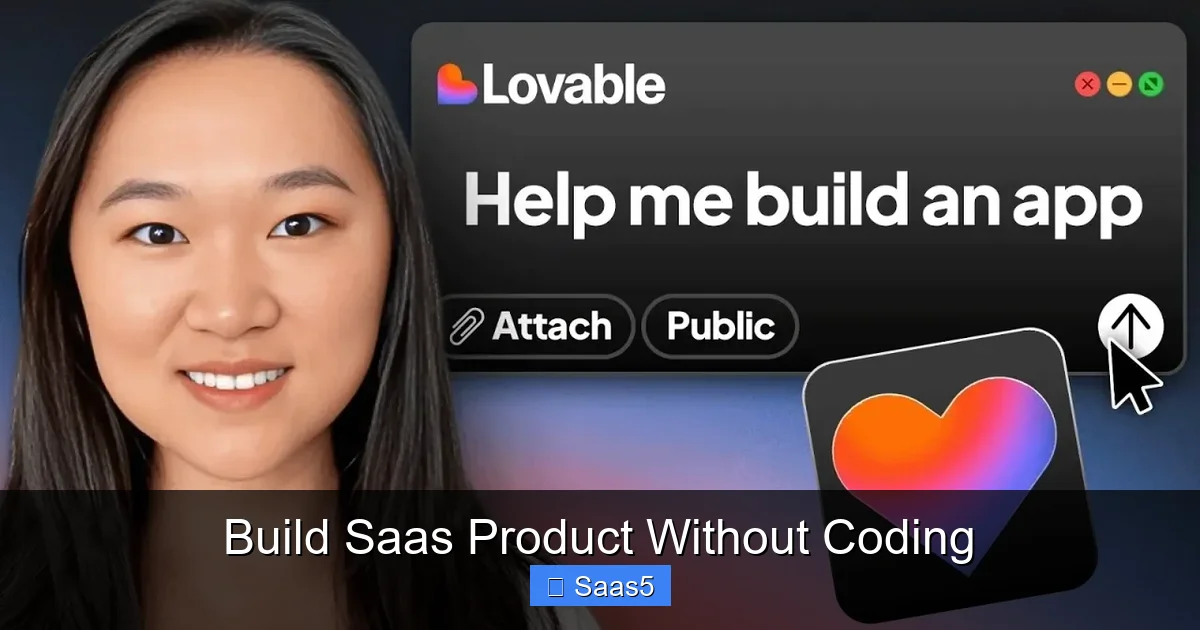
You can absolutely build a profitable SaaS product without coding. The no-code revolution provides powerful visual development tools that handle the complex backend logic, databases, and user authentication for you. This approach drastically reduces startup costs, accelerates time-to-market from months to weeks, and allows you to validate your business idea with real customers before investing in engineering talent. Focus on solving a real problem and talking to users; the technology is now accessible to everyone.
Key Takeaways
- No-Code is Mainstream: Platforms like Bubble, Webflow, and Softr are mature, production-ready tools capable of building complex, scalable SaaS applications.
- Speed is the Superpower: You can prototype and launch a functional MVP in weeks, not months or years, allowing for faster learning and adaptation.
- Cost Efficiency is Immediate: Eliminate the need for expensive developer salaries in the early stages, preserving capital for marketing, customer support, and validation.
- Focus on Business, Not Bits: Your time is freed to solve customer problems, define features, craft messaging, and build a brand—the real keys to SaaS success.
- Scalability Requires Planning: While no-code scales well initially, you must design your data structure and workflows carefully from day one to avoid technical debt.
- You Still Need “Tech Sense”:strong> Understanding databases, APIs, and user flows is crucial. No-code removes coding, but not the need for logical product thinking.
- Validation Comes First: Use no-code to build the smallest possible testable version of your idea to gauge real market interest before over-investing.
📑 Table of Contents
- The “No-Code” Gold Rush: Why You’re Hearing So Much About It
- Choosing Your Weapon: The No-Code Platform Ecosystem
- Blueprint to Launch: Step-by-Step from Idea to MVP
- Beyond the Build: The Real Business of SaaS
- Scaling and the Inevitable “What’s Next?”
- Pitfalls and Pro-Tips: Avoiding Common No-Code Traps
The “No-Code” Gold Rush: Why You’re Hearing So Much About It
Not long ago, the phrase “build a SaaS product” was synonymous with “find a technical co-founder” or “raise a million dollars for an engineering team.” The barrier to entry was a wall of code, server infrastructure, and complex DevOps. That wall has crumbled. We are in the midst of a no-code gold rush, and the pickaxes are visual, drag-and-drop interfaces.
This isn’t about building simple brochure websites. This is about constructing full-fledged software-as-a-service applications with user authentication, payment processing, complex dashboards, and real-time data updates. Platforms have evolved to handle the heavy lifting of backend logic, database management, and security protocols. The shift is profound: the primary constraint is no longer technical skill, but creativity and problem-solving ability.
For aspiring entrepreneurs, this is a paradigm shift. It democratizes software creation. You can now be the architect of your digital product without being a programmer. You can test your craziest business ideas with a fraction of the risk. Let’s explore how this is possible and how you can do it.
Choosing Your Weapon: The No-Code Platform Ecosystem
Not all no-code tools are created equal. Your choice depends entirely on the type of SaaS you’re building. Think of them as specialized toolkits. Picking the wrong one can lead to frustration and dead ends. Here’s a breakdown of the major categories and leading contenders.
Visual guide about Build Saas Product Without Coding
Image source: thesaasmonster.com
1. The All-in-One Application Builders (The Bubble Family)
These are the heavyweight champions. They provide a complete environment to define your database schema (your tables and relationships), build user interfaces, and write complex workflows using visual logic blocks. They are true full-stack replacements.
- Bubble: The undisputed leader for complex web apps. It handles everything from social networks and marketplaces to internal tools. Its learning curve is steeper, but its power is unmatched in the no-code world. You can connect to external APIs, manage file uploads, and build highly customized user experiences.
- Adalo: Often considered more user-friendly than Bubble for simpler apps, especially mobile-first ones. It has a great library of pre-built components and a more intuitive interface for connecting data to screens.
- FlutterFlow: A powerful contender that builds production-ready Flutter code (which can be exported to native iOS/Android apps). It’s excellent for designers who want pixel-perfect control and a direct path to native mobile deployment.
Practical Tip: Before committing, sketch your app’s core user flow and data model. Try building that single flow in Bubble and Adalo. Which one feels more intuitive? Which handles the logic you need more cleanly?
2. The Web & Content Powerhouses (The Webflow & Softr Duo)
If your SaaS is content-driven, membership-based, or relies on stunning visual design, this category is your起点 (starting point).
- Webflow: The king of visual web design. It gives you CSS-level control without code, making it perfect for marketing sites, portfolios, and blogs. Its CMS is robust for content-heavy applications. However, its “app logic” capabilities are more limited than Bubble’s, though it integrates beautifully with other tools via APIs.
- Softr: Built on top of Airtable (or SmartSuite). It’s the fastest way to turn a spreadsheet into a beautiful, functional web app with user logins, member areas, and dynamic content. Ideal for client portals, membership sites, and internal dashboards where the data structure is relatively simple.
Example: A SaaS offering “curated design resources” could use Webflow for the stunning public marketing site and blog, and Softr for the members-only area where subscribed users access a searchable library of assets stored in Airtable.
3. The Glue & Automation Specialists (Zapier, Make, n8n)
No-code isn’t just about building the primary product; it’s about wiring your entire business operation. These tools connect your SaaS to the outside world.
- Zapier / Make (Integromat): Create “if this, then that” automations between thousands of apps. Use them to: send a welcome email in Mailchimp when a user signs up in your Bubble app, create a Trello card for new support requests, or add a customer to a Slack channel. They are the nervous system of your no-code business.
- n8n: A powerful, self-hostable alternative with more complex logic capabilities. It’s favored by teams needing more control and complex workflow branching.
Key Insight: Your SaaS will rarely exist in a vacuum. From the start, map out your key workflows: onboarding, payments, support, notifications. These automation tools will be critical to delivering a seamless professional experience.
Blueprint to Launch: Step-by-Step from Idea to MVP
Okay, you’ve chosen a platform. Now what? Building without code still requires a process. Skipping steps leads to messy, unscalable apps. Follow this disciplined approach.
Visual guide about Build Saas Product Without Coding
Image source: subscribed.fyi
Step 1: Ruthless Validation & Sketches
Do not open your no-code builder yet. First, get out of the building. Talk to 10-15 potential customers. Define the one core job your SaaS does. Then, sketch your app on paper or a whiteboard. Focus on the single most important user journey. For a project management tool, it’s: “User signs up -> creates first project -> adds a task -> marks it complete.” That’s your MVP. Everything else is a distraction.
Step 2: Build Your Data Foundation
This is the most critical technical step. In your no-code platform, design your database tables first. For a simple “client portal” SaaS:
- Users Table: (email, password, subscription_tier)
- Clients Table: (name, company, user_id [links to Users])
- Projects Table: (title, status, client_id [links to Clients])
- Tasks Table: (description, due_date, project_id [links to Projects])
Get these relationships (one-to-many, many-to-many) right. A flawed data structure will make every future feature a nightmare to build. Spend time here.
Step 3: Construct the Core User Flow
Now, build the pages and workflows for your single core journey from Step 1. In Bubble, this means:
- Create a “Sign Up” page that writes to the Users table.
- Create a “Dashboard” page that only loads if the user is logged in.
- On the Dashboard, add a button “Create New Client.” This button triggers a workflow: “Create a new thing in the Clients table” with the current user’s ID.
- Clicking on a client shows their projects. This is a “Repeating Group” element set to display Projects where Client ID = current page’s Client ID.
You are connecting UI elements to your database with logic. It feels like playing with advanced LEGO. Get this loop working perfectly before adding a single “nice-to-have” feature.
Step 4: Integrate Essential Services
Your no-code app needs to talk to the real world. Integrate:
- Payments: Stripe is the gold standard. Most platforms have official Stripe plugins. Set up subscriptions, one-time payments, and handle webhooks for payment success/failure.
- Email: Use a transactional email service like SendGrid, Postmark, or even Mailjet. Send welcome emails, password resets, and notification digests.
- File Storage: Connect to AWS S3, Cloudinary, or the platform’s built-in storage for user uploads (avatars, documents).
Test these integrations in “test mode” thoroughly. A payment that fails silently or an email that lands in spam will kill trust instantly.
Beyond the Build: The Real Business of SaaS
Building the app is 20% of the battle. The other 80% is everything else. Your no-code advantage means you can spend your time here from day one.
Visual guide about Build Saas Product Without Coding
Image source: tailor.tech
Crafting a Go-to-Market Strategy on a Budget
Your product is built. Now, find users.
- Content & SEO: Use Webflow (or your builder’s blog feature) to create content that solves your target customer’s problems. “How to manage freelance clients” if you built a client portal. Rank for these terms.
- Community Outreach: Find where your customers hang out online (Reddit, LinkedIn groups, niche forums). Don’t spam your product. Answer questions, provide value, and mention your tool only when it’s a genuine solution.
- Partnerships: Because you built fast, you can approach potential partners (complementary tool makers, influencers) with a working product and a clear, simple integration proposal. A “we connect to your API” pitch is powerful.
Pricing, Packaging, and Positioning
No-code makes it easy to test pricing models.
- Tiered Plans: Most platforms (Bubble, Webflow) have built-in ways to restrict features or usage based on a user’s plan field in your database. Build logic: “If user.plan = ‘Pro’, show advanced analytics dashboard.”
- Usage-Based: Track metrics (number of projects, storage used) in your database and use workflows to check limits and trigger upgrade prompts.
- The “Grandfather” Clause: Your early adopters are gold. Offer them a special lifetime price for being first. It builds immense loyalty and gives you case studies.
Remember: Your pricing page is a product feature. It must be clear, simple, and justify its value. Use your no-code builder to A/B test different pricing structures and copy.
Scaling and the Inevitable “What’s Next?”
Your SaaS is gaining traction. Users love it. You’re processing payments. Now the questions about scale and future-proofing arise.
When (and If) You’ll Need a Developer
The “no-code ceiling” is a real concern, but it’s higher than most think. You’ll likely need a developer when:
- You need extremely complex, real-time algorithms (e.g., a unique AI/ML model).
- Your app’s performance degrades with 10,000+ users and complex queries, and your platform’s hosting limits are hit.
- You need a native mobile app with deep device integration that your current tool can’t export to.
The Smart Path: Use your no-code app to prove the business model and generate revenue. Then, use that revenue to fund the hire of a developer to rebuild the core engine on a custom stack, or to build specific high-performance features as microservices that plug into your existing no-code frontend. You are not starting from zero; you are a funded company with a proven product and paying customers.
Architecting for an Easy Transition
If you plan to eventually migrate to a custom codebase, build with that in mind from the start:
- Clean Data Models: Use standard naming conventions and logical relationships. This makes data export/import easier.
- API-First Mindset: Where possible, use your platform’s API to fetch and send data rather than hardcoding everything. This creates a layer of abstraction.
- Separate “Business Logic” from “UI”: In Bubble, use “Backend Workflows” (API workflows) for core logic instead of attaching everything to button clicks. This centralizes your rules, making them easier to replicate later.
Think of your no-code app as the ultimate prototype—a fully functional, revenue-generating specification document for your future engineering team.
Pitfalls and Pro-Tips: Avoiding Common No-Code Traps
The freedom of no-code can lead to chaos. Here’s how to avoid the biggest mistakes.
The “Spaghetti Workflow” Nightmare
It’s easy to create hundreds of disconnected workflows on buttons across dozens of pages. When you need to change a core process (e.g., how a “Project” is created), you have to hunt everywhere. Pro-Tip: Centralize logic. Create a single “Backend Workflow” (e.g., “Create New Project”) that handles all the data creation and side effects. Have every “Create Project” button on your site call that one workflow. Now, change the logic in one place.
Ignoring App Performance & User Experience
No-code apps can become slow if you load too much data on a single page or have inefficient repeating groups. Pro-Tip: Implement pagination (“Show only 10 items, load more on click”). Use “Privacy Rules” rigorously to ensure users only load data they are allowed to see. This is a security AND performance win.
Neglecting Security & Compliance
Your platform handles server security, but you are responsible for application-level security. Pro-Tip: Master “Privacy Rules” (in Bubble) or equivalent. Define who can “view” and “edit” every single data type. Never trust the frontend. Assume a malicious user will try to access other users’ data by manipulating URLs. Design your rules to prevent this by default.
Vendor Lock-In Fear
Yes, you’re building on someone else’s platform. But the risk is often overstated. Pro-Tip: Regularly export your application’s data and logic. Most platforms have export features. Keep a clean, documented data schema. The real lock-in is not in the code, but in the *time and business momentum* you’ve built. Your first priority is to validate and grow. Worry about portability when you have the revenue to afford a rebuild.
Frequently Asked Questions
Is it really possible to build a *serious*, scalable SaaS without coding?
Yes. Platforms like Bubble and Webflow power thousands of successful, revenue-generating businesses. They are production-ready and handle scalability, security, and hosting. The “serious” part depends on your business logic and execution, not the tool you use. Many founders use no-code to reach $10k-$50k MRR before considering a technical rebuild.
What are the main limitations of no-code platforms?
The primary limitations are in highly specialized, compute-intensive tasks (unique AI models, complex real-time gaming engines), and deep native mobile hardware access. Performance can degrade with extremely complex data relationships and very high user concurrency if not architected carefully. Vendor lock-in and potential migration costs are also considerations for long-term, massive scale.
How do I handle complex business logic or unique algorithms?
For complex logic, most advanced no-code platforms (Bubble, FlutterFlow) offer “plugin” or “custom code” ecosystems. You can often embed small snippets of JavaScript or Python for specific calculations. More commonly, you can call external APIs that perform the complex task (e.g., an AI image generation API, a fraud detection service). The no-code app becomes the orchestrator.
What about data security and compliance (like GDPR)?
Reputable no-code platforms are SOC 2 compliant, offer data encryption, and are GDPR-ready in their infrastructure. However, application-level security is your responsibility. You must correctly configure privacy rules, authenticate users properly, and avoid exposing API keys on the frontend. The platform provides the secure house; you must lock the doors and windows correctly.
Can I connect my no-code SaaS to other tools my customers use?
Absolutely. This is a core strength. Use automation tools like Zapier, Make, or the platform’s native API connectors to integrate with Slack, Google Calendar, QuickBooks, Salesforce, etc. You can also build your own API endpoints (in Bubble, for example) to allow other services to push and pull data from your app, enabling powerful ecosystem integrations.
How do I monetize a no-code-built SaaS? Is it any different?
Monetization is identical to a coded SaaS. You integrate a payment processor (Stripe, Paddle) and build logic around subscription tiers or usage limits. The key difference is that implementing these payment flows and tiered access controls is often faster and requires no backend development. You focus on your pricing strategy and value proposition, not on coding the checkout cart.