Is German Easy to Learn for English Speakers
Yes, German is one of the easier languages for English speakers to learn. Both languages share Germanic roots, leading to significant vocabulary overlap and similar sentence structures. The primary hurdles are the four grammatical cases and complex verb conjugation, but these are systematic and conquerable with the right approach. With abundant resources and a logical grammar framework, dedicated learners can achieve solid proficiency. Consistency and practical application are far more critical than innate difficulty.
Key Takeaways
- Shared Germanic Roots: English and German are linguistic siblings, offering a massive head start with vocabulary and basic syntax.
- The Case System is the Main Hurdle: Mastering nominative, accusative, dative, and genitive cases is challenging but follows clear rules.
- Pronunciation is Largely Predictable: German sounds are consistent once you learn the core rules, with few silent letters.
- False Friends Abound: Many similar-looking words have completely different meanings, requiring careful attention.
- Resources are Everywhere: From podcasts to apps, high-quality learning materials for German are extremely accessible.
- Mindset Trumps “Difficulty”: Viewing German as a logical puzzle rather than an insurmountable wall is key to sustained progress.
📑 Table of Contents
- So, Is German Easy to Learn for English Speakers? The Short Answer
- The Unbeatable Head Start: Shared Germanic Roots and Cognates
- Grammar: The Mountain to Climb (And How to Scale It)
- Pronunciation and Spelling: A System You Can Trust
- Practical Strategies: How to Learn German Effectively
- Resources and Community: Your Support System
- The Realistic Timeline and Final Verdict
So, Is German Easy to Learn for English Speakers? The Short Answer
Let’s be honest: the question “Is German easy?” often comes with a mental image of convoluted grammar, endless compound words, and a guttural sound that seems impossible to replicate. If you’ve ever heard someone say “Ich liebe dich” or struggled through a long German noun like “Donaudampfschiffahrtselektrizitätenhauptbetriebswerkbauunterbeamtengesellschaft,” you might have laughed and thought, “No way.” But here’s the surprising truth that flips the script: for an English speaker, German is objectively one of the most accessible foreign languages to learn.
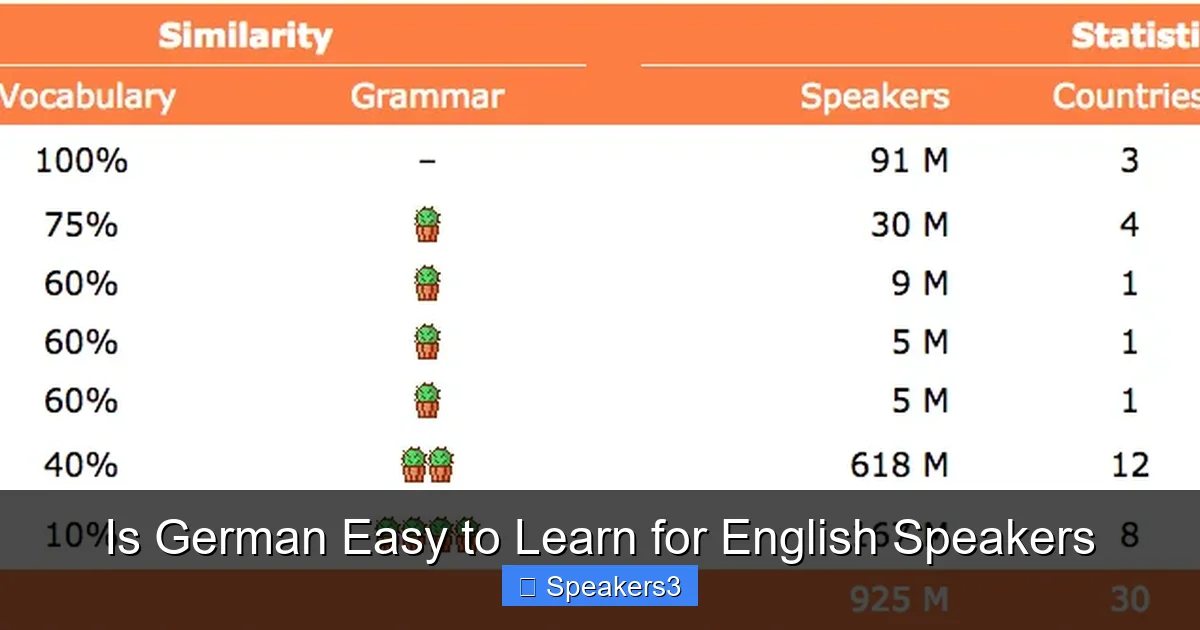
Think of it like this: you’re not starting from scratch in a foreign jungle. You’re exploring a neighboring country where the street signs look oddly familiar, the food has comforting similarities, and the basic laws of the land operate on a logic you already half-understand. The Foreign Service Institute (FSI) of the U.S. Department of State, which trains diplomats in languages, categorizes German as a Category II language. This means it requires approximately 750 classroom hours (or about 30 weeks of intensive study) to reach professional working proficiency. That’s significantly less time than required for Category III languages like Russian or Arabic, and far, far less than Category IV “super-hard” languages like Mandarin or Japanese. This official classification is based on the linguistic distance between English and the target language. German’s proximity to English is the single biggest factor in its relative ease.
This article isn’t about pretending German is a walk in the park. It has its formidable peaks, most notably its case system. Instead, we’re going to have a frank, friendly conversation about exactly what makes German both wonderfully familiar and uniquely challenging. We’ll break down the grammar, celebrate the vocabulary, tackle pronunciation, and arm you with practical strategies. By the end, you’ll have a clear, realistic picture of the learning journey ahead and know exactly why your English brain already has a secret advantage.
The Unbeatable Head Start: Shared Germanic Roots and Cognates
To understand why German is easy for English speakers, you must first understand your family tree. Both English and German are West Germanic languages. They share a common ancestor, Proto-Germanic, spoken thousands of years ago. While English was heavily influenced by French after the Norman Conquest and German evolved along its own path, the core DNA remains strikingly similar. This isn’t just academic trivia; it’s your daily toolkit.
Visual guide about Is German Easy to Learn for English Speakers
Image source: learnenglish100.com
The Vocabulary Treasure Trove: Cognates Galore
Look at these pairs. You already know what they mean without any study:
- English: house / mouse / sand / winter / gold / silver / arm / hand / finger / name
- German: das Haus / die Maus / der Sand / der Winter / das Gold / das Silber / der Arm / die Hand / der Finger / der Name
These are called cognates—words that have a common etymological origin and look/sound similar. Estimates vary, but roughly 30% of modern German vocabulary is of Germanic origin and thus directly recognizable to an English speaker. This is a colossal advantage. When you see “die Katze,” you don’t need a dictionary to guess it’s “cat.” When you read “der Stuhl,” the connection to “stool” is immediate. This instant recognition builds confidence from day one and dramatically speeds up vocabulary acquisition. You’re not memorizing random symbols; you’re uncovering the family resemblance.
False Friends: The Hilarious (and Dangerous) Cousins
But beware! This family has many tricky members known as false friends (or “false cognates”). These are words that look identical but have different meanings. They are the classic pitfall for beginners and can lead to hilarious or awkward misunderstandings.
- Gift: In German, this means “poison.” Not a great thing to receive.
- Fast: Means “almost.” If you say “Ich bin fast da,” you’re saying “I’m almost there,” not “I’m fast.”
- Bald: Means “soon.” (“Ich komme bald.” = “I’m coming soon.”)
- Welt: Means “world,” not “weld” or a rolled pastry (that’s “Waffel”).
- Mist: Means “manure” or “dung.” A “Mist” day is not a misty day; it’s, well, a sh*t day.
- Braun: Is “brown.” The famous “Braun” shaver company is not named after a man named Braun, but the color.
Learning these false friends is a rite of passage. The key is to always check a reliable source when a word seems too perfectly obvious. Your brain will thank you later.
Grammar: The Mountain to Climb (And How to Scale It)
If vocabulary is the friendly welcome mat, grammar is the locked door you must learn to pick. For English speakers, German grammar presents two major, interconnected challenges: cases and verb conjugation. But here’s the crucial perspective: German grammar is logical. It’s not a chaotic set of random exceptions like some languages (*cough* English spelling *cough*). Once you understand the core systems, the rules apply consistently. It’s a code to be deciphered, not a mystery to be solved by rote memorization alone.
Visual guide about Is German Easy to Learn for English Speakers
Image source: languagelearnings.com
Conquering the Four Cases: Der, Die, Das Changes Everything
This is the big one. In English, we have “the.” In German, “the” changes form depending on the noun’s gender (masculine, feminine, neuter) and its function in the sentence (its “case”). The four cases are:
- Nominative: The subject of the sentence. (Der Mann liest. / The man reads.)
- Accusative: The direct object. (Ich sehe den Mann. / I see the man.)
- Dative: The indirect object (to/for whom?). (Ich gebe dem Mann das Buch. / I give the man the book.)
- Genitive: Shows possession (of the). (Das Buch des Mannes. / The man’s book.)
Each definite article (“the”) has a different form for each case/gender combination. For masculine nouns alone, “the” becomes der (Nom), den (Acc), dem (Dat), des (Gen). And it’s not just articles; adjectives and pronouns change too (“ein guter Mann” vs. “einen guten Mann”).
How to Tackle It: Don’t try to learn all 16+ combinations at once. Start with the Nominative and Accusative. A simple trick: if you can ask “What?” or “Who?” about the verb, that’s usually the Accusative. “I see what?” -> “the man” (den Mann). Practice with high-frequency verbs like haben (to have), sehen (to see), mögen (to like). Use diagrams and color-coding. Most importantly, don’t fear mistakes. Germans are generally forgiving of case errors by learners, as long as your meaning is clear. The goal is comprehension, not perfection.
Verb Conjugation: Regular and Irregular, But Predictable
German verb conjugation is more straightforward than English in many ways. There are far fewer irregular verbs, and the patterns are consistent. The main endings for present tense are -e, -st, -t, -en, -t, -en (for ich, du, er/sie/es, wir, ihr, sie/Sie). The challenge comes with:
- Separable Verbs: Prefixes like an-, auf-, zu- move to the end of the clause. “Ich stehe um 6 Uhr auf” (I get up at 6 o’clock).
- Modal Verbs: können, müssen, wollen, etc., which are essential and have their own conjugation patterns.
- Strong (Irregular) Verbs: These change their stem vowel (like English sing/sang/sung). There are only about 200 common ones. Learn them in groups (e.g., finden/fand/gefunden, sehen/sah/gesehen).
How to Tackle It: Drill the regular patterns until they’re automatic. Then, create a dedicated list of the top 20-30 strong verbs and practice their past participles. The separable verb rule feels odd at first, but you’ll quickly internalize it by listening to and mimicking natural speech.
Word Order: The V2 Rule and the Verb Final
English word order is famously rigid: Subject-Verb-Object (SVO). German is more flexible but governed by a powerful rule: **in a main clause, the conjugated verb must be in the second position**. This is called the V2 rule. Everything else can shift for emphasis.
- Ich lese heute ein Buch. (I read today a book.) – Standard SVO.
- Heute lese ich ein Buch. (Today read I a book.) – Time element first, then verb in second position.
In subordinate clauses (introduced by words like weil [because], dass [that], wenn [if]), **the conjugated verb gets kicked to the very end**. This is non-negotiable and a major adjustment.
- Ich bleibe zu Hause, weil es regnet. (I stay home because it rains.) – “regnet” (rains) is at the end.
How to Tackle It: Initially, just learn to identify a main vs. subordinate clause. The “verb second / verb final” pattern is your new mantra. Practice by taking simple English sentences and translating them, consciously placing the verb. Listen to slow, clear German news (like Deutsche Welle’s “Langsam gesprochene Nachrichten”) to hear this rhythm in action.
Pronunciation and Spelling: A System You Can Trust
After grappling with cases, pronunciation feels like a breath of fresh, predictable air. German is a phonetic language. The relationship between letters and sounds is overwhelmingly consistent. Once you learn the rules, you can pronounce almost any word you see. There are no silent letters like in “knight” or unpredictable vowel sounds like in “through” vs. “tough.” This is a monumental advantage.
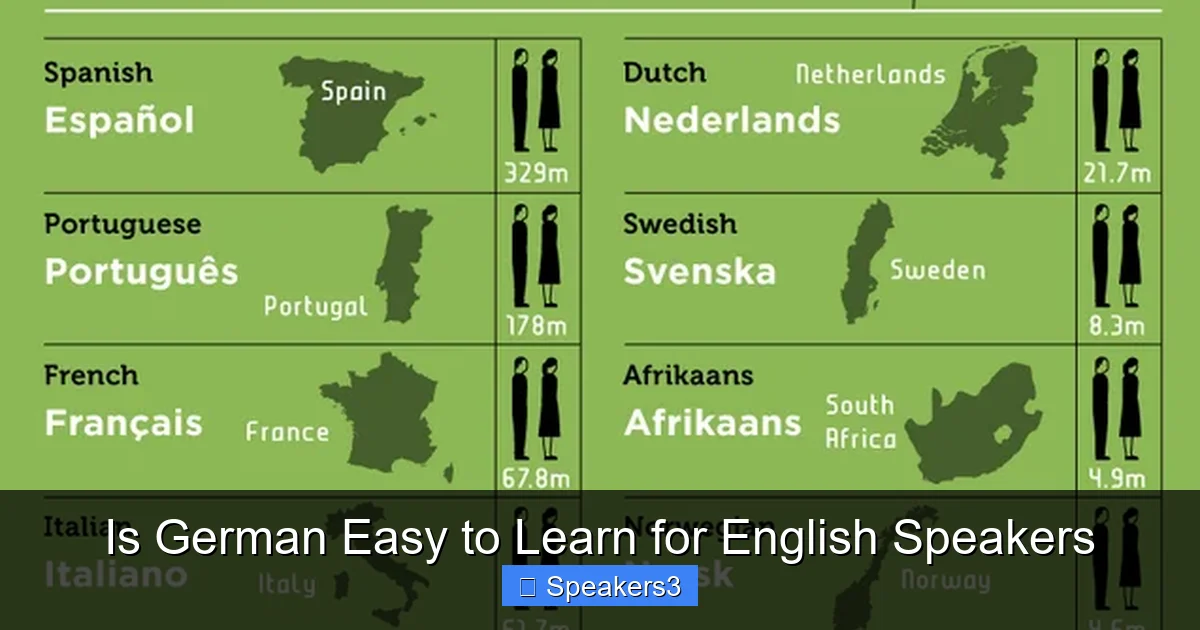
Visual guide about Is German Easy to Learn for English Speakers
Image source: 2.bp.blogspot.com
The Sounds That Trip You Up (And How to Master Them)
There are a handful of sounds that don’t exist in English. They are not inherently “hard,” just different. With focused practice, you can master them.
- The “ch” sounds: The famous guttural sound. After a, o, u, au (as in Bach, noch, Buch), it’s a soft, raspy sound made in the back of the throat (the voiceless velar fricative). After e, i, ei, eu, ä, ö, ü and at the beginning of words like ich, it’s a softer, hissing sound made on the tongue (the voiceless palatal fricative). Practice by saying “shhh” but with your tongue slightly raised for the soft ch.
- The “r”: There are two main types. The uvular R (guttural, like a soft gargle) is common in Northern and Standard German. The rolled/alveolar R (like a light Spanish “rr”) is more common in Southern Germany, Austria, and Switzerland. For learners, the uvular R is often easier to start with. Don’t stress perfection here; a clear, strong “r” sound of any kind is acceptable.
- Umlauts (ä, ö, ü): These are not just fancy “a, o, u.” They are distinct vowel sounds. ä is like the “e” in “bed.” ö is like the “i” in “girl” or the “eu” in French “peur.” ü is like the “u” in French “lune” or the “ew” in “few.” To form them, start saying the base vowel (a, o, u) and then gently round your lips into the shape for the next vowel (e, i, u).
How to Tackle It: Use YouTube! Search for “German pronunciation for English speakers.” Watch mouth close-ups. Record yourself. The ch and umlauts are the only real hurdles, and they can be conquered in a weekend of focused practice.
Compound Nouns: Not As Scary As They Look
Yes, German loves to smash words together. “Donaudampfschiffahrtselektrizitätenhauptbetriebswerkbauunterbeamtengesellschaft.” This legendary word is a joke, but real compounds exist: Küchenschrank (kitchen cupboard), Wolkenkratzer (skyscraper), Schlüsselanhänger (keychain). The secret? They are just descriptive phrases written as one word. You read them from the right. “Schlüsselanhänger” is literally “key-hanger.” “Küchenschrank” is “kitchen-cupboard.” Your brain, trained on English compounds like “toothpaste” or “bookstore,” is already equipped for this. It’s a feature, not a bug—it allows for precise, efficient description.
Practical Strategies: How to Learn German Effectively
Knowing the landscape is step one. Step two is choosing the right gear and route. Your success will depend less on some mythical “language gene” and more on your methodology and consistency.
Immersion from Day One: Listen, Listen, Listen
You don’t need to live in Berlin to immerse yourself. Start your German journey with your ears. Your brain needs to internalize the rhythm, melody, and sound patterns. Here’s how:
- Podcasts for Learners: “Coffee Break German,” “Slow German mit Annik Rubens,” “Deutsche Welle Langsam gesprochene Nachrichten.” Listen during your commute, chores, or walk. Don’t worry about understanding every word; just get used to the flow.
- YouTube: Channels like “Easy German” (street interviews with subtitles) are gold. “Learn German with Anja” is fantastic for clear explanations. Watch kids’ shows like “Die Sendung mit der Maus.” The language is simple and clear.
- Music & Audiobooks: Make a German playlist. Find an audiobook of a book you already know in English (like a Harry Potter translation). The context will help you follow along.
Goal: Aim for 30-60 minutes of passive listening daily. This builds crucial neural pathways for pronunciation and comprehension.
Vocabulary: Quality Over Quantity, Context Over Lists
Do not just memorize random word lists from an app. It’s inefficient and forgettable. Instead:
- Learn in Chunks & Themes: Learn the words for everything in your kitchen together. Learn office supplies. Learn phrases you will actually use: “Wie sage ich…?” (How do I say…?), “Können Sie das wiederholen?” (Can you repeat that?).
- Use Spaced Repetition Systems (SRS): Apps like Anki or Memrise are scientifically proven to move words from short-term to long-term memory. But create your own decks from words you encounter in real content (podcasts, articles).
- Prioritize High-Frequency Words: Focus on the 1,000 most common German words first. They will cover about 80% of everyday speech. You can find these lists easily online.
Grammar: Integrate, Don’t Isolate
Don’t study the dative case in a vacuum for a week. Learn it through use.
- Pattern-Based Learning: When you learn a new verb, immediately learn its preposition (if any) and the case it governs. For example, gedenken (to remember) always takes the genitive. helfen (to help) always takes the dative. This connects grammar to vocabulary.
- Use Reference, Not Textbook: Keep a good, concise grammar reference (like “German Grammar in a Nutshell”) handy. When you encounter a structure you don’t understand in your reading/listening, look it up immediately in context.
- Drill with Purpose: Do short, focused exercises on one specific point (e.g., “Accusative with ‘den'”) and then immediately try to use it in a spoken sentence or written message.
Speaking: Start Early, Embrace Mistakes
This is the most common piece of advice and the most ignored. You must speak from week one, even if it’s just talking to yourself in the shower.
- Shadowing: Listen to a short audio clip and repeat it aloud immediately, trying to mimic the intonation and speed exactly. This builds muscle memory for your mouth and ear.
- Language Partners: Use apps like Tandem, HelloTalk, or iTalki to find native speakers for text or voice chat. Be clear you’re a beginner. Most people are kind and helpful.
- Talk to Yourself: Describe your day, what you see, what you’re planning to do, entirely in German. It’s low-pressure and builds fluency pathways.
- Mistakes are Data: Every error tells you what you need to work on. Thank the person who corrects you. Do not let fear paralyze you.
Resources and Community: Your Support System
You are not alone on this journey. The ecosystem for learning German is vast, high-quality, and often free.
Structured Courses (Paid & Free)
- Deutsche Welle (DW): Arguably the best free resource on the planet. Their “Nicos Weg” course is a complete, interactive A1-B1 course with videos, exercises, and a storyline. It’s professional, engaging, and completely free.
- Goethe-Institut: The cultural institute of Germany. They offer excellent online courses and in-person classes worldwide (for a fee). Their materials are top-notch.
- Textbooks: “Menschen” is very visual and communicative. “Studio d” is classic and thorough. “Sicher!” is great for B1 level and beyond with authentic materials.
Digital Tools and Apps
- Duolingo / Babbel: Good for building a daily habit and basic vocabulary. Don’t rely on them solely. They are a warm-up, not the workout.
- DeepL: The superior translation tool. Use it to check your writing, not to generate it. Compare its output to Google Translate to see nuance.
- Duden.de: The official German dictionary. Use it for spelling, definitions, and grammar explanations. It’s your authoritative source.
- Forvo.com: Hear any German word pronounced by a native speaker.
Engaging with Native Content
Once you have A2 level, start consuming “native” content tailored for learners or general audiences.
- Easy German (YouTube): As mentioned, street interviews with bilingual subtitles.
- LingQ / Readlang: Browser extensions that let you click on any word in a foreign text for an instant translation. Great for reading news sites like “Nachrichtenleicht.de” (simple news).
- German Netflix: Watch familiar shows with German audio and German subtitles. Start with children’s animations (clearer speech) or shows you already know well.
The Realistic Timeline and Final Verdict
So, how long does it actually take? According to the FSI’s 750-hour estimate for professional proficiency:
- Casual, Consistent Study (1 hour/day): You’ll be comfortably conversational (A2/B1 level) in about 2-2.5 years. You can handle travel, social situations, and basic work tasks.
- Intensive Study (e.g., 3-4 hours/day in a course): You can reach B2 (independent user, can work in the language) in 1-1.5 years.
- True Fluency (C1/C2): This takes years of immersion, reading complex texts, and nuanced conversation, regardless of your starting language. This is the plateau where you refine, not acquire.
The Final Verdict: Is German easy? It is systematically challenging but fundamentally accessible. The initial hump of the case system feels steep, but it is a finite, rule-based mountain. The rewards of climbing it are immense. You gain access to the literature of Goethe and Kafka, the philosophy of Nietzsche and Kant, the music of Bach and Beethoven, and the economic powerhouse of the European Union. You connect with over 100 million native speakers in Germany, Austria, Switzerland, and beyond. The shared vocabulary gives you constant wins. The logical grammar, once cracked, provides a satisfying structure. The pronunciation is reliable. The resources are unparalleled.
Your success will not be determined by some innate “easiness” factor. It will be determined by your consistency (daily exposure), your courage (to speak and make mistakes), and your curiosity (to engage with the culture behind the language). Approach it not as a chore, but as a puzzle you are slowly, satisfyingly, piecing together. The first “Aha!” moment when you understand a whole sentence on the radio, the first time a German friend laughs at your (correct) joke, the first page of a German novel you read without help—these moments are the real measure of “easy.” And they are absolutely within your reach.
Frequently Asked Questions
Is German harder than French or Spanish for an English speaker?
Generally, no. The FSI places German (750 hours) and French/Spanish (600-750 hours) in the same Category II of difficulty for English speakers. While German’s cases are a new concept, French’s pronunciation and spelling are notoriously irregular, and Spanish has more verb tenses. German’s logical grammar often makes it easier to master systematically than the more phonetic but irregular Romance languages.
What is the single hardest part of learning German?
The unanimous answer from learners is the four-case system (der, die, das changes). It requires you to constantly think about a noun’s function in a sentence, not just its meaning. This mental switch is unfamiliar and takes time to internalize. However, it is a finite system with clear rules, and with practice, it becomes second nature.
Can I learn German fluently without ever going to a German-speaking country?
Absolutely. The digital age has made location irrelevant. With high-quality online courses (Deutsche Welle), language exchange apps (Tandem), streaming services with German audio/subtitles, and virtual tutors (iTalki), you can achieve B2/C1 fluency from home. Immersion can be created actively through media and conversation, not just geographically.
How long does it realistically take to become conversational in German?
With consistent study (1-2 hours daily), you can reach a solid A2 level (conversational for travel, simple topics) in 6-12 months. Reaching a comfortable B1 level (handling most daily situations, expressing opinions) typically takes 18-24 months. “Fluency” is a spectrum, but basic conversational ability is a very realistic goal within two years of regular effort.
Do I need to learn the formal “Sie” and informal “du” distinction?
Yes, it’s important socially. Using “du” with strangers, superiors, or older people can be seen as disrespectful. Start by using “Sie” with everyone you don’t know well. If someone offers you “du” (they might say “Sagen wir du”), then you can switch. It’s a key part of German politeness culture and is relatively simple to master.
Is it worth learning German if I only want to travel?
Yes, but with a caveat. In major tourist hubs (Berlin, Munich, Frankfurt), most people in hospitality speak excellent English. However, learning even basic German (greetings, please, thank you, numbers) will dramatically improve your experience. It shows respect, opens doors to more authentic interactions, and is invaluable in smaller towns, local shops, and public transport outside the biggest cities. It transforms you from a tourist to a guest.