Laptop with 32gb of Ram
A laptop with 32GB of RAM is a powerhouse built for heavy multitasking, professional workloads, and future-proof performance. Whether you’re editing 4K video, running virtual machines, or gaming at the highest settings, 32GB ensures your system never slows down. This guide breaks down everything you need to know before buying a laptop with 32GB of RAM.
Key Takeaways
- 32GB of RAM is ideal for power users: If you run demanding software like video editors, 3D modeling tools, or virtual machines, 32GB gives you the headroom you need.
- Not everyone needs 32GB: Casual users who browse the web, stream videos, or use office apps will find 8GB or 16GB more than sufficient.
- Gaming benefits from 32GB: Modern AAA titles and streaming while gaming perform noticeably smoother with 32GB of RAM.
- Future-proofing matters: Software requirements keep increasing, so a laptop with 32GB of RAM stays relevant for years longer.
- Pair it with the right specs: A fast processor like an Intel Core i7 or AMD Ryzen 7 and an SSD are essential to complement 32GB of RAM.
- Upgradability varies by model: Some laptops have soldered RAM, so check if you can upgrade later before buying.
- Price has dropped significantly: Laptops with 32GB of RAM are more affordable than ever, making them accessible to more users.
📑 Table of Contents
Why a Laptop with 32GB of RAM Is a Game-Changer
Let’s be honest. Most people buying a laptop don’t think twice about RAM. They look at the processor, maybe the storage, and call it a day. But here’s the thing — RAM is the unsung hero of your entire computing experience. And when you step up to a laptop with 32GB of RAM, you’re stepping into a completely different league of performance.
Think of RAM as your laptop’s short-term memory. Every app you open, every browser tab you keep alive, every background process running — they all live in RAM. When you run out, your laptop starts using your hard drive as a backup, and that’s when everything grinds to a halt. With 32GB, you essentially eliminate that bottleneck for almost every real-world task.
So who actually needs a laptop with 32GB of RAM? And is it worth the extra cost? Stick around — we’re going to cover everything from who benefits most, to the best configurations, to how to pick the right one for your needs.
Who Actually Needs 32GB of RAM?
Creative Professionals
If you work with video editing software like Adobe Premiere Pro, DaVinci Resolve, or Final Cut Pro, you already know how hungry these programs are for memory. A single 4K timeline can eat through 16GB of RAM like it’s nothing. Add color grading, effects, and multiple layers, and you’ll hit the ceiling fast. A laptop with 32GB of RAM lets you edit smoothly without constant rendering or crashes.
Photographers working with large RAW files in Photoshop or Lightroom also benefit enormously. When you’re stitching panoramas, working with hundreds of layers, or processing batch edits, 32GB keeps everything responsive. 3D artists using Blender, Maya, or Cinema 4D will tell you the same story — more RAM means faster renders and smoother viewport performance.
Software Developers and Engineers
Developers running Docker containers, virtual machines, or local servers know the pain of running out of memory. A single virtual machine can easily consume 8GB. Run two or three alongside your IDE, browser, and communication tools, and 16GB disappears in minutes. A laptop with 32GB of RAM gives developers the freedom to run complex local environments without compromise.
Engineers running CAD software, simulation tools, or data analysis platforms like MATLAB and Python-based machine learning frameworks also need serious RAM. These applications load massive datasets into memory, and having 32GB means you can work with larger files without constant swapping to disk.
Gamers and Streamers
Gaming has evolved. Modern titles like Cyberpunk 2077, Starfield, and Hogwarts Legacy can use 16GB or more on their own. Now add a streaming app like OBS, Discord, a web browser with guides open, and maybe some music in the background. Suddenly 16GB isn’t enough. A gaming laptop with 32GB of RAM ensures you never have to choose between performance and multitasking.
Streamers especially benefit because encoding video in real-time while gaming is incredibly resource-intensive. With 32GB, your system handles both tasks simultaneously without dropping frames or stuttering.
Data Scientists and Analysts
Working with large datasets in tools like R, Python (Pandas, NumPy), or Tableau? These tools load data directly into RAM for processing. A 10GB dataset on a 16GB machine is a problem. On a laptop with 32GB of RAM, it’s a breeze. If your work involves big data, financial modeling, or machine learning, 32GB isn’t a luxury — it’s a necessity.
How 32GB of RAM Compares to 8GB and 16GB
The Entry Level: 8GB
8GB of RAM is the bare minimum for a functional Windows or macOS experience in 2024. It’s fine for web browsing, email, document editing, and light media consumption. But the moment you open more than a handful of Chrome tabs or try to run a demanding application alongside your regular tasks, you’ll feel the limitations. For students or casual users on a tight budget, 8GB works — but it leaves almost no room for growth.
The Sweet Spot for Most: 16GB
16GB is where most people should land. It handles multitasking well, runs most games comfortably, and supports moderate creative work. If you’re a laptop user with 16GB of RAM and an i7 processor, you’re in great shape for everyday productivity and even some heavier workloads. But 16GB is starting to show its age as software demands increase.
The Power User Zone: 32GB
A laptop with 32GB of RAM is where you stop worrying about memory entirely. You can keep 50 browser tabs open, run a virtual machine, edit a video, and still have headroom. It’s the configuration that says, “I don’t want to think about RAM ever again.” For professionals and enthusiasts, this is the sweet spot that balances performance with longevity.
Beyond 32GB: 64GB and More
Some extreme users — think 8K video editors, massive 3D rendering farms running locally, or researchers processing terabytes of data — may need a gaming laptop with 64GB of RAM or more. But for the vast majority of people, 32GB is more than enough. Going beyond that yields diminishing returns unless you have very specific professional needs.
Key Specs to Pair with 32GB of RAM
Processor: Don’t Bottleneck Your RAM
What good is 32GB of RAM if your processor can’t keep up? To fully utilize a laptop with 32GB of RAM, you need a capable CPU. An Intel Core i7 or AMD Ryzen 7 processor paired with 32GB of RAM is the gold standard for most power users. These processors have enough cores and threads to take advantage of all that available memory.
For even more demanding workloads, consider an Intel Core i9 or AMD Ryzen 9. These chips offer higher core counts and clock speeds, which pair beautifully with 32GB of RAM for tasks like 3D rendering, compiling large codebases, or running multiple virtual machines simultaneously.
Storage: SSD Is Non-Negotiable
RAM works hand-in-hand with storage. A laptop with 32GB of RAM but a slow hard drive will still feel sluggish. Always pair your RAM with an NVMe SSD. A laptop with 32GB of RAM and a 1TB SSD gives you the best of both worlds — lightning-fast data access and plenty of space for your files, projects, and games.
NVMe SSDs are significantly faster than traditional SATA SSDs, offering read and write speeds that can hit 3,500 MB/s or more. This means your system boots in seconds, applications launch instantly, and large files transfer in a fraction of the time.
Graphics: Integrated vs. Dedicated
If you’re buying a laptop with 32GB of RAM for professional creative work or gaming, you’ll want a dedicated GPU. An NVIDIA RTX 4060 or higher, or an AMD Radeon RX 7600M or better, will handle GPU-accelerated tasks like video rendering, 3D modeling, and modern gaming with ease.
For developers or data scientists who don’t need graphical horsepower, integrated graphics from Intel or AMD are perfectly fine. Your 32GB of RAM will be doing the heavy lifting for your workloads, and you’ll save money and battery life by skipping a dedicated GPU.
Best Use Cases for a Laptop with 32GB of RAM
Video Editing and Content Creation
Content creators are among the biggest beneficiaries of a laptop with 32GB of RAM. Whether you’re a YouTuber editing 4K footage, a filmmaker working on short films, or a social media creator juggling multiple projects, 32GB ensures your editing software runs smoothly. Applications like Premiere Pro, After Effects, and DaVinci Resolve all scale beautifully with more memory.
Rendering times also improve because more data can be held in RAM rather than constantly being read from and written to storage. When you’re on tight deadlines, those saved minutes add up fast.
Running Virtual Machines
IT professionals, cybersecurity researchers, and software testers often need to run multiple operating systems simultaneously. Each virtual machine typically requires 4GB to 8GB of RAM. With 32GB, you can comfortably run three or four VMs alongside your host operating system without any slowdown.
This is especially valuable for developers who need to test their applications across different environments, or for security professionals who analyze malware in isolated virtual environments.
Music Production
Digital audio workstations like Ableton Live, FL Studio, and Logic Pro can consume massive amounts of RAM when you’re working with large sample libraries, multiple tracks, and real-time effects. A laptop with 32GB of RAM lets producers work with complex projects without audio dropouts or latency issues.
Orchestral composers using sample libraries like Kontakt, Spitfire Audio, or EastWest will particularly appreciate the extra memory. These libraries can load gigabytes of samples into RAM for real-time playback.
Scientific Computing and Research
Researchers running simulations, computational models, or statistical analyses often work with datasets that exceed 16GB. A laptop with 32GB of RAM allows them to load entire datasets into memory, dramatically speeding up computation times. Fields like bioinformatics, physics, economics, and engineering all benefit from this extra capacity.
How to Choose the Right Laptop with 32GB of RAM
Check Upgradability
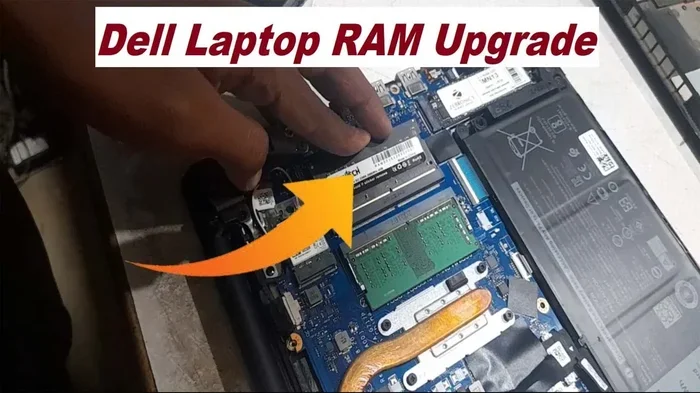
Here’s a critical detail many buyers overlook — some laptops have RAM soldered directly to the motherboard. That means what you buy is what you’re stuck with forever. Before purchasing, check whether the laptop’s RAM is user-upgradeable. If it is, you might save money by buying a model with 16GB and upgrading to 32GB yourself. Our guide on how to upgrade RAM in a laptop walks you through the process step by step.
Business-class laptops like the Lenovo ThinkPad series and Dell Latitude line often offer upgradeable RAM. Many ultrabooks and thin-and-light models do not. Gaming laptops vary — some allow upgrades, others don’t. Always verify before you buy.
Consider the Display
A powerful laptop deserves a great display. If you’re doing creative work, look for a screen with accurate color reproduction — 100% sRGB coverage at minimum, or 100% DCI-P3 for professional video work. Resolution matters too. A 2560×1600 or 4K display gives you more screen real estate for multitasking, which pairs perfectly with the multitasking capability of 32GB of RAM.
For gamers, refresh rate is key. A 144Hz or 240Hz display makes games feel incredibly smooth. Pair that with 32GB of RAM and a good GPU, and you have a portable gaming powerhouse.
Battery Life Considerations
More RAM doesn’t significantly impact battery life on its own. But the kind of laptop that comes with 32GB of RAM — typically high-performance models with powerful processors and dedicated GPUs — tends to consume more power overall. If battery life is a priority, look for laptops with efficient processors like Intel’s latest Ultra series or AMD’s Ryzen 7000 mobile chips.
Some laptops with 32GB of RAM are designed for portability and offer 8+ hours of battery life. Others are desktop replacements that prioritize performance over endurance. Know what you need before you shop.
Build Quality and Portability
A laptop with 32GB of RAM is an investment. You want it to last. Look for solid build quality — aluminum or magnesium alloy chassis, sturdy hinges, and a keyboard that feels good to type on. If you travel frequently, weight and thickness matter. Some 32GB laptops weigh under 3 pounds, while desktop-replacement models can exceed 6 pounds.
Consider your daily use case. If you carry your laptop to meetings, coffee shops, or co-working spaces, portability is key. If it lives on your desk most of the time, a heavier, more powerful machine makes sense.
Common Myths About 32GB of RAM
Myth: More RAM Always Means Faster Performance
This is only partially true. If you’re currently running out of RAM, upgrading to 32GB will feel like a revelation. But if you’re only using 10GB of your current 16GB, jumping to 32GB won’t make your laptop faster. RAM doesn’t speed up tasks you’re already handling — it enables you to do more simultaneously without slowdowns.
Myth: 32GB Is Only for Gamers
While gamers benefit from 32GB, they’re actually a small slice of the market for these laptops. Creative professionals, developers, data scientists, and engineers are the primary audience. Gaming is just one of many use cases where 32GB shines.
Myth: You Can’t Use All 32GB
Some people argue that 32GB is “too much” and that the system can’t utilize it all. That’s simply not true for power users. Between your operating system, background services, browser tabs, and demanding applications, 32GB can be fully utilized in a single work session. It’s not about whether you can use it — it’s about whether you need to use it.
Conclusion
A laptop with 32GB of RAM isn’t for everyone — and that’s okay. But if you’re a creative professional, developer, data scientist, gamer, or anyone who pushes their computer to its limits, 32GB of RAM transforms your experience. It eliminates the frustration of slowdowns, crashes, and memory warnings. It lets you focus on your work instead of managing your system resources.
The good news is that laptops with 32GB of RAM are more accessible than ever. Prices have dropped, options have expanded, and you can find configurations that pair 32GB with fast processors, spacious SSDs, and gorgeous displays. Whether you choose a sleek ultrabook for on-the-go productivity or a beefy gaming machine for entertainment, 32GB of RAM ensures your laptop stays fast and capable for years to come.
Take the time to assess your needs, check upgradability, and pair your RAM with the right supporting specs. Do that, and you’ll wonder how you ever settled for less.
Frequently Asked Questions
Is 32GB of RAM overkill for everyday use?
For basic tasks like web browsing, email, and document editing, 32GB is more than you need. However, if you multitask heavily, keep dozens of browser tabs open, or run demanding applications, 32GB provides a noticeably smoother experience and keeps your laptop future-proof.
Can I upgrade my laptop to 32GB of RAM later?
It depends on the laptop. Some models have user-accessible RAM slots that allow upgrades, while others have soldered RAM that cannot be changed. Always check the manufacturer’s specifications before assuming you can upgrade later.
Does 32GB of RAM improve gaming performance?
Yes, especially in modern AAA titles and when multitasking while gaming. Games like Cyberpunk 2077 and Starfield benefit from 32GB, and streaming or running background apps while gaming becomes much smoother with the extra memory headroom.
How much does a laptop with 32GB of RAM cost?
Prices vary widely based on brand, processor, and other specs. You can find laptops with 32GB of RAM starting around $800 for budget models, while premium configurations with high-end processors and displays can cost $2,000 or more.
Should I choose 32GB of RAM or a better processor?
Ideally, you want both. But if you have to prioritize, choose based on your workload. For multitasking and memory-heavy applications, prioritize RAM. For tasks that are CPU-intensive like compiling code or rendering, invest in a stronger processor first.
Is a laptop with 32GB of RAM good for video editing?
Absolutely. Video editing is one of the best use cases for 32GB of RAM. It allows you to edit 4K and even 8K footage smoothly, work with complex timelines, and run effects-heavy projects without constant rendering or crashes.