Lead Generation Strategies for Saas Companies
Lead generation for SaaS isn’t about casting the widest net; it’s about attracting the right prospects with genuine value. This guide moves beyond basic tactics to explore integrated strategies—from defining your Ideal Customer Profile to leveraging product-led growth and account-based marketing. You’ll learn how to build a predictable pipeline by aligning marketing, sales, and your product itself to create a seamless experience that converts visitors into loyal, paying customers.
Let’s be honest. The phrase “lead generation” can feel a bit… old school. It conjures images of cold calls, purchased lists, and spray-and-pray email blasts. But for a SaaS company? That’s like trying to catch fish with a shotgun. In the subscription economy, your growth depends on building relationships with people who genuinely need and love your software. That means your lead generation strategy must be smarter, more human, and deeply integrated with the very product you’re selling.
This isn’t about quick hacks or viral tricks. It’s about constructing a reliable, scalable system that feeds your sales team with leads who are not just email addresses, but real people with real problems your software can solve. We’re going to dive into the core strategies that modern SaaS companies use to build predictable pipelines. From the foundational work of knowing exactly who you’re talking to, to letting your product do the talking, to the precision of account-based plays—this is your complete playbook.
Key Takeaways
- Define Your ICP Rigorously: All successful strategies start with a crystal-clear Ideal Customer Profile. Target the companies and personas most likely to get immense value from your solution and become long-term advocates.
- Content is Your Top-of-Funnel Engine: Create educational, problem-solving content (blogs, videos, webinars) that attracts your ICP organically and positions your brand as a trusted authority, not just a vendor.
- Embrace Product-Led Growth (PLG): Let your product sell itself. Offer a frictionless freemium or free trial that delivers immediate “aha!” moments, converting users into qualified leads and paying customers through in-product experiences.
- Implement Targeted ABM for High-Value Accounts: For enterprise sales, use Account-Based Marketing to personalize every touchpoint for specific high-value companies, treating them as a market of one.
- Leverage Social Proof & Community: Build trust with customer case studies, testimonials, and reviews. Foster a user community to turn customers into promoters who generate referrals and organic leads.
- Measure, Analyze, and Iterate Relentlessly: Track the right metrics (CAC, LTV, conversion rates) at each funnel stage. Use data to identify bottlenecks, double down on what works, and continuously optimize your lead generation engine.
- Integrate, Don’t Isolate: The most powerful lead gen systems connect marketing, sales, and product data. Ensure a seamless handoff and unified customer view to nurture leads effectively from awareness to advocacy.
📑 Table of Contents
- 1. The Non-Negotiable Foundation: Defining Your Ideal Customer Profile (ICP)
- 2. Content Marketing: The Engine of Inbound Lead Generation
- 3. Product-Led Growth (PLG): Let Your Product Be Your Best Salesperson
- 4. Account-Based Marketing (ABM): The Precision Strike for Enterprise
- 5. The Trust Multipliers: Social Proof, Reviews, and Community
- 6. Data-Driven Optimization: The Cycle of Continuous Improvement
- Conclusion: Building Your Integrated Lead Generation Flywheel
1. The Non-Negotiable Foundation: Defining Your Ideal Customer Profile (ICP)
Before you write a single blog post, design a landing page, or send an email, you must answer one question with brutal clarity: Who are we for? “Everyone” is the wrong answer. “Small businesses” is too vague. Your Ideal Customer Profile is the North Star for every single lead generation activity. It’s a semi-fictional representation of the company (not just the individual) that gets the most value from your product, has the lowest churn risk, and represents your best lifetime value.
Why Your ICP is Your Most Important Strategic Asset
Think of your ICP as a filter. A sharp filter saves immense time and money. A vague filter lets in a flood of unqualified leads who will churn quickly, drain your support resources, and never upgrade. A well-defined ICP aligns your entire organization:
- Marketing knows exactly what messaging, channels, and content to create.
- Sales spends time with prospects who have a high probability of closing and succeeding.
- Product builds features for the users who will derive the most value and advocate for the product.
How to Build Your ICP: Go Beyond Firmographics
Firmographics (industry, company size, location) are a starting point, but they’re table stakes. The magic is in the technographics and behavioral signals.
- Technographics: What other software do they use? A company already using Zapier and Salesforce has a different tech-savviness and integration need than one using manual spreadsheets.
- Pain Points & Triggers: What specific, urgent problem are they trying to solve? Is it a recent funding round (Series B = growth mandate)? A new regulation? A competitor launching a better feature?
- Current Workarounds: How are they solving the problem today? (e.g., “We use three different tools and a lot of manual Excel work”). This reveals the level of pain and your potential value proposition.
Practical Tip: Interview your best 10-20 customers. Ask: “What was the moment you realized you needed a solution like ours?” “What did you try before?” “What outcomes were you looking for?” The patterns in their answers will form the heart of your ICP.
2. Content Marketing: The Engine of Inbound Lead Generation
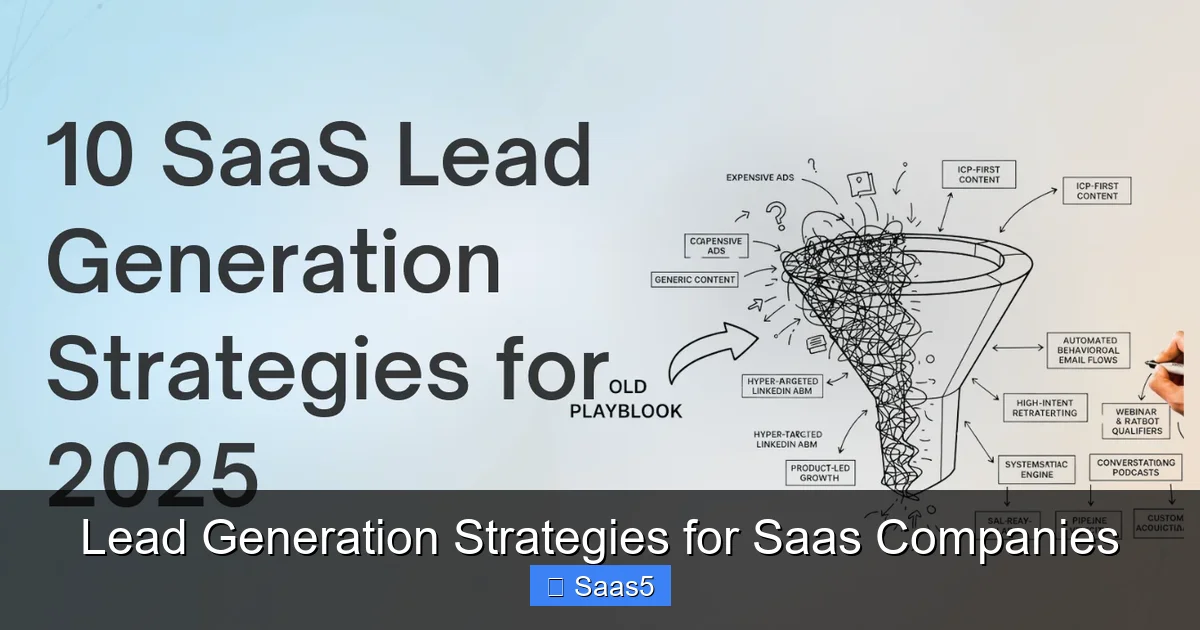
If your ICP defines who, content marketing is the primary tool for reaching them where they are—in the messy, early stages of their buyer’s journey. The goal isn’t to sell immediately. The goal is to teach, help, and build trust so that when they are ready to buy, you are the only logical choice.
Visual guide about Lead Generation Strategies for Saas Companies
Image source: voxturr.com
Mapping Content to the Buyer’s Journey
Your content must match the prospect’s mindset. A one-size-fits-all blog will fail.
- Awareness Stage (Top of Funnel): They feel a problem but don’t know the solution. Create content that names and validates their pain. Examples: “The 5 Hidden Costs of Manual Reporting,” “Is Your Team Suffering from Tool Fatigue?” Use blog posts, short videos, and social media snippets.
- Consideration Stage (Middle of Funnel): They’ve defined the problem and are researching solutions. This is where you showcase your unique approach. Examples: “Feature Comparison: All-in-One Platforms vs. Best-of-Breed Tools,” “How to Calculate ROI from a Project Management Tool.” Use webinars, case studies, and detailed comparison guides.
- Decision Stage (Bottom of Funnel): They’re ready to buy. Provide content that de-risks the decision. Examples: “A Day in the Life with [Your Product],” “Implementation Checklist,” detailed pricing pages, and free trial offers.
Beyond the Blog: A Multi-Format Content Strategy
Relying only on blog posts is a missed opportunity. Repurpose one core idea into multiple formats to reach different preferences and platforms:
- Webinars & Workshops: Live, interactive, and excellent for lead capture. A 45-minute deep dive on solving a specific problem can generate hundreds of qualified leads.
- Video Content: Short explainer videos for social media (TikTok, LinkedIn). Detailed tutorial videos for your knowledge base. Video testimonials are incredibly powerful social proof.
- Podcasts & Interviews: Appear on podcasts your ICP listens to. Host your own to interview experts and customers.
- Interactive Tools & Assessments: A “ROI Calculator” or “Process Maturity Assessment” is a high-value lead magnet that also pre-qualifies users.
Practical Example: A SaaS for remote teams doesn’t just blog about “remote work.” They create a video series on “Running Effective Async Stand-ups,” a webinar on “Building Culture in a Hybrid Model,” and a free tool to “Audit Your Meeting Health.” Each piece targets a specific pain point of their ICP (HR leaders, engineering managers) and captures leads at different stages.
3. Product-Led Growth (PLG): Let Your Product Be Your Best Salesperson
This is the game-changer for modern SaaS. Instead of forcing a sales conversation first, you remove friction and let prospects experience your product’s core value before they talk to sales. The product itself becomes the primary lead generation and qualification tool.
Visual guide about Lead Generation Strategies for Saas Companies
Image source: leadgeneration.com.au
The PLG Funnel: User → Lead → Opportunity
In a PLG model, the funnel looks different:
- User Acquisition: Someone signs up for a freemium plan, a free trial, or uses a “forever free” tier with limited features.
- Activation & “Aha!” Moment: This is the critical step. Your onboarding must guide them to experience the core value proposition as quickly as possible. Did they create their first project? Invite their first team member? Generate their first report? This moment is the trigger that turns a user into a qualified product-led lead.
- Expansion & Conversion: Through in-app messaging, usage data, and smart prompts, you encourage them to upgrade to a paid plan to unlock more value, seats, or features. Sales teams then focus on these high-intent, product-engaged users (often called “sales-qualified product-led leads”).
Designing for Conversion Within the Product
Your product’s UI/UX is now part of your marketing team. Key tactics include:
- Contextual Upsells: Don’t just show a generic “Upgrade” button. Show it when a user hits a limit. “You’ve used all 5 projects on your free plan. Upgrade to create unlimited projects and invite your team.”
- In-App Onboarding & Checklists: Guide users to completion. “Complete these 3 steps to set up your first automated workflow.” This drives activation and provides a clear path to value.
- Usage-Based Triggers for Sales: Set alerts for sales reps. “Prospect X from [Target Account] has invited 10 team members and used 80% of their storage. Time to reach out.”
WhoPLG Works For: It’s ideal for products with a low barrier to entry, clear individual value (not just team/enterprise value), and where users can experience value quickly. Tools like Slack, Calendly, and Notion are masters of this. Even complex B2B SaaS can use a PLG motion for a specific user persona (e.g., an individual developer trying an API) before expanding to the enterprise.
4. Account-Based Marketing (ABM): The Precision Strike for Enterprise
While PLG casts a wide net, ABM is a sniper rifle. It’s a focused strategy where marketing and sales align to identify and win specific, high-value target accounts. Instead of generating leads broadly, you generate opportunities within a predefined list of ideal companies.
Visual guide about Lead Generation Strategies for Saas Companies
Image source: marketjoy.com
The Three Pillars of ABM
- Identify: Use your ICP criteria to build a list of 50-200 target accounts. Tools like Clearbit, ZoomInfo, or even LinkedIn Sales Navigator help enrich this list with contact and firmographic data.
- Orchestrate: Create personalized, multi-channel campaigns for each account (or a segment of similar accounts). This isn’t just “Dear [First Name]” email blasts. It’s coordinated touches across:
- Personalized LinkedIn ads and content.
- Direct mail (sending a physical gift or book to an executive).
- Targeted email sequences from both marketing and the sales rep.
- Personalized landing pages with the company’s logo and specific value props for their industry.
- Measure: Track account-level engagement (website visits, content downloads, meeting bookings) and pipeline influenced/revenue won from target accounts.
ABM Lite: A Scalable Starting Point
You don’t need a $50k platform to start. Begin with “ABM Lite”:
- Segment your target list into 3-5 clusters by industry, size, or use case.
- Create tailored content and campaigns for each cluster (e.g., a case study for financial services, another for healthcare).
- Use your marketing automation tool (HubSpot, Marketo) to deliver these segmented experiences.
- Have sales prioritize outreach to accounts showing engagement.
Key Insight: ABM flips the traditional funnel. You start with the account (the “market”), not the lead. Marketing’s job is to get your foot in the door and warm up the entire buying committee, not just one initial contact.
5. The Trust Multipliers: Social Proof, Reviews, and Community
No matter how great your content or product, skepticism remains. This is where third-party validation becomes your most powerful lead generation asset. People trust other customers more than they trust you.
Harvesting and Showcasing Social Proof
- Customer Case Studies & Success Stories: These are your #1 sales collateral. Follow a simple format: Challenge → Solution → Results (with hard numbers). “Company X used our tool to reduce onboarding time by 70%.” Use quotes, logos, and specific metrics. Create both long-form (PDF) and short, scannable versions (web pages, one-pagers).
- Third-Party Reviews: Actively manage your profiles on G2, Capterra, TrustRadius. A steady stream of positive reviews is a massive SEO and trust signal. Implement a system to ask happy customers for reviews at the moment of delight (e.g., after a successful onboarding or support interaction).
- User-Generated Content & Testimonials: Feature short video testimonials on your homepage. Create a “Customers” page with logos. Encourage users to share their setups on social media with a branded hashtag.
Building a Community to Fuel Advocacy
A community turns customers into a loyal fanbase that generates its own leads.
- User Forums/Communities: A place for users to ask questions, share tips, and help each other. This reduces support burden and creates a knowledge hub that attracts new users searching for solutions.
- Customer Advocacy Programs: Identify your most passionate users. Invite them to beta test features, provide feedback, or speak at your webinars. In return, offer them recognition, early access, or swag. They become your evangelists.
- Host Events (Virtual or IRL): User conferences, meetups, or masterminds. The networking and shared learning experience creates immense loyalty and often leads to organic referrals within the community.
Practical Tip: Feature your community prominently. A simple “Join our Community of 5,000+ Marketers” button on your site signals confidence and belonging, lowering the barrier to entry for new leads.
6. Data-Driven Optimization: The Cycle of Continuous Improvement
Lead generation is not a “set it and forget it” activity. It’s a cycle of hypothesis, testing, measurement, and iteration. Without rigorous analytics, you’re flying blind.
Track the Right Metrics (Not Just Vanity Metrics)
Move beyond “website visitors” and “leads generated.” Drill down to the metrics that tell you about funnel health and ROI:
- Top of Funnel: Traffic by source/channel, Cost per Click (CPC), organic keyword rankings.
- Middle of Funnel: Lead-to-Marketing Qualified Lead (MQL) conversion rate, MQL-to-Sales Qualified Lead (SQL) rate, email open/click rates.
- Bottom of Funnel: SQL-to-Close rate, Customer Acquisition Cost (CAC), Average Deal Size.
- Post-Sale: Customer Lifetime Value (LTV), churn rate, Net Promoter Score (NPS). The holy grail is the LTV:CAC ratio (aim for 3:1 or higher).
Implement a Test-and-Learn Culture
Dedicate a portion of your budget and team time to experimentation.
- A/B Test Everything: Landing page headlines, form lengths, email subject lines, CTA button colors and text. Change one variable at a time.
- Channel Diversification & Experimentation: Don’t put all eggs in one channel (e.g., just LinkedIn ads). Test new channels: podcast sponsorships, niche community partnerships, affiliate programs with micro-influencers in your space.
- Analyze Funnel Leaks: Where are you losing prospects? Is it high bounce rate on a landing page? Low webinar attendance? Long sales cycles? Use session recording tools (like Hotjar) and funnel analysis in your CRM to find the bottlenecks.
Practical Framework: Run a quarterly “Marketing Sprint Review.” Look at the data from the last 90 days. What experiment had the best CAC payback? Which content piece drove the most SQLs? What channel showed the best engagement? Decide what to double down on, what to tweak, and what to kill.
Conclusion: Building Your Integrated Lead Generation Flywheel
The most successful SaaS companies don’t rely on one silver bullet. They build an integrated lead generation flywheel where each strategy feeds and reinforces the others.
Your ICP informs the content you create. That content attracts leads who can try your product via a PLG motion. Engaged product users become prime targets for your ABM efforts on high-value accounts. Every new customer provides social proof that makes your content and product more credible, attracting more leads. And through it all, data tells you what’s working so you can pour fuel on the fire.
Start by auditing your current efforts against this framework. Where is your biggest gap? Is your ICP fuzzy? Is your content not mapped to the journey? Are you missing a PLG motion? Choose one area to focus on this quarter. Build it, measure it, and get it working. Then add the next layer. This is how you move from hoping for leads to systematically generating a pipeline of high-quality opportunities that fuel sustainable, profitable growth.
Frequently Asked Questions
How much budget should a SaaS company allocate to lead generation?
There’s no one-size-fits-all number, but a common benchmark is 10-20% of annual revenue for total marketing/sales spend, with a significant portion dedicated to lead generation. Early-stage startups often spend more (30-50% of revenue) to fuel growth. The key is to track CAC and LTV to ensure your spend is sustainable. Start by testing small channels, measure ROI, and scale what works.
Is Product-Led Growth suitable for all SaaS companies?
No, PLG works best for products with a low-friction sign-up, clear individual user value, and a short time-to-value. Complex, high-touch enterprise solutions (e.g., large ERP systems) often require a sales-led approach from the start. However, many companies use a hybrid “product-led sales” model, where a freemium tier captures users and sales engages when usage signals expansion potential.
What’s the biggest mistake SaaS companies make with lead generation?
The biggest mistake is focusing on lead quantity over lead quality. A flood of unqualified leads wastes sales and marketing resources and inflates metrics without moving revenue. This stems from an unclear ICP. Fix your ICP first, then build strategies to attract only those who fit. It’s better to have 100 highly interested prospects than 10,000 tire-kickers.
How long does it take to see results from a new lead generation strategy?
It depends on the strategy. Content marketing and SEO are long-term plays; expect 6-12 months to see significant traffic and lead volume. Paid ads can generate leads in days but take ongoing optimization to be profitable. PLG can show activation metrics in weeks, but conversion to paid can take months. ABM campaigns can yield meetings in 1-3 months. Set realistic expectations and focus on leading indicators (e.g., content downloads, trial sign-ups) while waiting for lagging indicators (closed revenue).
Should we prioritize inbound or outbound lead generation?
For most SaaS companies, a balanced mix is best. Inbound (content, SEO, PLG) builds a scalable, cost-efficient pipeline and establishes brand authority. Outbound (targeted email, LinkedIn outreach, ABM) is crucial for proactively engaging specific high-value accounts that may not find you organically. A common effective model is using inbound to fill the top of the funnel and outbound/ABM to accelerate and target specific opportunities.
What are the essential tools for a SaaS lead generation stack?
A minimal stack includes: CRM (HubSpot, Salesforce) as the central database; Marketing Automation (HubSpot, Mailchimp) for nurturing; Website Analytics (Google Analytics 4); SEO/Content Tool (Ahrefs, Semrush); Sales Intelligence (LinkedIn Sales Navigator, Clearbit) for enrichment; and Product Analytics (Mixpanel, Amplitude) for PLG motion tracking. Integrate them all to create a unified view of the prospect journey.