Why Are Saas Companies So Profitable
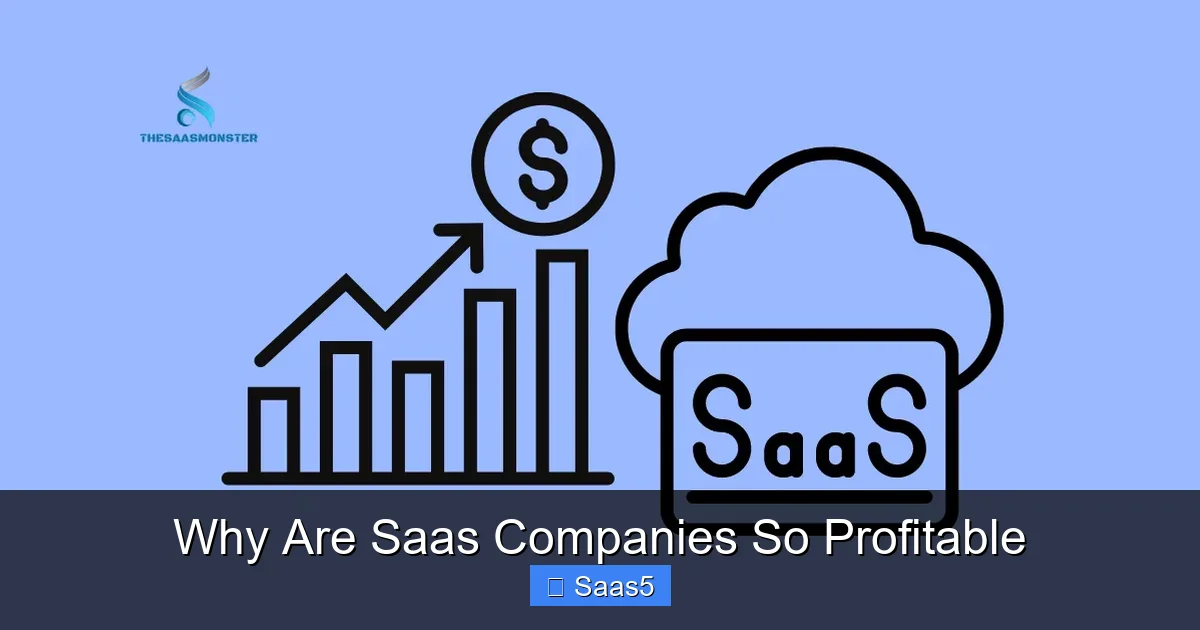
SaaS companies achieve exceptional profitability through a powerful combination of structural advantages. Their subscription model generates predictable, recurring revenue that grows over time. Marginal costs near zero mean each new customer adds almost pure profit. Scalability and high retention create compounding growth, while data and ecosystem lock-in build durable competitive moats. This isn’t luck—it’s a fundamentally different economic model.
Walk into any tech conference, scan a venture capital portfolio, or look at the stock market’s darlings, and one pattern screams for attention: Software-as-a-Service (SaaS) companies are wildly, almost bafflingly, profitable. From giants like Salesforce and Adobe to breakout startups like Slack and Zoom, the sector consistently produces high gross margins, strong cash flow, and market valuations that seem detached from traditional business logic. But why? It’s not magic, and it’s not just because they sell software.
The profitability of SaaS companies is a deliberate, engineered outcome of a fundamentally different business model. It’s the result of stacking several powerful economic principles—recurring revenue, negligible marginal costs, extreme scalability, and compounding retention—on top of each other. When these forces align, they create a financial engine that, once warmed up, can generate astonishing returns. This article will dissect the anatomy of SaaS profitability, moving beyond the surface-level “subscription model” explanation to reveal the deep structural and operational advantages that make this business model one of the most compelling in the modern economy.
Key Takeaways
- Recurring Revenue is King: Monthly/annual subscriptions create predictable cash flow, increase customer lifetime value (LTV), and allow for premium valuations based on revenue multiples.
- Near-Zero Marginal Costs: Once software is built, serving an additional customer costs almost nothing, leading to skyrocketing gross margins (often 80-90%).
- Scalability is Built-In: Cloud infrastructure allows SaaS products to scale to millions of users without proportional cost increases, turning product adoption directly into profit.
- Retention Fuels Growth: Low churn rates mean revenue compounds annually as new sales layer on top of the retained base, creating a “snowball” effect.
- Data Creates Moat: Aggregated user data improves the product, personalizes experiences, and creates switching costs that protect market position and pricing power.
- Operational Leverage: Automated delivery, self-service onboarding, and efficient customer success maximize operating leverage as revenue grows.
- Ecosystem Stickiness: Integrations, APIs, and embedded workflows make products central to business operations, drastically increasing the cost of switching for customers.
📑 Table of Contents
- The Recurring Revenue Engine: Predictability is Priceless
- The Marginal Cost Mirage: Why Serving One More User is Almost Free
- Scalability and Compounding: The Snowball Effect
- Customer Acquisition & The Path to Efficiency
- The Data & Ecosystem Moats: Profitability’s Defensive Walls
- Operational Efficiency: Automating the Profit Engine
- Conclusion: A Model Built for Profit, Not Just Growth
The Recurring Revenue Engine: Predictability is Priceless
At its heart, the shift from a perpetual license to a subscription model is the first and most critical profit driver. Traditional software companies had a “hockey stick” revenue graph: huge spikes when a new version launched, followed by long troughs. This made financial planning, investment, and valuation a nightmare.
How Subscription Transforms the Financial Landscape
A SaaS company’s revenue is a smooth, ascending curve. Every month, a predictable portion of its customer base renews, and new customers subscribe. This predictability does three profound things for profitability:
- Lowers Customer Acquisition Cost (CAC) Payback Period: Because revenue comes in monthly, the cost of acquiring a customer (sales, marketing) is recouped over a shorter, more predictable timeframe. Investors and managers can aggressively reinvest in growth, knowing the return is steady.
- Enables Premium Valuation: Public markets value companies on revenue multiples. A company with 95% annual recurring revenue (ARR) retention and predictable growth trades at a 10x, 15x, or even 20x multiple. That “multiple” is a direct reflection of perceived profitability and risk. A lumpy, unpredictable revenue stream might trade at 3x.
- Fuels Iterative Product Investment: Steady cash flow allows for continuous, smaller R&D investments instead of betting the farm on a monolithic release every few years. This leads to better products, which drive better retention, which feeds the revenue engine.
Practical Example: Adobe’s transition to Creative Cloud in 2013 is the textbook case. Their stock, which had been stagnant, rocketed as investors priced in the shift from unpredictable upgrade cycles to a smooth, growing subscription stream. The market wasn’t just valuing software sales; it was valuing a predictable, high-margin revenue stream.
The Net Revenue Retention (NRR) Multiplier
Here’s where the real magic happens. In SaaS, you don’t just keep the customers you have; you ideally grow revenue from them. This is measured by Net Revenue Retention (NRR). An NRR over 100% means even if you stopped all new sales, your revenue would still grow from existing customers through upsells, cross-sells, and price increases.
Top-tier SaaS companies boast NRRs of 110-130%. This means the “core” business is compounding on its own. Profitability explodes because the cost to serve an existing customer is a fraction of the cost to acquire a new one. Every dollar of upsell is near-pure profit. This creates a profitability flywheel: better product → higher retention/expansion → more cash to invest in product → better product.
The Marginal Cost Mirage: Why Serving One More User is Almost Free
This is the single biggest profit lever most people outside of tech fail to grasp. In a manufacturing business, selling 1,000 more units means buying 1,000 more units of raw materials, paying for more factory shifts, and shipping more boxes. The marginal cost is high.
Visual guide about Why Are Saas Companies So Profitable
Image source: images.unsplash.com
For a SaaS company, once the software is developed and hosted on cloud infrastructure (like AWS or Azure), the cost of adding one more user is functionally zero. The server capacity scales automatically. The support ticket might take 5 minutes instead of 4. The incremental cost is negligible.
Gross Margin: The Profitability Canary in the Coal Mine
This dynamic is why SaaS gross margins are astronomical—routinely 75% to 90%+. Gross margin is (Revenue – Cost of Goods Sold) / Revenue. For SaaS, COGS is primarily hosting costs, third-party software licenses (like Stripe for payments), and a sliver of support personnel. There is no inventory, no cost of materials, no shipping.
Contrast this with a hardware company with a 30% gross margin or a retailer with 40%. That 50-60% gross margin difference is a colossal competitive advantage. It means every dollar of revenue contributes far more to covering operating expenses (sales, marketing, R&D, admin) and ultimately, to profit. A company with 85% gross margins can afford to spend more on sales and marketing to grow faster than a company with 40% margins, all while staying profitable at a lower revenue scale.
The Scale Threshold: From Startup to Profit Machine
This is crucial. A brand-new SaaS startup has terrible unit economics. Its R&D costs are huge relative to its tiny revenue base. Its sales and marketing spend is high to find its first customers. It’s not profitable. But because marginal costs are near zero, there is a magical point—often around $10-20M in ARR—where the business model “tips.”
At this inflection point, the revenue from the existing customer base is so large that the near-zero marginal cost of serving them means the gross profit dollars start to massively outpace the fixed operating costs. The company reaches “cash flow breakeven” and then profitability. This scale threshold is much lower for SaaS than for any other business model. You don’t need to be a global conglomerate; you need a few thousand loyal customers paying $100/month to reach a highly profitable scale.
Scalability and Compounding: The Snowball Effect
Recurring revenue and low marginal costs are powerful alone. Together, they create a compounding engine that is rare in business. Let’s trace a hypothetical but realistic SaaS company:
Visual guide about Why Are Saas Companies So Profitable
Image source: enreap.com
- Year 1: 100 customers, $1,200 ARR each = $120k ARR. High churn, high CAC. Losses.
- Year 3: 1,000 customers, $1,300 ARR (due to product expansion), 8% monthly churn. ARR ~$1.5M. Gross margins at 80%. Still investing heavily. Breakeven in sight.
- Year 5: 5,000 customers, $1,500 ARR. Churn reduced to 5% monthly through better onboarding. New sales add $1M ARR. Existing customers expand by $300k. Total new ARR = $1.3M. ARR now ~$7.5M. With 80% gross margins, gross profit is $6M. Operating expenses might be $4M. Profit.
Notice in Year 5, the company added $1M in *new* ARR from sales, but the *total* ARR grew by $1.3M because the existing base expanded. That $300k of “free” revenue comes with almost zero acquisition cost. This is compounding. Each year, the retained revenue base becomes a larger contributor to total growth, making profitability easier to achieve and sustain.
The Power of Negative Churn
When expansion revenue (upsells) from existing customers exceeds the revenue lost to churn, you have negative churn. This is the holy grail. It means your customer base is not just retaining; it’s organically growing in value. Companies with negative churn can grow profitably even if they slash their sales and marketing budget. They have an internal growth engine that is almost pure profit. This is a structural advantage no product-based business can match. A supermarket can’t reliably sell more groceries to its existing customers every year without opening new locations or launching new product lines.
Customer Acquisition & The Path to Efficiency
If SaaS profitability is so great, why aren’t all SaaS companies profitable? The answer lies in the other side of the equation: Customer Acquisition Cost (CAC). You can have the best gross margins in the world, but if you spend $2 to acquire a customer who only generates $1 in lifetime gross profit, you lose money.
Visual guide about Why Are Saas Companies So Profitable
Image source: e2z4bvoss6u.exactdn.com
The path to profitability is mastering the CAC Payback Period—the number of months it takes for a customer’s gross profit to cover the cost of acquiring them. Venture-backed growth-stage SaaS often targets a payback of 12-18 months. A truly efficient, profitable SaaS business aims for a payback under 12 months, and ideally under 6.
Efficiency Levers: Product-Led Growth & Self-Service
The most profitable SaaS companies don’t rely solely on expensive, enterprise sales teams. They use a Product-Led Growth (PLG) motion. The product itself is the primary acquisition, conversion, and expansion channel.
- Freemium/Free Trial: Users experience core value at no cost, converting to paid plans based on their own perceived need. Acquisition cost is near zero (just hosting). Slack and Zoom are masters of this.
- Self-Serve Sign-Up: A credit card and an email. No salesperson needed for small deals. This automates the bottom of the funnel, drastically reducing CAC.
- In-Product Upsells: The moment a team hits a usage limit or needs an advanced feature, the upgrade prompt appears contextually. This is the highest-conversion, lowest-cost expansion channel possible.
Tip for Founders: Design your pricing and packaging to encourage self-service for small deals and easy, automated upgrades. The more you can move upmarket with a hybrid model (PLG for SMB, sales for enterprise), the more efficient your overall CAC becomes.
The LTV:CAC Ratio: The Golden Metric
All paths lead to the Lifetime Value to Customer Acquisition Cost (LTV:CAC) ratio. A ratio of 3:1 or 4:1 is considered healthy. It means for every dollar spent on marketing/sales, you generate $3-4 in gross profit over the customer’s lifetime.
Achieving this requires:
- High Gross Margins (we have that).
- Low Churn (to extend customer lifetime and increase LTV).
- Efficient CAC (through PLG, efficient sales motions).
- Strong Expansion Revenue (to boost LTV without new CAC).
When a SaaS company hits and maintains a 4:1 LTV:CAC, it can confidently increase its sales and marketing spend, knowing each new dollar spent will be multiplied. This is the lever that turns profitable companies into hyper-growth, still-profitable companies.
The Data & Ecosystem Moats: Profitability’s Defensive Walls
Profitability is nice, but sustainable profitability requires a moat—a competitive advantage that protects your margins from erosion. SaaS companies build two incredibly powerful, intertwined moats: data and ecosystem.
Data: The Compound Interest of Business Intelligence
Every click, every workflow, every collaboration in a SaaS product generates data. Over years, this aggregates into a proprietary dataset that becomes a product in itself.
- Product Improvement: Data shows which features are used, where users get stuck. This allows for data-driven development, creating a better product that competitors without that data can’t match. Think of Netflix’s recommendation algorithm versus a new entrant with no viewing data.
- AI/ML Advantage: Modern SaaS is embedding AI. The quality of an AI feature (e.g., Salesforce’s Einstein, Grammarly’s suggestions) is directly proportional to the volume and quality of training data. First-mover SaaS companies accumulate this data moat over years, making it almost impossible for a startup to replicate the intelligence.
- Benchmarking & Insights: Aggregate, anonymized data can be sold back to customers as industry benchmarks (e.g., “your sales cycle is 20% longer than the median for your industry”). This creates a new revenue stream and deeply embeds the product as a strategic tool, not just a utility.
Ecosystem Lock-In: The Switching Cost Multiplier
Data moats are powerful, but ecosystem moats are often the ultimate profit protector. A SaaS product doesn’t live in a vacuum; it becomes a hub. Think of Salesforce as a central nervous system for a sales team, or Slack as the communication hub.
This happens through:
- APIs and Integrations: Customers build custom workflows connecting the SaaS product to dozens of other tools (ERP, marketing automation, HR systems). The product becomes the glue. Replacing it means rebuilding all those connections—a project so costly and disruptive it’s rarely attempted.
- Embedded Workflows: Teams design their entire operational processes around the tool. The “way we work” is encoded in the software. The switching cost is no longer just a software fee; it’s retraining, lost productivity, and operational risk.
- Marketplace/App Store: Platforms like Salesforce’s AppExchange or Shopify’s app store create an entire economy on top of the core product. Customers invest in custom apps and third-party integrations, multiplying the lock-in effect.
Result: This ecosystem stickiness allows SaaS companies to raise prices annually with minimal churn. Customers grumble, but the cost of leaving is far higher than the cost of staying. This pricing power is a direct, powerful driver of sustained profitability and margin expansion over time.
Operational Efficiency: Automating the Profit Engine
The final piece of the profitability puzzle is operational excellence. The SaaS model inherently encourages efficiency, but top performers obsess over it.
Automating the Customer Journey
The ideal SaaS company has a frictionless, automated journey:
- Acquisition: Content, SEO, PLG funnels bring in leads at low cost.
- Onboarding: Interactive product tours, automated setup emails, and in-app guidance get users to their “aha moment” without human intervention. This reduces early churn dramatically.
- Support: Comprehensive knowledge bases, community forums, and AI chatbots handle tier-1 support. Human support is reserved for complex, high-value issues.
- Expansion: Usage-based alerts, in-app prompts, and automated billing handle upgrades.
Every human touchpoint removed or automated improves the gross margin and the CAC payback. A company that can onboard 10,000 new users a month with a small, automated team has a massive operational advantage over one that needs to hire 100 new support reps for the same volume.
The Cloud-Native Cost Structure
Modern SaaS is born in the cloud. This isn’t just a tech choice; it’s a profit choice. Cloud computing (AWS, Azure, GCP) converts large, fixed capital expenditures (buying servers) into small, variable operating expenses (paying for compute by the hour).
This provides:
- Elasticity: Scale up during usage spikes, scale down during lulls. No over-provisioning waste.
- Focus: Engineering talent focuses on product, not data center maintenance. This improves R&D efficiency.
- Global Scale: Launching in a new region doesn’t require building a new data center. It’s a cloud configuration. This enables rapid, capital-efficient global expansion.
The cloud, combined with modern DevOps (CI/CD, infrastructure as code), means the cost of running the software scales linearly—or even sub-linearly—with revenue. This is the operational manifestation of the near-zero marginal cost principle.
Conclusion: A Model Built for Profit, Not Just Growth
So, why are SaaS companies so profitable? The answer is a symphony of interconnected advantages:
They replaced unpredictable, one-time sales with recurring revenue, creating financial predictability that the market rewards with high valuations. They built on a foundation of near-zero marginal costs, generating gross margins that fund relentless growth. They harnessed the power of compounding retention and expansion, where the existing customer base fuels its own growth. They engineered efficient, automated customer acquisition through product-led motions to keep CAC in check. And they fortified their position with data and ecosystem moats that allow for sustained pricing power.
This is not to say every SaaS company is a profit machine. Many fail by mispricing, having high churn, or burning cash on inefficient sales. But the model itself is inherently profitable at scale. The profitability of the best-in-class SaaS companies—Snowflake, Atlassian, Cloudflare—is a testament to a business model where value is delivered continuously, costs are optimized for scale, and the customer relationship is a long-term partnership, not a transaction. It’s a model where, once the initial product-market fit is achieved and operational efficiency kicks in, the economic logic almost compels profitability. They aren’t just selling software; they’re building financial engines where each new user doesn’t just add revenue, it adds a stream of high-margin cash flow that compounds year after year. In the economy of the 21st century, that’s a powerful engine indeed.
Frequently Asked Questions
Is SaaS profitability sustainable long-term, or is it just a VC-fueled bubble?
SaaS profitability is structurally sustainable for companies that achieve product-market fit and operational efficiency. The model’s high gross margins and compounding revenue create inherent profitability at scale, as seen in public companies like Microsoft (Azure/Office 365) and Adobe. The “bubble” concerns often apply to overvalued, unprofitable growth-stage startups, not the core model itself.
How does high customer churn destroy SaaS profitability?
High churn directly attacks the compounding engine. It increases the CAC payback period, forces constant spending just to maintain revenue (the “leaky bucket” problem), and lowers LTV. A 5% monthly churn rate means you lose over 46% of your customers annually, making growth exponentially more expensive and profitability nearly impossible.
Can a SaaS company be profitable with a low-cost, self-service model?
Absolutely, and this is often the most profitable path. Companies like Mailchimp (before acquisition) and Calendly built massive, highly profitable businesses with minimal sales teams. Their low CAC from self-service, combined with high gross margins and solid retention, created efficient, cash-flow-positive businesses from an early stage.
What’s the biggest mistake SaaS companies make that hurts profitability?
Over-investing in sales and marketing for the wrong customer segment or before achieving a solid LTV:CAC ratio. Blowing cash on generic ads or a large salesforce to acquire customers who don’t stick around or expand is the fastest way to burn money. Profitability requires disciplined, efficient growth aligned with a sticky product.
Do all SaaS companies have the same profit potential?
No. Profit potential varies dramatically by segment. Vertical SaaS (e.g., healthcare, legal) often commands higher prices and has lower churn due to mission-critical workflows, leading to better economics. Horizontal SaaS (e.g., project management) faces more competition and may have lower price points, requiring greater scale to achieve similar profitability.
How do network effects boost SaaS profitability?
Network effects occur when a product becomes more valuable as more people use it (e.g., Slack, Figma). This creates a powerful, self-reinforcing moat. It drives viral, low-CAC growth, increases retention (your team is already there), and allows for premium pricing because the collaborative value is unique. This dramatically improves LTV and overall profitability.