How Much Ram Can a Laptop Have

The maximum RAM a laptop can handle isn’t a single number—it’s a puzzle determined by your motherboard, CPU, and operating system. While modern gaming and workstation laptops often support 32GB to 64GB, ultrabooks and older models may be capped at 16GB or even 8GB. Always check your specific model’s official specifications before buying RAM, as exceeding the manufacturer’s limit can cause instability. More RAM eliminates slowdowns from multitasking and large applications, but it’s only one part of the performance equation.
Key Takeaways
- Hardware Dictates the Hard Limit: Your laptop’s motherboard chipset and CPU memory controller establish the absolute maximum RAM capacity, which is non-negotiable.
- OS Matters, But 64-Bit is King: A 32-bit operating system artificially caps usable RAM at ~4GB, while modern 64-bit Windows and macOS support theoretical limits far beyond current hardware capabilities.
- Typical Modern Ranges Vary Widely: In 2024, expect mainstream laptops to max at 32GB, high-performance models at 64GB, and some mobile workstations to reach 128GB, with budget/ultrabooks often soldered at 8-16GB.
- Always Verify Your Exact Model: Use tools like Crucial’s System Scanner, check your laptop’s manual, or visit the manufacturer’s support page to find the confirmed, tested maximum RAM for your specific configuration.
- Dual-Channel Performance is Key: For optimal speed, install RAM in matching pairs (e.g., two 8GB sticks) if your laptop supports dual-channel mode, rather than a single larger stick.
- Upgrading is Cost-Effective, But Not a Cure-All: Adding RAM is one of the best performance upgrades, but it won’t fix a slow hard drive or an underpowered CPU. Ensure your other components are adequate for your tasks.
- Future-Proof Based on Your Needs: Consider your software requirements 3-5 years out. For general use, 16GB is the new sweet spot; for content creation or engineering, 32GB+ is a wise investment.
📑 Table of Contents
- Understanding the RAM Question: It’s Not a Simple Answer
- The Hardware Ceiling: Your Motherboard and CPU Are the Bosses
- Operating System Boundaries: The 32-bit vs. 64-bit Chasm
- Current Market Realities: What Do Laptops Actually Support in 2024?
- How to Determine Your Laptop’s Exact Maximum RAM: A Step-by-Step Guide
- Future-Proofing and Practical Advice: How Much RAM Do You *Really* Need?
- The Upgrade Process: Compatibility and Installation Basics
- Conclusion: Knowledge is Power (and Better Performance)
Understanding the RAM Question: It’s Not a Simple Answer
You’ve likely asked it: “How much RAM can my laptop have?” You’re imagining a single, universal number—like all laptops can take 32GB or 64GB. The frustrating, liberating truth is: there is no one-size-fits-all answer. The maximum RAM your specific laptop can support is a unique fingerprint, determined by a combination of hardware decisions made by engineers years before you buy the machine. Think of it like asking how much weight a bridge can hold. The answer depends on the materials, the design, the year it was built, and the local building codes. Your laptop’s RAM limit is its own “bridge,” and we’re here to give you the blueprint to read it.
This article will be your complete guide. We’ll move beyond vague advice and dive into the three pillars that define your RAM ceiling: the physical hardware (motherboard and CPU), the rules set by your operating system, and the practical realities of the laptop market. We’ll give you the exact tools and steps to find the number for your machine, explain what that number means for your daily tasks, and help you decide how much is truly enough for a smooth, future-ready experience. Forget guessing—let’s get you the facts.
The Hardware Ceiling: Your Motherboard and CPU Are the Bosses
Before an operating system even loads, the physical components of your laptop have already drawn the line in the sand. The two primary hardware arbiters of RAM capacity are the motherboard chipset and the CPU’s integrated memory controller (IMC). They work in tandem, and if either says “no,” that’s the final word.

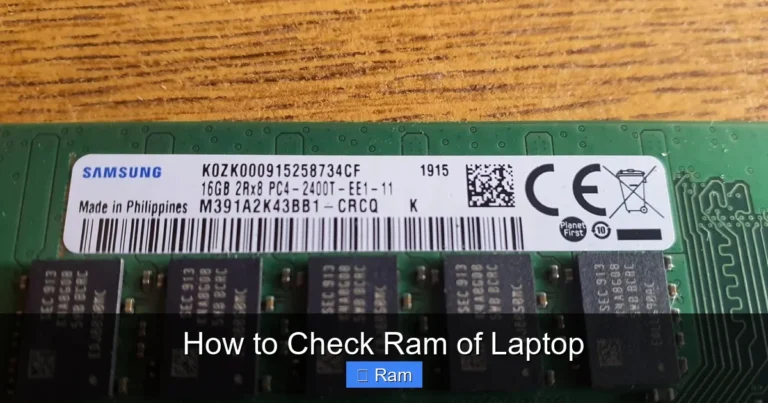
Visual guide about How Much Ram Can a Laptop Have
Image source: robots.net
The Motherboard Chipset: The Traffic Controller
The chipset is the central hub on your motherboard that manages data flow between the CPU, RAM, storage, and peripherals. It has a fundamental limit on how many memory “addresses” it can handle. This is often expressed in the number of memory “ranks” or total gigabytes it supports. A chipset from 2015 might max out at 32GB total across its slots, while a 2023 Intel HX-series or AMD Ryzen 7040HS chipset can address 128GB or more. The chipset also dictates how many physical RAM slots (SO-DIMMs) are available—usually two in most laptops, but sometimes just one (soldered), or rarely, four in massive desktop-replacement models.
The CPU’s Memory Controller: The Final Gatekeeper
Modern CPUs have the memory controller built directly into the chip itself, not on the separate motherboard chipset. This design improves speed but means the CPU itself has a hard limit. For example, Intel’s 10th Gen Comet Lake H-series processors officially support up to 128GB of RAM, while a lower-power U-series chip from the same generation might only support 64GB. AMD’s Ryzen 7 7840HS supports up to 64GB, but the older Ryzen 5 5600U is capped at 32GB. You must check the specifications for your exact CPU model, not just the brand or series.
Physical and Electrical Constraints
Beyond the logical limits, there are real-world physical ones. Laptop RAM modules (SO-DIMMs) come in specific capacities—typically 4GB, 8GB, 16GB, 32GB, and now 64GB modules. Your laptop’s slots must physically accommodate the module’s size and pin count (260-pin for DDR4/DDR5). There’s also a power draw consideration; high-capacity, high-speed modules may draw more power than the laptop’s design can supply, especially in ultra-thin models. This is why you’ll rarely see a 13-inch ultrabook supporting 64GB, even if the chipset technically could.
Operating System Boundaries: The 32-bit vs. 64-bit Chasm
Even if your hardware could theoretically handle 128GB, your operating system can throw a giant wrench in the works. The distinction between 32-bit (x86) and 64-bit (x64) operating systems is critical here, though it’s becoming largely historical for new laptops.

Visual guide about How Much Ram Can a Laptop Have
Image source: robots.net
The 4GB Glass Ceiling of 32-Bit
A 32-bit OS uses a 32-bit memory address space. This means it can only “see” and use 2^32 bytes of memory, which is 4,294,967,296 bytes—or approximately 4GB. In practice, due to system reservations, a 32-bit Windows or Linux system will only show and use about 3.2GB to 3.5GB of RAM, no matter how many sticks you install. Any laptop with more than 4GB of RAM must run a 64-bit operating system to utilize it. All consumer laptops sold new since about 2016 have come with 64-bit Windows pre-installed for this reason.
64-Bit Theoretical Limits vs. Real-World Use
64-bit systems have a colossal theoretical limit: 2^64 bytes, which is 16 exabytes (16 million terabytes). The real limits are imposed by the specific OS edition:
- Windows 11/10 Home: Supports up to 128GB.
- Windows 11/10 Pro, Pro for Workstations, Enterprise: Supports up to 2TB (Windows 10/11 Pro) or 6TB (Pro for Workstations).
- macOS: Modern versions (Ventura, Sonoma) on Apple Silicon Macs have limits tied to the SoC, but they are very high (e.g., M3 supports up to 128GB on some models). Intel-based Macs followed similar Intel CPU limits.
The key takeaway: Your 64-bit OS will not be the bottleneck for any RAM configuration you can actually buy for a laptop today. The hardware limits we discussed first are always tighter. If you’re running a 32-bit OS on an old laptop, upgrading to a 64-bit OS (if the CPU supports it) is a prerequisite for using more than 4GB.
Current Market Realities: What Do Laptops Actually Support in 2024?
Now for the practical, shopper-focused view. Here’s a breakdown of typical maximum RAM configurations you’ll encounter, segmented by laptop category. Remember, these are general ranges; always confirm your exact model number.

Visual guide about How Much Ram Can a Laptop Have
Image source: robots.net
Mainstream & Business Laptops (e.g., Dell Latitude, Lenovo ThinkPad T-series, HP EliteBook)
These are the workhorses. In the last 2-3 years, the standard has shifted from 16GB to 32GB as the maximum user-upgradeable or configured option. Many newer models in the 14-16 inch range offer two SO-DIMM slots, with a max of 32GB per slot (64GB total). Some older or slimmer models may have one slot and one soldered module, limiting upgrades. For example, a 2022 ThinkPad T14 Gen 3 (AMD) supports up to 64GB (2x32GB), while a 2021 ThinkPad X1 Carbon (Intel) is limited to 32GB (2x16GB) due to its chipset and design.
Gaming Laptops & High-Performance Mobile Workstations
This segment pushes the limits. Modern gaming laptops from brands like ASUS ROG, Lenovo Legion, and MSI often use Intel HX-series or AMD HX-series processors paired with chipsets that support 128GB. You’ll frequently see configurations offering 32GB as standard and 64GB as a high-end option. Some massive 17-inch models with four RAM slots can even support 128GB (4x32GB). Mobile workstations like the Dell Precision or HP ZBook, designed for CAD and video editing, are the champions, with many 2023+ models officially supporting 128GB or even 192GB of RAM, using specialized high-capacity modules.
Ultrabooks & Thin-and-Light Laptops
This is where the most severe limitations live. To achieve svelte designs, manufacturers almost universally solder the RAM directly to the motherboard. This means no user upgrades are possible at all. The RAM capacity is fixed at the time of purchase. In 2022-2023, common soldered configurations are 8GB, 16GB, and increasingly 32GB. Finding a new ultrabook with 64GB soldered is rare and typically found only in the highest-end professional models (like certain MacBook Pros or Dell XPS 17). Always check if the RAM is “soldered” or “upgradeable” in the specs. If it’s soldered, the amount you buy is what you’re stuck with forever.
Budget & Entry-Level Laptops
These often use older, lower-power processors (like Intel Pentium, Celeron, or AMD Athlon) with chipset limits of 16GB or 32GB. They frequently have only one RAM slot, with the other position either empty or also soldered. A typical $400 laptop from a few years ago might max at 16GB (1x16GB in the slot + 0 soldered, or 8GB soldered + 8GB slot). Don’t expect more than 32GB here.
How to Determine Your Laptop’s Exact Maximum RAM: A Step-by-Step Guide
Enough with generalizations. Here is your actionable plan to find the definitive answer for the laptop sitting on your desk or the one you’re about to buy.
Step 1: Identify Your Exact Laptop Model
This is the most critical step. “Dell Inspiron 15” is not enough. You need the full model number, usually found on a sticker on the bottom of the laptop or in the system information. It looks like “Dell XPS 13 9310,” “Lenovo ThinkPad T14 Gen 3 AMD,” or “HP Pavilion 15-ek1xxx.” Flip it over, find that label, and write down every letter and number.
Step 2: Consult the Official Manufacturer’s Specifications
Go to the laptop brand’s official support website (e.g., support.dell.com, lenovo.com/support). Enter your exact service tag or model number. Navigate to the “Specifications” or “Technical Details” page. Look for sections titled “Memory,” “Memory Specifications,” or “Upgradeability.” You will find a line that says something like: “Memory: 32GB, 2x SO-DIMM slots” or “Maximum Memory: 16GB (soldered).” This is the number you trust. It is tested and guaranteed by the manufacturer.
Step 3: Use Reliable Third-Party System Scanner Tools
Websites like Crucial.com (by Micron) and Kingston.com have excellent system scanner tools. You download and run a small application that analyzes your system’s hardware. It will tell you:
- How many slots you have.
- What is currently installed (size, speed, type).
- The maximum memory module size per slot and total supported.
These tools are very accurate because they cross-reference their vast database of laptop models with the known chipset/CPU limits. They are perfect for a quick, user-friendly check.
Step 4: Decode the CPU and Chipset (For the Technically Inclined)
If you want to dig deeper, you can identify your CPU (using Task Manager > Performance > CPU) and look up its official “Maximum Memory” specification on Intel’s ARK or AMD’s product pages. Then, find the chipset used in your laptop model (sometimes listed in the manual or on tech review sites). The lowest number between the CPU limit and the chipset limit is your theoretical maximum. However, the manufacturer’s official spec (Step 2) is the final word, as they may have chosen to implement a lower limit for stability or cost reasons.
Future-Proofing and Practical Advice: How Much RAM Do You *Really* Need?
Knowing the maximum is one thing; deciding what to buy is another. Here’s a practical guide based on use case, assuming your laptop’s maximum is at least 32GB (which covers most upgradeable 2020+ models).
The 2024 Sweet Spot: 16GB
For the vast majority of users—web browsing with 20+ tabs, office productivity (Word, Excel, PowerPoint), HD video streaming, and light photo editing—16GB is the new comfortable baseline. It allows for smooth multitasking without the constant memory pressure that causes slowdowns. If your laptop maxes at 16GB, this is the configuration to buy.
The Power User & Creator Standard: 32GB
Step up to 32GB if you: work with large Photoshop files or edit 4K video, run virtual machines for software testing, do serious data analysis in Excel or Python, play modern AAA games while streaming, or are a developer with multiple IDEs and containers running. This amount provides ample headroom for demanding applications and ensures your laptop feels fast for 4-5 years.
The “No Compromise” Professional Tier: 64GB+
Reserve this for true mobile workstations. If you’re editing 8K video, working with massive 3D assemblies in SolidWorks or Blender, running multiple heavy VMs simultaneously, or doing scientific computing with huge datasets, 64GB or 128GB is a professional necessity. For these users, RAM is the primary bottleneck, and investing in the maximum their laptop supports is a direct investment in productivity and time saved.
A Crucial Warning: The “Bottleneck” Effect
Adding RAM to a system with a slow hard drive (especially a traditional HDD) or a weak, old CPU will yield disappointing results. The system will still feel sluggish because it’s waiting on the storage or processor. The ideal upgrade path is: 1) Ensure you have an SSD. 2) Then, add sufficient RAM (to at least 16GB). 3) Finally, consider a CPU upgrade (which in laptops, usually means a new laptop). Always diagnose the slowdown with Task Manager (Ctrl+Shift+Esc). If your RAM usage is consistently above 80-90%, an upgrade will help. If it’s below 50% and your disk is at 100%, you need an SSD first.
The Upgrade Process: Compatibility and Installation Basics
You’ve found your max is 32GB. You have two 16GB DDR4-3200 SO-DIMMs ready to go. What next?
Compatibility Checklist: Speed, Type, and Voltage
RAM must match in type (DDR4 vs. DDR5—they are physically incompatible), speed (e.g., 3200MHz), and voltage (typically 1.2V for DDR4, 1.1V for DDR5). Your laptop’s specs or existing RAM will dictate this. You can usually install faster RAM than the base spec, and it will run at the highest speed your CPU/chipset supports (JEDEC speed). For example, installing DDR4-3200 in a laptop that officially supports DDR4-2666 will work, but it will run at 2666MHz. Mixing speeds is possible but will default all modules to the speed of the slowest module. For best dual-channel performance, use identical pairs (same brand, model, size, speed).
Installation: Simple but Delicate
For most laptops with accessible bottom panels, upgrading RAM is a 5-minute job. You’ll need a small Phillips screwdriver. Power off, unplug, remove the battery if possible (many are internal now), and ground yourself. Locate the RAM slots, gently pry open the side clips, and the module will pop up at an angle. Pull it out. Insert the new module at the same angle, aligning the notch, then press it down flat until the clips snap into place. Reassemble. If your laptop has a sealed bottom (common in ultrabooks), the RAM is soldered and cannot be upgraded.
Conclusion: Knowledge is Power (and Better Performance)
So, how much RAM can a laptop have? The answer is a spectrum. It’s a number etched by silicon and circuitry, not opinion. For some, it’s a fixed 8GB soldered into a sleek ultrabook. For others, it’s an expansive 128GB waiting to be unlocked in a mobile workstation. Your job is no longer to guess, but to discover. Use the steps we outlined—find your exact model, check the manufacturer’s specs, verify with a scanner tool—and turn that vague question into a specific, actionable number. Then, match that number to your real-world needs. Invest wisely in RAM, but always as part of a balanced system. With this knowledge, you’re no longer a passive buyer; you’re an informed owner, ready to squeeze every last bit of performance from your laptop, today and for years to come.
Frequently Asked Questions
Can I install more RAM than the manufacturer’s stated maximum?
Technically, you might be able to physically install a larger module (like a 32GB stick in a slot labeled for 16GB), but it is not supported, tested, or guaranteed to work. You risk system instability, failure to boot, or data corruption. Always adhere to the published maximum for your specific model.
Does the speed (MHz) of the RAM matter for performance?
Yes, but with diminishing returns. Faster RAM (e.g., DDR5-5600 vs. DDR5-4800) can provide small performance boosts in memory-intensive tasks like gaming, video editing, and integrated graphics performance. However, capacity (having enough GB) is almost always a more significant factor for overall system responsiveness than a small speed increase.
What’s the difference between DDR4 and DDR5, and does my laptop need DDR5?
DDR5 is the newer generation, offering higher speeds, better efficiency, and larger burst lengths. Your laptop’s CPU and motherboard chipset dictate which type it supports—they are not interchangeable. If your laptop uses DDR4, you must buy DDR4. If you’re buying new, a laptop with DDR5 is more future-proof, but for most users, the real-world performance difference between fast DDR4 and early DDR5 is minimal compared to the jump from 8GB to 16GB.
Can I mix RAM sizes, like an 8GB stick with a 16GB stick?
You can, and the system will use the total combined capacity (e.g., 24GB). However, for optimal dual-channel performance (which doubles the memory bandwidth), it’s best to use identical pairs. With mismatched sizes, the system will run in a hybrid “flex mode,” where part of the RAM runs in dual-channel and part in single-channel, which is less efficient.
My laptop shows 15.9GB usable out of 16GB installed. Is that normal?
Yes, this is completely normal. The operating system and your laptop’s integrated graphics (if it uses shared system memory) reserve a portion of the installed RAM for critical processes. You will never see 100% of the physical RAM listed as “usable” in Windows or macOS. A small discrepancy of 0.5GB to 1GB is expected.
Is upgrading RAM worth it on an old laptop?
It can be, but with caveats. If your old laptop has a traditional hard drive (HDD), upgrading to an SSD is the single greatest performance improvement you can make—far more impactful than adding RAM. Once you have an SSD, adding RAM (to at least 8GB, preferably 16GB) can breathe new life into a system for basic tasks. However, if the CPU is very old and slow, even with an SSD and 16GB of RAM, demanding modern software will still feel sluggish. Evaluate the whole system.