How to Connect 4 Speakers to 2 Channel Amplifier

Connecting four speakers to a two‑channel amp is easy when you understand wiring methods, impedance limits, and the right accessories. This guide walks you through bridge, parallel, and series‑parallel setups, shows how to protect your amp, and gives practical tips so you get full‑range sound without overheating your equipment. All you need is a few cables, a little math, and the confidence to wire it right.
Key Takeaways
- Know your amp’s impedance rating: Staying within the manufacturer’s limits prevents damage.
- Bridge mode doubles power: Use it only with speakers that can handle the lower impedance.
- Parallel wiring is simple but lowers impedance: Ideal for matching low‑impedance speakers.
- Series‑parallel combines strengths: Keeps overall impedance safe while powering four speakers.
- Use quality speaker wire and secure connections: Reduces resistance and noise.
- Consider a speaker selector or impedance‑matching transformer: Adds flexibility and protection.
- Test each step: Verify polarity and listen for distortion before finalizing.
📑 Table of Contents
Introduction
Imagine you’ve just bought a sleek two‑channel amplifier for your home theater or car audio upgrade, but you have four speakers waiting in the garage. You might think, “That won’t work – a two‑channel amp only has two outputs.” The good news is it does work, and you have several wiring options that let you power all four speakers without breaking the bank or the amp.
In this friendly, step‑by‑step guide we’ll explore three main methods—bridging, parallel wiring, and series‑parallel wiring—explain the math behind impedance, and share practical tips to keep your system safe and sounding great. By the end, you’ll feel confident to plug in those four speakers and enjoy richer, fuller sound.
Understanding the Basics: Channels, Impedance, and Power
What is a “channel”?
A channel is simply an output that sends an audio signal to a speaker. A two‑channel amp has a left (L) and a right (R) output. Each channel can drive one speaker, or you can combine speakers to share a channel.

Visual guide about How to Connect 4 Speakers to 2 Channel Amplifier
Image source: visor.ph
Impedance 101
Impedance, measured in ohms (Ω), is the speaker’s electrical resistance to the amp’s signal. Most home speakers are 8 Ω, car speakers are often 4 Ω. Amplifiers list a “minimum load” they can safely handle—commonly 4 Ω per channel. If you wire speakers so the total load drops below this, the amp can overheat and fail.
Power and Sensitivity
Power (watts) tells you how much energy the amp can deliver. Speaker sensitivity (dB @ 1 W/1 m) shows how loud a speaker gets with a given wattage. Matching power and sensitivity ensures you get volume without distortion.
Method 1: Bridging (Bi‑amping) the Amplifier
When to use bridging
Bridging combines the left and right channels into a single, more powerful channel. This is perfect when you have two pairs of speakers that can handle a lower impedance (usually 4 Ω) and you want maximum output for each pair.

Visual guide about How to Connect 4 Speakers to 2 Channel Amplifier
Image source: cbu01.alicdn.com
Step‑by‑step bridging guide
- Check the amp’s manual: Not all amps can bridge. Look for “bridgeable” or “BTL” (bridge‑tied load) specifications.
- Identify the bridge pins: Most amps label them “Bridge In” or “B”. Typically you’ll use the positive (+) of the left channel and the negative (–) of the right channel.
- Connect speaker pair A: Wire the positive terminal of the left channel to the positive terminal of the first speaker, and the negative terminal of the right channel to the negative terminal of the same speaker.
- Connect speaker pair B: Do the same with the remaining two speakers, using the opposite polarity (right‑channel positive to speaker positive, left‑channel negative to speaker negative).
- Set the amp to bridge mode: Usually a switch or a setting on the front panel.
- Verify impedance: Two 4 Ω speakers in bridge mode present a 4 Ω load—safe for most amps.
Pros and cons of bridging
- Pros: Doubles power per channel, simple wiring for two speaker pairs.
- Cons: Requires speakers that can handle lower impedance; you lose stereo separation if you bridge each pair separately.
Method 2: Parallel Wiring (All Four Speakers on One Channel)
Why parallel?
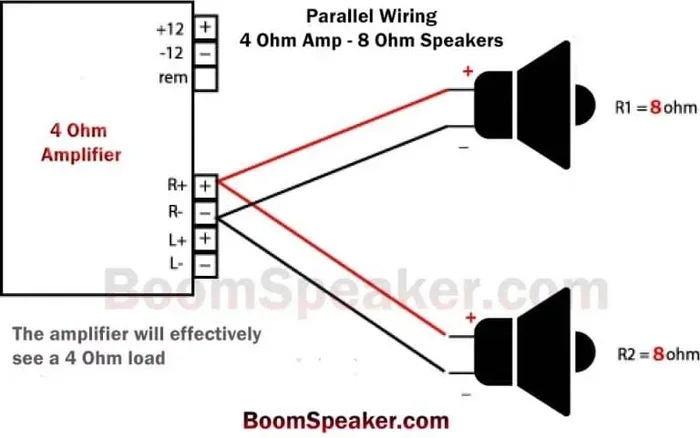
Parallel wiring ties the positive terminals together and the negative terminals together, letting one channel drive multiple speakers. This is the easiest method if you want all four speakers to receive the same signal (e.g., a front‑stage surround setup).

Visual guide about How to Connect 4 Speakers to 2 Channel Amplifier
Image source: png.pngtree.com
Calculating parallel impedance
The formula for two speakers in parallel is 1 / (1/R₁ + 1/R₂). For four identical speakers, it becomes 1 / (4 / R). Example: four 8 Ω speakers in parallel = 1 / (4 / 8) = 2 Ω. Most two‑channel amps can’t handle 2 Ω per channel, so you must use higher‑impedance speakers or a selector.
Using a speaker selector or impedance‑matching transformer
A speaker selector with built‑in impedance protection lets you safely connect multiple speakers in parallel. Alternatively, an impedance‑matching transformer (also called a “speaker load box”) can raise the overall load to a safe level.
Step‑by‑step parallel wiring with a selector
- Purchase a speaker selector: Look for one rated for at least 4 Ω per channel.
- Connect the amp’s left output to the selector’s input A, right output to input B.
- Wire each speaker to its own output on the selector. Keep polarity consistent (positive to positive, negative to negative).
- Turn on the selector’s impedance protection. This automatically switches resistors to keep the load safe.
- Power up and test. Start at low volume, check for distortion.
Pros and cons of parallel wiring
- Pros: Simple, all speakers get the same signal, works with most amps when using a selector.
- Cons: Requires extra hardware, may lower overall volume if impedance is too low.
Method 3: Series‑Parallel (Hybrid) Wiring
What is series‑parallel?
Series‑parallel (also called “series‑parallel”) combines the benefits of both methods. You wire two speakers in series (positive to negative) to raise impedance, then wire that pair in parallel with another series pair. This often results in a safe 4 Ω load for a two‑channel amp.
Example calculation
Two 8 Ω speakers in series = 16 Ω. Two such series pairs in parallel = 1 / (1/16 + 1/16) = 8 Ω. So each channel sees an 8 Ω load—well within safe limits.
Step‑by‑step series‑parallel wiring
- Group speakers into pairs: Pair 1 (Speaker 1 & 2), Pair 2 (Speaker 3 & 4).
- Wire each pair in series: Connect the positive terminal of Speaker 1 to the amp’s positive output. Connect Speaker 1’s negative to Speaker 2’s positive. The negative of Speaker 2 goes back to the amp’s negative output.
- Repeat for the second pair on the other channel.
- Check polarity: All positive terminals face the amp’s positive, negatives face the amp’s negative.
- Measure total impedance: Use a multimeter or calculate to confirm it matches the amp’s rating.
- Power up and listen. Adjust volume gradually.
Pros and cons of series‑parallel
- Pros: Keeps impedance safe without extra gear, works with most speaker combos.
- Cons: Slightly more complex wiring, may affect tonal balance if speakers differ.
Essential Tools and Materials
What you’ll need
- Speaker wire (16‑14 gauge for home use, 12‑10 gauge for car audio)
- Wire cutters/strippers
- Crimp connectors or banana plugs (optional but tidy)
- Multimeter (to verify impedance)
- Speaker selector or impedance‑matching transformer (if using parallel wiring)
- Electrical tape or heat‑shrink tubing
Choosing the right wire gauge
Long runs need thicker wire to reduce resistance. A good rule: for runs under 25 ft, 16 AWG is fine; over 25 ft, step up to 14 AWG. In cars, use 12‑10 AWG to handle higher current.
Safety Tips and Common Mistakes to Avoid
Never exceed the amp’s minimum impedance
If the amp is rated for 4 Ω minimum per channel, don’t drop below that. Doing so can cause overheating, distortion, and permanent damage.
Frequently Asked Questions
What is how to connect 4 speakers to 2 channel amplifier?
how to connect 4 speakers to 2 channel amplifier is an important topic with many practical applications.