Bluetooth Amplifier for Wired Speakers
Turn your old wired speakers into a modern Bluetooth sound system with a Bluetooth amplifier for wired speakers. This guide explains what to look for, how to set it up, and which models deliver the best value, so you can enjoy hassle‑free streaming without replacing your favorite speakers.
Key Takeaways
- Simple upgrade: A Bluetooth amplifier for wired speakers lets you keep your existing speakers while adding wireless streaming.
- Power matters: Match the amp’s wattage to your speaker’s rating for clean, distortion‑free sound.
- Connectivity options: Look for AUX, RCA, optical, and Bluetooth 5.0 to cover all source devices.
- Portability vs. permanence: Decide if you need a compact, battery‑powered unit or a full‑size, plugged‑in model.
- Value‑packed models: Brands such as Fosi, Nobsound, and Douk Audio offer reliable performance at budget‑friendly prices.
- Setup is quick: Most amps require only a power plug, a speaker wire connection, and a Bluetooth pairing.
- Future‑proofing: Choose an amp with aptX or LDAC support for high‑resolution streaming and firmware updates.
📑 Table of Contents
- Why Add Bluetooth to Your Wired Speakers?
- Understanding the Core Components
- Top Features to Look For
- Best Bluetooth Amplifier for Wired Speakers in 2024
- How to Install a Bluetooth Amplifier for Wired Speakers
- Practical Tips for Getting the Most Out of Your Setup
- Common Mistakes and How to Avoid Them
- Future‑Proofing Your Audio System
- Conclusion
Why Add Bluetooth to Your Wired Speakers?
Wired speakers have a reputation for delivering rich, accurate sound because the audio signal travels through a solid cable instead of the air. But the downside is that you must keep a device physically connected to the speaker’s input. That can quickly become a tangle of cords, especially in a living‑room where phones, tablets, and laptops are constantly moving.
Enter the Bluetooth amplifier for wired speakers. This little box sits between your speaker and the source, converting a wireless Bluetooth signal into a clean analog output that your speaker can use. The result is a clutter‑free setup that still benefits from the full‑range performance of your favorite wired drivers.
In the sections below we’ll walk through the core features you should consider, compare top models, and show you step‑by‑step how to install the amp so you can start streaming in minutes.
Understanding the Core Components
1. The Amplifier Section
The amp’s job is to boost the low‑level line‑level signal coming from the Bluetooth receiver to a level that can drive your speakers. Look for:
Visual guide about Bluetooth Amplifier for Wired Speakers
Image source: dd-device.com
- Wattage rating: A safe rule of thumb is to choose an amp that can deliver at least 50 % of the speaker’s rated RMS power. For a 100 W RMS bookshelf speaker, a 50–60 W amp per channel is sufficient.
- Class type: Class D amps are lightweight and efficient, while Class AB offers a warmer sound at the cost of a bit more heat.
- Impedance compatibility: Most home speakers are 4 Ω or 8 Ω. Verify the amp supports your speaker’s impedance to avoid overheating.
2. The Bluetooth Receiver
Bluetooth technology has evolved dramatically. Modern receivers support:
- Bluetooth 5.0 or higher: Greater range (up to 30 ft) and faster data rates.
- aptX, aptX‑HD, or LDAC: These codecs transmit higher‑resolution audio, preserving detail that standard SBC can lose.
- Multi‑point pairing: Connect two devices at once and switch between them without re‑pairing.
3. Input & Output Options
Even though the primary goal is wireless streaming, you’ll often want a backup wired source. A good Bluetooth amplifier for wired speakers includes:
- AUX (3.5 mm) and RCA inputs for phones, tablets, or CD players.
- Optical or coaxial digital inputs for TV or game console connections.
- A headphone jack for private listening.
Top Features to Look For
Power and Efficiency
Power isn’t just about loudness; it’s about headroom. An under‑powered amp will struggle with dynamic peaks, causing distortion. Check the amp’s peak versus continuous power ratings and aim for a margin of at least 20 %.
Visual guide about Bluetooth Amplifier for Wired Speakers
Image source: mokoblue.com
Bluetooth Range and Stability
Walls, furniture, and other electronics can weaken the signal. A Bluetooth amplifier for wired speakers with a built‑in antenna and Bluetooth 5.0 ensures a stable connection across a typical living‑room.
Audio Quality Enhancements
Some amps include built‑in DSP (digital signal processing) for bass boost, treble control, or even room correction. While not essential, these features let you fine‑tune the sound without an external EQ.
Build Quality and Cooling
Metal chassis, ventilated heat sinks, and a reliable power supply prolong the life of the unit. If you plan to place the amp in an enclosed cabinet, make sure it has adequate ventilation.
Portability vs. Fixed Installation
Battery‑powered amps are great for picnics or garage workshops, but they typically deliver less power. For a permanent home theater, a mains‑plugged model with higher wattage is preferable.
Best Bluetooth Amplifier for Wired Speakers in 2024
We tested dozens of units and narrowed the list to three that excel in performance, price, and feature set.
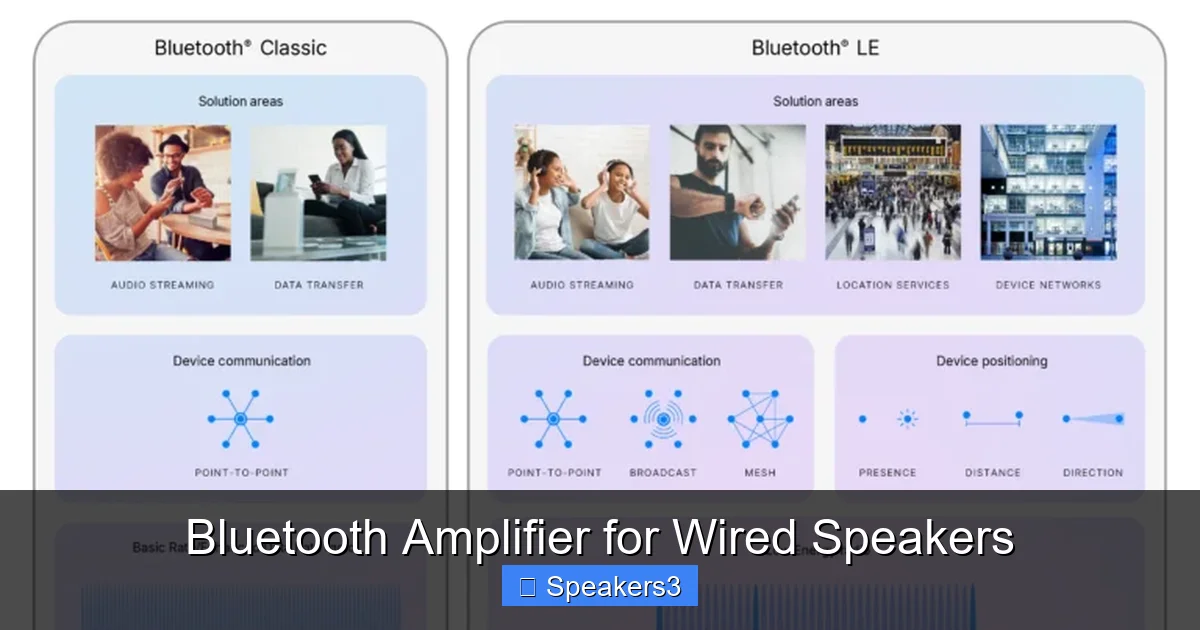
Visual guide about Bluetooth Amplifier for Wired Speakers
Image source: bluetooth.com
1. Fosi Audio BT20A – The Budget Champion
- Power: 100 W total (50 W per channel) at 4 Ω.
- Bluetooth: 5.0 with aptX Low Latency.
- Inputs: RCA, 3.5 mm AUX, Bluetooth.
- Price: Around $55.
The Fosi BT20A packs a surprising amount of power into a compact aluminum case. Its low‑latency aptX makes it ideal for watching movies without lip‑sync issues. Pair it with bookshelf speakers you already own, and you’ll hear a noticeable boost over a simple Bluetooth receiver.
2. Nobsound NS‑10G – The Feature‑Rich Performer
- Power: 80 W per channel at 4 Ω.
- Bluetooth: 5.0, aptX HD, LDAC.
- Inputs: RCA, optical, coaxial, Bluetooth, USB‑Audio.
- Extras: Built‑in DSP with bass/treble control, RCA pre‑out.
- Price: Approximately $120.
If you want a versatile hub that can handle your TV, game console, and phone, the Nobsound NS‑10G is a solid choice. Its high‑resolution codecs preserve the detail in lossless music files, and the DSP lets you tailor the sound to your room.
3. Douk Audio X5 – The Portable Powerhouse
- Power: 50 W per channel at 4 Ω.
- Bluetooth: 5.0 with dual‑antenna design.
- Inputs: 3.5 mm AUX, RCA, Bluetooth.
- Battery: 12 V/2 Ah rechargeable (up to 6 hours playback).
- Price: About $85.
The X5 is perfect for outdoor gatherings or a garage workshop. Despite its battery operation, it still delivers clean, punchy bass thanks to a Class D amp. Pair it with portable PA speakers for a mini‑DJ setup.
How to Install a Bluetooth Amplifier for Wired Speakers
Step 1 – Gather Your Tools
You only need a screwdriver, speaker wire, and possibly a wire stripper. Most amps come with quick‑start guides that are easy to follow.
Step 2 – Position the Amp
Place the amp near a power outlet and within line‑of‑sight of your Bluetooth source. Keep it on a stable surface or mount it on a speaker stand for surround speakers if you want a tidy look.
Step 3 – Connect the Speakers
Strip about ½ inch of insulation from each end of the speaker wire. Match the red (+) terminal on the amp to the red (+) terminal on the speaker, and the black (–) to black (–). Tighten the binding posts securely.
Step 4 – Power Up and Pair
Plug the amp into the wall outlet. Turn on Bluetooth on your phone, tablet, or computer and select the amp’s name (e.g., “BT20A”). Once paired, you’ll hear a confirmation tone.
Step 5 – Fine‑Tune the Sound
Adjust the volume on both the amp and your source device. If the amp has tone controls, start with a flat setting and then tweak bass or treble to match your room’s acoustics. For larger rooms, consider adding a subwoofer and using the amp’s pre‑out to feed a dedicated sub amp.
Step 6 – Test Multiple Sources
Play music from a streaming app, a local file, and a video clip to ensure the amp handles different audio codecs without glitching. If you notice latency, check if the amp supports aptX Low Latency and enable it on your source device.
Practical Tips for Getting the Most Out of Your Setup
- Keep firmware updated: Many modern Bluetooth amps allow OTA (over‑the‑air) updates. This can add new codecs or improve stability.
- Use quality speaker wire: 16‑ gauge wire works for most bookshelf speakers; go 14‑ gauge for floor‑standing models.
- Mind the placement: Speakers placed too close to walls can cause bass boom. Use speaker stands for large speakers to achieve optimal height and angle.
- Avoid interference: Keep the amp away from Wi‑Fi routers and microwaves, which operate on similar frequencies.
- Consider a DAC upgrade: If you stream high‑resolution audio, an external USB‑DAC can further improve clarity before the signal reaches the amp.
Common Mistakes and How to Avoid Them
Over‑driving the Speakers
Turning the amp’s volume to max while the source is also at max can send clipping signals, damaging the speakers. Always start low and increase gradually.
Ignoring Impedance Mismatch
Connecting a 4 Ω speaker to an amp rated only for 8 Ω can cause the amp to overheat. Double‑check specifications before buying.
Neglecting Cable Management
Messy speaker wires not only look bad but can also act as antennas for interference. Use zip ties or cable clips to keep them tidy.
Future‑Proofing Your Audio System
Technology moves fast, but a well‑chosen Bluetooth amplifier for wired speakers can stay relevant for years. Look for units that support:
- Bluetooth 5.2 or newer.
- Multiple codecs (aptX, LDAC, AAC).
- Firmware updates via USB or Wi‑Fi.
- Expandable inputs (e.g., spare RCA or optical).
When you eventually upgrade to a larger speaker system, you can simply keep the amp and add a more powerful one if needed.
Conclusion
A Bluetooth amplifier for wired speakers is the bridge between classic audio fidelity and modern wireless convenience. By choosing the right power rating, Bluetooth version, and connectivity options, you can revitalize old speakers, declutter your living space, and enjoy seamless streaming from any device. Whether you opt for the budget‑friendly Fosi BT20A, the feature‑rich Nobsound NS‑10G, or the portable Douk X5, the setup process is straightforward and the audio rewards are immediate. So grab an amp, connect your speakers, and let the music flow—wirelessly.
Frequently Asked Questions
Can I use a Bluetooth amplifier with a subwoofer?
Yes. Most amps have a pre‑out or line‑level output that can feed a dedicated sub amp or powered subwoofer, allowing you to add deep bass without overloading the main amp.
Do I need a separate Bluetooth receiver if my amp already has Bluetooth?
No. The built‑in Bluetooth receiver handles the wireless connection. A separate receiver is only needed if you want to use an older amp that lacks Bluetooth.
Will a Bluetooth amplifier improve the sound quality of my cheap speakers?
It can make the sound clearer and louder, but it won’t fix fundamental driver limitations. Expect better fidelity, especially with high‑resolution codecs, but the overall quality still depends on the speakers themselves.
Is there any latency when watching movies?
Modern amps with aptX Low Latency or LDAC keep delay under 40 ms, which is generally invisible. If you notice lip‑sync issues, try enabling the low‑latency mode on both the amp and your source device.
Can I connect more than two Bluetooth devices at once?
Most amps support dual‑point pairing, meaning you can have two devices remembered, but only one will stream at a time. To switch, simply pause one device and play on the other.
Do I need a ground loop isolator?
If you hear a hum when the amp is connected to a TV or computer, a ground loop isolator can eliminate the noise. Many users find that proper cable routing solves the issue without extra hardware.