How Far Apart Should Speakers Be

Finding the perfect distance between speakers is key to balanced, immersive sound. This guide breaks down the science, room factors, and easy‑to‑follow steps so you can set up your system like a pro—whether it’s a tiny apartment or a home‑theater space.
Key Takeaways
- Start with the “sweet spot.” Position your listening spot first, then place speakers around it.
- Use the 1‑to‑1.5 rule. Ideal speaker spacing is roughly equal to the distance from each speaker to the listener.
- Room acoustics matter. Walls, furniture, and flooring can shift the optimal distance.
- Toe‑in the tweeters. Angling speakers slightly toward the listener improves imaging.
- Test and tweak. Small adjustments (2‑4 inches) can make a big difference.
- Match speaker type. Bookshelf, floor‑standing, and satellite speakers each have unique spacing needs.
- Don’t ignore wiring. Proper gauge and secure connections, like those shown in how to wire speakers to amp, keep sound clean.
📑 Table of Contents
- Introduction: Why Speaker Placement Is More Than Just a Guess
- 1. The Basic Geometry: The 1‑to‑1.5 Rule
- 2. Room Shape and Size: Adjusting the Rule
- 3. Speaker Type Matters
- 4. Practical Placement Tips You Can Try Tonight
- 5. Common Mistakes and How to Fix Them
- 6. Advanced Techniques for Audiophiles
- Conclusion: Find Your Sweet Spot and Stay Flexible
Introduction: Why Speaker Placement Is More Than Just a Guess
Imagine you’ve just bought a pair of sleek bookshelf speakers. You set them on a shelf, turn the amp on, and the music sounds… okay, but something feels off. Bass is boomy, the vocals seem to come from the wall, and the stereo image feels flat. The culprit? Speaker spacing.
Getting the distance right isn’t magic; it’s physics mixed with a little listening art. When speakers are too close, they can “cancel” each other’s sound, making the bass weak. Too far apart, and you get a cavernous feel where the center of the mix drifts away from your ears. This article walks you through the simple math, the room‑by‑room tweaks, and the practical steps to answer the question, how far apart should speakers be, for any listening environment.
1. The Basic Geometry: The 1‑to‑1.5 Rule
What the rule means
The most common starting point is the “1‑to‑1.5 rule.” In plain terms, the distance between the two speakers should be about the same as the distance from each speaker to your listening spot, or up to 1.5 times that distance. For example, if you sit 6 feet from each speaker, place the speakers 6 to 9 feet apart.

Visual guide about How Far Apart Should Speakers Be
Image source: sakysteel.com
Why it works
This rule balances two acoustic phenomena: interaural time difference (ITD) and interaural level difference (ILD). Your brain uses these cues to locate sounds. When the speakers follow the 1‑to‑1.5 ratio, the cues line up nicely, giving a stable “sweet spot” where the stereo image is centered.
Quick math check
- Measure the distance from your chair to the left speaker (D).
- Measure the same to the right speaker (should be similar).
- Set the speaker‑to‑speaker distance (S) to D × 1.0 – 1.5.
That’s it! If D = 8 ft, aim for S = 8 – 12 ft.
2. Room Shape and Size: Adjusting the Rule
Small rooms and apartments
In a compact living room, you might not have the luxury of a 12‑ft spread. Pull the speakers closer—around 4‑5 ft apart—but compensate by moving the listening spot a little farther back. Adding soft furnishings (curtains, rugs) helps tame reflections that become louder when speakers are near walls.

Visual guide about How Far Apart Should Speakers Be
Image source: n.sinaimg.cn
Large rooms and home theaters
Big spaces (20 ft + wide) benefit from a wider speaker spread, up to 12‑15 ft. This widens the sweet spot and creates a more enveloping soundstage. However, keep the speakers at least 2‑3 ft from the side walls to avoid early reflections that muddy the mids.
Irregular shapes
If your room has an L‑shape or protruding columns, treat each listening zone separately. Place the speakers so the main listening position (your couch or chair) still follows the 1‑to‑1.5 rule, even if that means angling one speaker around a corner.
3. Speaker Type Matters
Bookshelf vs. floor‑standing
Bookshelf speakers are smaller and tend to have tighter dispersion. They can sit closer together—often 4‑6 ft—while still delivering a solid image. Floor‑standing models, with larger drivers, can handle wider spacing (8‑12 ft) without losing bass cohesion.
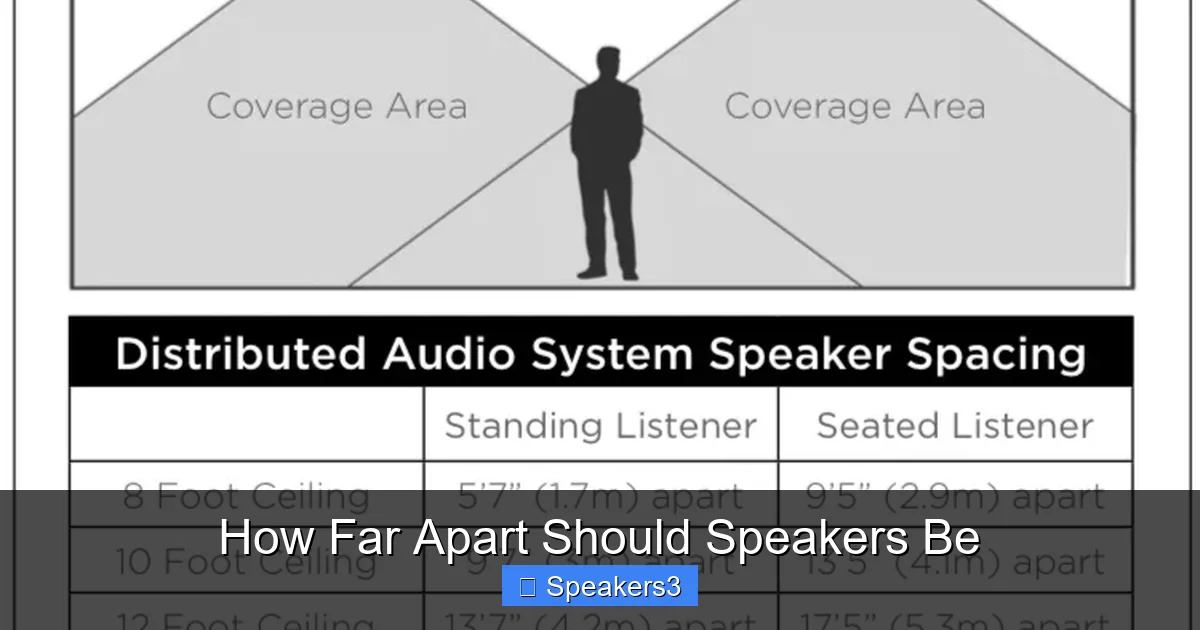
Visual guide about How Far Apart Should Speakers Be
Image source: uploads-eu-west-1.insided.com
Satellite and in‑wall speakers
These are designed for discreet setups. Because they lack large bass drivers, keep them relatively close (3‑5 ft) and rely on a subwoofer to handle low frequencies.
Subwoofers
Subwoofer placement is a separate topic, but remember: the main speakers should still obey the 1‑to‑1.5 rule. Once they’re set, experiment with the sub’s location to blend seamlessly.
4. Practical Placement Tips You Can Try Tonight
Step‑by‑step setup
- Mark your listening spot. Place a piece of tape where you’ll sit.
- Measure the distance to the wall. Keep at least 2 ft from the back wall.
- Apply the 1‑to‑1.5 rule. Use a tape measure to set the speaker spread.
- Toe‑in the speakers. Angle the tweeters 5‑10° toward the listening spot.
- Check the height. The tweeter should be about ear level when seated.
- Listen and tweak. Play a familiar track and adjust in 2‑inch increments.
Using everyday objects for measurement
If you don’t have a tape measure, a standard sheet of A4 paper (11.7 in) can help. Lay down a row of papers to estimate distances. It’s not high‑tech, but it works!
When to bring in acoustic panels
Hard, reflective surfaces bounce sound and can make the optimal distance feel off. Adding a few affordable acoustic panels behind the speakers or on the side walls can smooth out the response, letting you stay closer to the textbook spacing.
5. Common Mistakes and How to Fix Them
Too close to the wall
Speakers glued to a wall boost bass dramatically, often resulting in a “boomy” sound. Pull them out at least 2 ft; if space is limited, use isolation pads to reduce coupling.
Unequal distances
If one speaker is a foot farther from your ears than the other, the stereo image shifts. Use a laser level or a simple string to ensure both speakers are the same distance from the listening spot.
Ignoring the subwoofer
Placing a subwoofer right next to a speaker can cause phase cancellation. Position the sub at a different spot—often a corner works—but keep it at least a foot away from the main speakers.
Over‑angling (excessive toe‑in)
Pointing speakers too sharply toward you narrows the sweet spot, making the sound disappear when you move. Keep toe‑in subtle; 5‑10° is usually enough.
6. Advanced Techniques for Audiophiles
Using a measurement microphone
Professional setups use a calibrated mic and software (Room EQ Wizard) to plot frequency response. This data can reveal if your speaker spacing is causing peaks or dips, prompting precise adjustments.
Speaker stands vs. bookshelf placement
Elevating speakers on stands isolates them from desk vibrations and helps achieve the ideal ear‑level height. It also allows you to fine‑tune the distance without moving heavy furniture.
Bi‑amp and crossover considerations
If your speakers are bi‑amped, the high‑frequency drivers may have different dispersion patterns. In that case, you might need a slightly narrower spread for the tweeters while keeping the woofers wider. Check the manufacturer’s guidelines.
Conclusion: Find Your Sweet Spot and Stay Flexible
There’s no one‑size‑fits‑all answer to how far apart should speakers be, but the 1‑to‑1.5 rule gives you a reliable starting point. From there, consider room size, speaker type, and acoustic treatment. Measure, listen, and adjust in small steps. With a bit of patience, you’ll land on a speaker distance that delivers clear imaging, balanced bass, and a listening experience that feels tailor‑made for your space.
Frequently Asked Questions
What is the ideal speaker distance for a small bedroom?
In a bedroom, aim for 4‑6 ft between speakers and sit about the same distance away. Keep them at least 2 ft from the walls to avoid excessive reflections.
Should I place my speakers directly against the wall?
No. Placing speakers flush to a wall can cause bass boom and muddiness. Pull them out at least 2 ft, or use isolation pads if space is tight.
Does the height of the speakers affect spacing?
Height matters for imaging. The tweeter should be at ear level when seated. Adjust height first, then set the left‑right distance using the 1‑to‑1.5 rule.
Can I use the same spacing for surround speakers?
Surround speakers follow a different guideline—usually placed slightly above ear level and to the side or behind the listening position, about 1‑2 ft above ear level and angled toward the listener.
How do I know if my speaker placement is wrong?
If the center channel feels off, bass is too strong, or the sound feels “narrow,” your speakers are likely too close or too far apart. Small adjustments of 2‑4 inches often fix the issue.
Do I need professional help to set up my speakers?
Not necessarily. With the simple steps in this guide, most users can achieve great results. If you want precise measurements, a calibrated mic and software can help, but it’s optional.