How to Connect 4 Speakers to a 2 Channel Amp
Want to power four speakers with a two‑channel amp? It’s possible with the right wiring methods. This guide walks you through series, parallel, and bridged configurations, shows you how to calculate impedance, and gives practical tips to keep your system safe and sounding great.
Key Takeaways
- Impedance matters: Keep the total load within the amp’s rated range to avoid damage.
- Series vs. parallel: Choose the wiring style that matches your speaker specs and listening preferences.
- Bridge mode: Some amps let you combine channels for more power, but only if the amp supports it.
- Quality cabling: Use appropriate gauge wire to minimize loss and heat.
- Test before you play: Verify connections with a multimeter and start at low volume.
- Safety first: Never exceed the amp’s power rating or speaker’s wattage.
- Future upgrades: Plan wiring so you can add more speakers later without re‑doing everything.
📑 Table of Contents
Introduction
Imagine you’ve just bought a pair of bookshelf speakers for the front left and right, and you also want two rear surrounds for a home‑theater feel. Your amp, however, only has two channels. Do you have to settle for just two speakers? Not at all. With a little know‑how, you can hook up four speakers to a two‑channel amp and get a full‑range, immersive sound.
In this article we’ll break down the different wiring methods, explain the math behind impedance, and give you practical steps you can follow right now. Think of it as a friendly chat over coffee, where I’ll share the same tips I use in my own garage‑built audio rigs.
Understanding Impedance and Power Ratings
What is impedance?
Impedance, measured in ohms (Ω), is the resistance a speaker offers to the amp’s electrical signal. Most home speakers are rated at 4 Ω or 8 Ω. Your amp also lists a “minimum load” and “maximum load” impedance – for example, 4 Ω – 16 Ω. Staying within that range is crucial.

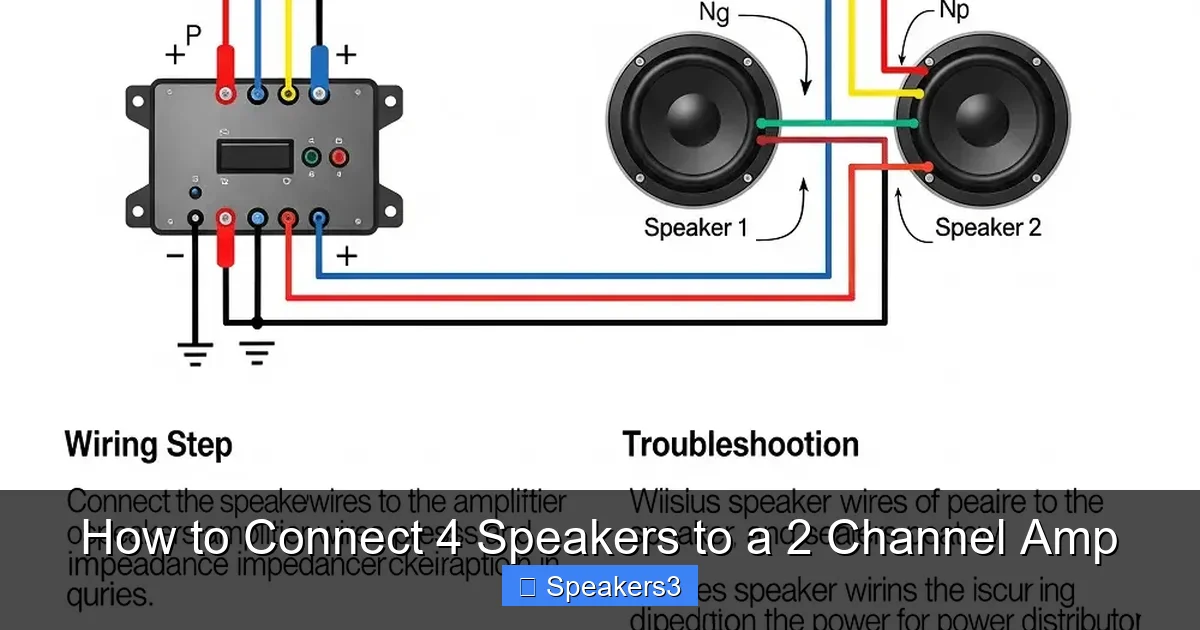
Visual guide about How to Connect 4 Speakers to a 2 Channel Amp
Image source: dygtyjqp7pi0m.cloudfront.net
Why does it matter?
If the total impedance is too low, the amp will try to push more current than it can handle, leading to overheating or shutdown. If it’s too high, you won’t get enough power, and the sound will be weak.
Quick calculation tip
Use this simple rule: When wiring speakers in parallel, divide the speaker impedance by the number of speakers. When wiring in series, multiply the impedances. For mixed configurations (series‑parallel), calculate each branch first, then combine.
Wiring Options for Four Speakers
1. Simple Parallel Wiring
Connect all four speakers to the same amp channel in parallel. This is the easiest method, but you must check the math.
Visual guide about How to Connect 4 Speakers to a 2 Channel Amp
Image source: bpic.588ku.com
Example: Four 8 Ω speakers in parallel give a total load of 2 Ω (8 Ω ÷ 4). Most 2‑channel amps cannot handle 2 Ω, so this setup is usually a bad idea unless the amp is specifically rated for 2 Ω loads.
2. Simple Series Wiring
Wire the speakers end‑to‑end (positive to negative) and then connect the series pair to the amp channel.
Example: Four 8 Ω speakers in series give a total load of 32 Ω (8 Ω × 4). This is far above the typical amp range and will result in very low volume.
3. Series‑Parallel Combination (The Sweet Spot)
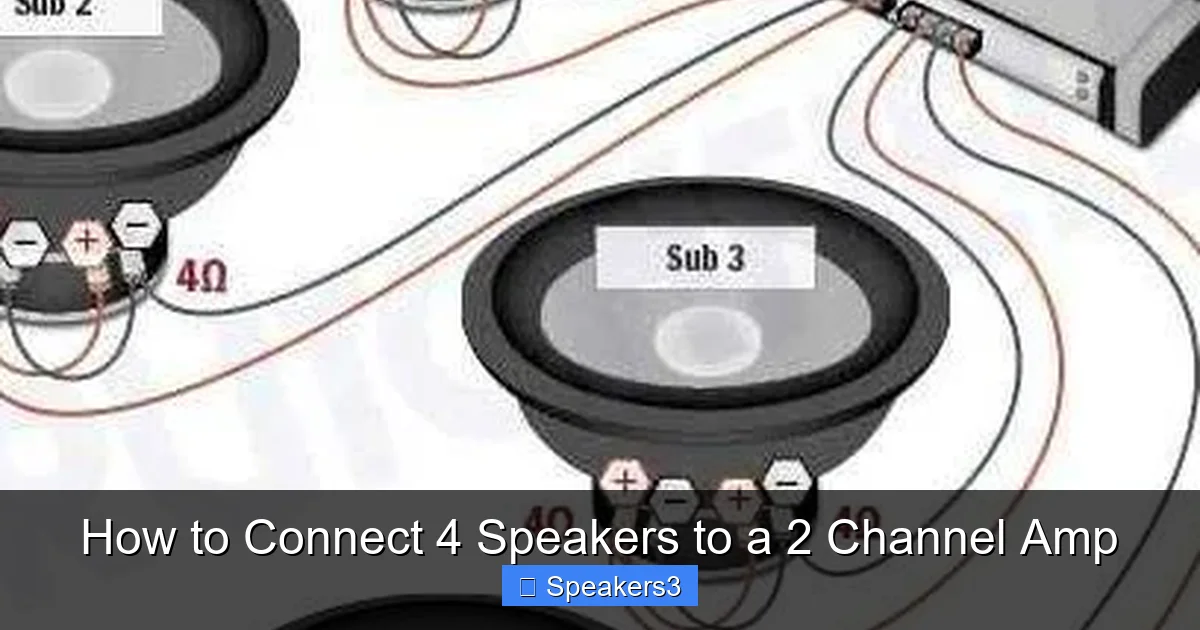
Split the four speakers into two pairs, wire each pair in series, then connect the two series pairs in parallel to the amp channel.
Calculation: Two 8 Ω speakers in series = 16 Ω per pair. Two 16 Ω pairs in parallel = 8 Ω total. This works perfectly for an amp that handles 8 Ω loads.
Most DIYers use this method because it balances power and safety.
4. Bridging the Amp (If Supported)
Some stereo amps let you “bridge” the two channels into one high‑power channel. When bridged, you can treat the amp as a single channel and wire all four speakers in a series‑parallel layout.
**Important:** Only bridge if the manufacturer explicitly states it’s safe. Bridging doubles the voltage but also halves the impedance tolerance.
Step‑by‑Step Wiring Guide
Materials You’ll Need
- Speaker wire (16‑14 gauge is typical for most home setups)
- Wire cutters/strippers
- Multimeter (to check continuity and impedance)
- Speaker terminals or banana plugs (optional but tidy)
- Audio diagram reference – see our How To Wire Speakers To Amp guide for visual aid
Step 1: Check Your Amp’s Specs
Locate the amp’s manual or look for a label on the back. Note the minimum and maximum impedance per channel and the power rating (watts RMS).
Visual guide about How to Connect 4 Speakers to a 2 Channel Amp
Image source: improvestereo.com
Step 2: Decide on a Wiring Scheme
Based on the speaker impedances, choose the series‑parallel method if you have four 8 Ω or four 4 Ω speakers. For mixed‑impedance sets, you may need a different arrangement or an external crossover.
Step 3: Prepare the Speaker Wire
Cut four lengths of wire long enough to reach each speaker from the amp. Strip about ½ inch of insulation from each end.
Step 4: Wire the First Pair in Series
- Connect the positive (+) terminal of Speaker 1 to the amp’s positive output.
- Connect the negative (–) terminal of Speaker 1 to the positive (+) terminal of Speaker 2.
- Leave the negative (–) terminal of Speaker 2 free – this will become the pair’s output.
Step 5: Wire the Second Pair in Series
Repeat the same steps for Speakers 3 and 4, creating a second series pair.
Step 6: Combine the Pairs in Parallel
- Take the free negative terminal from the first pair and connect it to the free negative terminal from the second pair.
- Connect the two free positive terminals (the ones attached to the amp) together.
- Now you have a single pair of wires leading back to the amp channel.
Step 7: Test the Impedance
Use a multimeter set to the “Ω” setting. Measure across the two wires that go to the amp. You should see the calculated total (e.g., 8 Ω). If the reading is off, double‑check your connections.
Step 8: Power Up Safely
Start with the amp volume at the lowest setting. Play a low‑volume track and gradually increase the level while listening for distortion. If anything sounds “tight” or the amp starts to overheat, shut it down immediately.
Practical Tips and Common Pitfalls
Tip 1: Keep Wire Length Balanced
Unequal wire lengths can cause slight timing differences, which are usually inaudible at home volumes but can be noticeable in high‑fidelity setups.
Tip 2: Use the Right Gauge
Long runs (over 25 ft) benefit from thicker wire (12‑14 AWG) to reduce resistance. Short runs can use 16 AWG safely.
Tip 3: Label Your Wires
Mark the positive and negative ends with colored tape. This saves time when you revisit the system later.
Pitfall: Ignoring the Amp’s Bridge Capability
Attempting to bridge an amp that isn’t designed for it can instantly fry the output stage. Always read the manual.
Pitfall: Mixing Different Impedance Speakers
If you combine a 4 Ω and an 8 Ω speaker in the same series‑parallel network, the total impedance will be uneven, potentially stressing the amp. Stick to matching impedances or use a dedicated crossover.
When to Consider an External Crossover or Bi‑Amp Setup
If you’re using full‑range speakers with built‑in tweeters, a simple series‑parallel network works fine. However, for high‑end two‑way or three‑way speakers, you might want a crossover that sends low frequencies to a dedicated sub‑amp and highs to the main amp. This keeps the load stable and improves sound clarity.
Another option is a bi‑amp configuration, where each amp channel drives a separate frequency band. This requires a more complex amp and speaker wiring but delivers superior performance.
Conclusion
Connecting four speakers to a two‑channel amp is completely doable once you understand impedance and choose the right wiring method. By following the series‑parallel guide, checking your calculations with a multimeter, and starting at low volume, you’ll protect your equipment and enjoy richer, fuller sound. Remember, safety first: never exceed the amp’s rated load, and always double‑check your connections.
Now that you’ve got the basics, go ahead and experiment with placement, try a bridge‑mode if your amp allows it, and enjoy the immersive audio experience you’ve built yourself. Happy listening!
Frequently Asked Questions
Can I connect four 4 Ω speakers to a two‑channel amp?
Yes, using a series‑parallel configuration will give a total load of 8 Ω per channel, which most amps can handle.
What happens if the total impedance is too low?
The amp will draw more current than it’s designed for, leading to overheating, distortion, or automatic shutdown.
Is it safe to bridge any two‑channel amp?
Only if the manufacturer specifically states that bridging is supported. Bridging an unsupported amp can damage the output stage.
Do I need a special cable for series‑parallel wiring?
No special cable is required; standard speaker wire of appropriate gauge works fine. Just keep the connections tight and secure.
Can I add a subwoofer to this setup?
Yes, but the subwoofer should have its own dedicated amplifier or be a powered (active) unit to avoid further loading the main amp.
Where can I find a visual wiring diagram?
Our How To Wire Speakers To Amp article includes clear diagrams for series, parallel, and series‑parallel connections.