Pro Studio Speakers 15 Inch
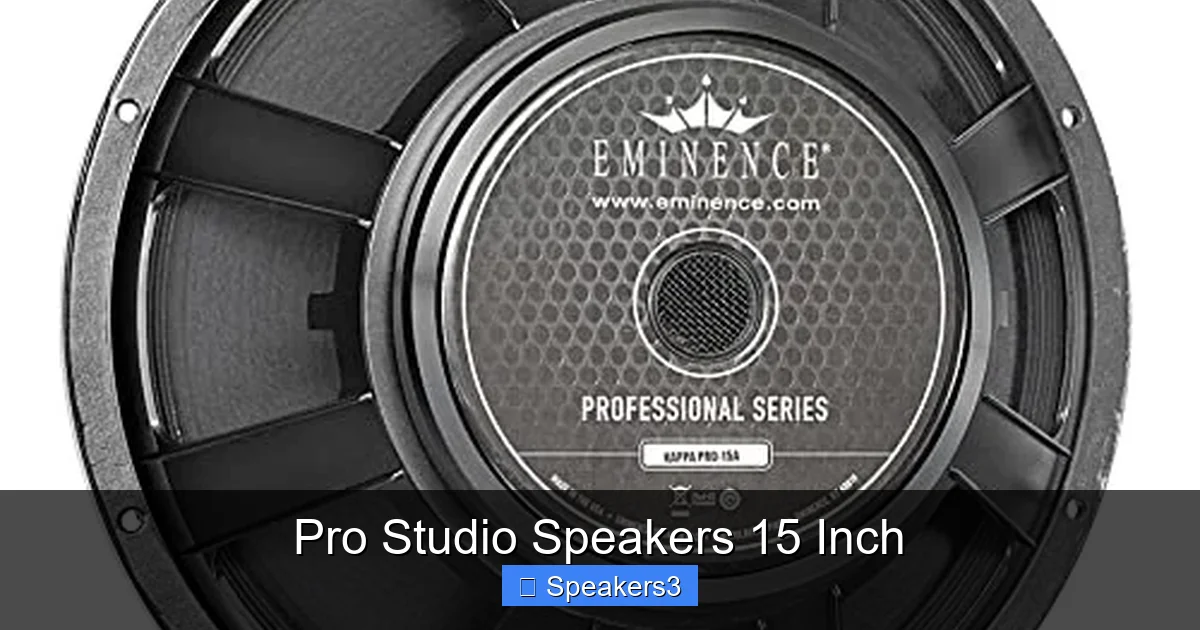
Pro studio speakers with a 15-inch woofer deliver unmatched low-end power and clarity for professional music production. They are the workhorse for large control rooms, providing the deep bass response needed for mixing genres like hip-hop, EDM, and film scores. Choosing the right pair involves understanding power handling, room size compatibility, and brand-specific voicing. Proper placement and room treatment are non-negotiable to unlock their full potential and achieve translation-ready mixes.
So, you’re building or upgrading your studio. You’ve got a great audio interface, a solid computer, and monitors on your list. Then you see it: the mighty 15-inch woofer. It looks powerful, serious, and frankly, a little intimidating. Are pro studio speakers 15 inch right for you, or are they overkill? Let’s cut through the noise and talk about what these workhorse monitors really bring to the table.
Think of your studio monitors as your most trusted pair of ears. They are the direct link between your creative decisions and what the listener will eventually hear. A 15-inch driver isn’t just about “more bass”; it’s about controlled, extended, and detailed bass. It’s the difference between guessing what’s happening below 60Hz and actually hearing it with clarity. For producers working in bass-heavy genres, this isn’t a luxury—it’s a necessity for making decisions that translate to car stereos, clubs, and headphones.
But size comes with responsibility. A 15-inch monitor in a small, untreated room is a recipe for disaster, creating a muddy, uneven low end that will sabotage your mixes. This guide will walk you through everything you need to know—from the engineering behind that big cone to room setup, brand comparisons, and common pitfalls. We’ll help you determine if these powerful speakers are the perfect fit for your creative space.
Key Takeaways
- 15-inch woofers excel at deep, controlled bass: Their larger surface area moves more air, producing lower frequencies with less distortion than smaller drivers, crucial for monitoring sub-bass content accurately.
- Power handling is critical for room size: These are high-power monitors. Ensure your room is sufficiently large (typically 300+ sq ft) to prevent boomy, uncontrolled bass from overpowering the space.
- Brands have distinct “voicings”: Yamaha is neutral, KRK is punchy, Adam is detailed. Your choice should align with your genre and personal preference for what “accurate” sounds like.
- Placement dictates performance more than price: Even the most expensive 15-inch monitors will sound poor if placed incorrectly against a wall or in a corner without acoustic treatment.
- Powered (active) designs are the studio standard: Nearly all professional 15-inch studio monitors are powered, with tailored amplifiers and crossovers for optimal performance and simplicity.
📑 Table of Contents
Why Choose a 15-Inch Woofer? The Physics of Power
To understand the 15-inch advantage, we need a quick, painless physics lesson. Sound is created by moving air. A larger speaker cone (the “woofer”) can move a greater volume of air with less physical excursion (travel in and out) than a smaller cone. This has two massive implications for studio monitoring.
Lower Extension with Less Distortion
To produce very low frequencies (say, 40Hz), a smaller 5-inch or 8-inch driver has to move an enormous amount of air, pushing its mechanical limits. This creates distortion and “chuffing” noise from the ports. A 15-inch driver, with its greater surface area, can produce those same frequencies with a much more relaxed, linear motion. The result is deeper bass extension (often down to 30Hz or lower) with significantly lower distortion and better transient response. You hear the note, not the struggle of the driver.
Higher Output and Headroom
This same principle applies to loudness. For tracking loud sources like drum kits or guitar amps, or for listening to mixes at high volumes to check dynamics, you need headroom. A 15-inch monitor can handle higher sound pressure levels (SPL) with less compression and distortion. This clean power is essential for critical listening at volume, a common practice in professional studios to feel the energy of a track.
The Genre-Specific Advantage
If your world is hip-hop, trap, dubstep, or any form of electronic music with sub-bass sine waves, a 15-inch monitor is your co-pilot. You can finally hear if that 808 kick is sitting perfectly in the mix or if it’s masking the bassline. For film and game audio, the ability to monitor LFE (Low-Frequency Effects) channels accurately is a game-changer. Even rock and pop engineers appreciate the added clarity on low-tuned guitars and floor toms. It provides a complete picture of the frequency spectrum from the lowest rumble to the highest hi-hat.
Key Features to Scrutinize: Beyond the Cone Size
Not all 15-inch studio monitors are created equal. The woofer size is just the starting point. To make a smart investment, you need to evaluate the entire system. Here are the critical features that separate budget-friendly options from professional-grade tools.
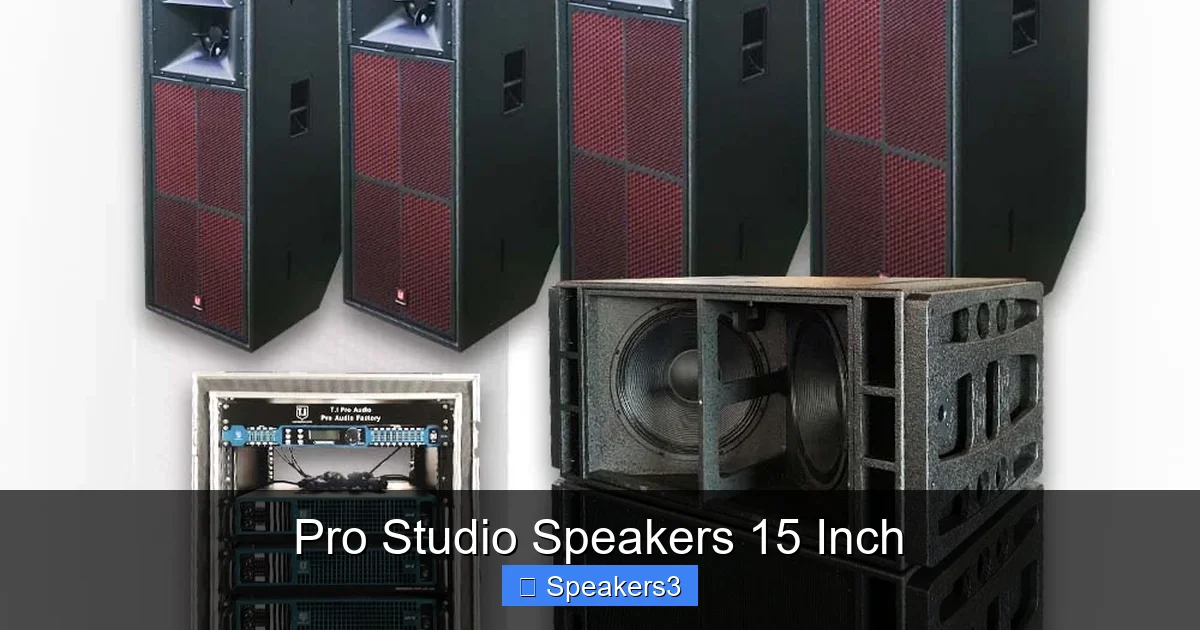
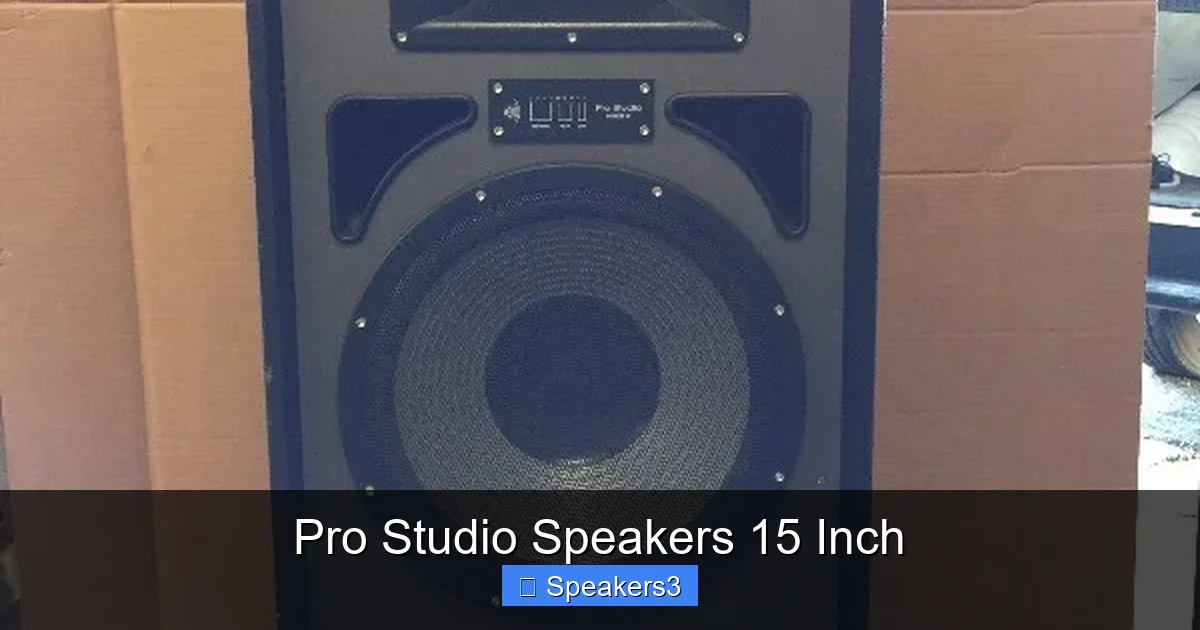
Visual guide about Pro Studio Speakers 15 Inch
Image source: static.gooecloud.com
Amplification: Bi-Amped is the Only Way
Forget passive monitors with an external amp. In the modern studio, powered (active) monitors are the absolute standard, and all serious 15-inch pro models are powered. Look specifically for bi-amped designs. This means there are two separate amplifiers: one dedicated to the 15-inch woofer and another for the mid/high driver (usually a 1-inch or larger dome tweeter). This allows each driver to be optimized for its specific frequency range, resulting in higher efficiency, better dynamic response, and built-in protection circuits. The crossover is also active (electronic), which is more precise than a passive crossover.
Power Rating (RMS vs. Peak)
Don’t be fooled by huge “Peak” power numbers (e.g., 500W Peak). The meaningful figure is RMS (Root Mean Square) power, which represents the continuous, clean power the amp can deliver. A typical professional 15-inch monitor will have 100W-200W RMS dedicated to the woofer. This ensures it has enough grunt to drive the large cone without clipping. Match the RMS rating to your room size—more power for bigger rooms.
Driver and Cabinet Construction
The woofer’s material matters. Common materials include:
- Polypropylene: The workhorse. Stiff, lightweight, and damped well. Found on excellent monitors like the Yamaha HS8.
- Kevlar/Carbon Fiber: Extremely stiff and lightweight (e.g., Focal, Adam Audio). Offers incredible transient response and detail.
- Treated Paper: Traditional, often damped with a foam surround. Can sound very natural but may be less rigid.
The cabinet must be rigid and braced to prevent unwanted resonance (coloration). Look for thick MDF, internal bracing, and rounded or damped corners. Ports (bass reflex) should be carefully designed to minimize turbulence noise.
Inputs and Controls
Professional monitors offer flexible connectivity. Look for:
- XLR (balanced) and 1/4″ TRS (balanced) inputs: Essential for connecting to professional audio interfaces with low-noise balanced connections.
- RCA (unbalanced) inputs: Useful for consumer gear, but keep cable runs short to avoid noise.
- Room adjustment controls: At minimum, a High-Frequency trim (+/- 2-4 dB) and often a Low-Frequency or “Room Gain” switch to compensate for boundary bass boost when placed near walls.
The Top Contenders: A Look at Leading Brands
The market for 15-inch studio monitors is competitive, with each major brand having a signature sound. Your choice here is deeply personal and genre-dependent. Let’s break down the key players.
Visual guide about Pro Studio Speakers 15 Inch
Image source: 946e583539399c301dc7-100ffa5b52865b8ec92e09e9de9f4d02.ssl.cf2.rackcdn.com
Yamaha HS Series (HS8, HS8S Sub)
The Yamaha HS8 is the industry’s neutral reference. It doesn’t hype the sound; it tells you the truth. The 15-inch HS8 (and its white sibling, the HS8W) is famous for its flat response and incredibly accurate midrange. It’s the choice of engineers who want to hear their mix exactly as it is, without any “smile” curve. The downside? Some find it a bit “boring” or lacking in low-end punch for pure enjoyment. It’s the ultimate tool for translation. Yamaha also offers the HS8S subwoofer for extending the response down to 22Hz when paired with the HS8s.
KRK Rokit RP5 G4 & RP7 G4
KRK’s iconic yellow-dome monitors are the face of project studios worldwide. The RP7 G4 (with a 7-inch woofer) and the larger models are known for their punchy, forward mid-bass. They have a slight “smile” EQ that makes them fun to listen to and can help you dial in kick drums and basslines with energy. The G4 series adds a slick LCD screen for DSP room correction and EQ settings. They are incredibly popular in hip-hop and electronic music production. Be aware: their voicing can sometimes mask problems in the upper bass/lower mids if you’re not careful.
Adam Audio T Series (T7V, T10V, T15V)
Adam Audio’s claim to fame is the X-ART ribbon tweeter. Even in their more affordable T Series, this tweeter delivers astonishing detail, air, and transparency in the high frequencies. Paired with a 15-inch polypropylene woofer (T15V), you get a monitor that is both powerful and incredibly articulate. The soundstage is wide and precise. They excel at revealing subtle reverb tails, stereo imaging, and high-frequency content. For producers who work with intricate arrangements or acoustic material, the Adam T15V is a formidable option.
Focal Alpha Series (Alpha 65, Alpha 80)
Focal, the French high-end manufacturer, brought their driver technology to the project studio with the Alpha series. The Alpha 80 features a 15-inch woofer with a unique “inverted dome” design made of a composite material. This, combined with their powerful amplifiers, delivers a dynamic, fast, and powerful sound. The Alpha monitors are known for their incredible transient response and lack of compression, even at high volumes. They sound big, expensive, and engaging, while still maintaining a high level of accuracy.
Room Setup and Placement: The Non-Negotiable Foundation
I cannot stress this enough: your room is the most important component of your monitoring system. A $10,000 pair of 15-inch monitors in a untreated rectangular room will sound worse than a $1,000 pair in a treated room. Placement is your first line of defense against acoustic problems.
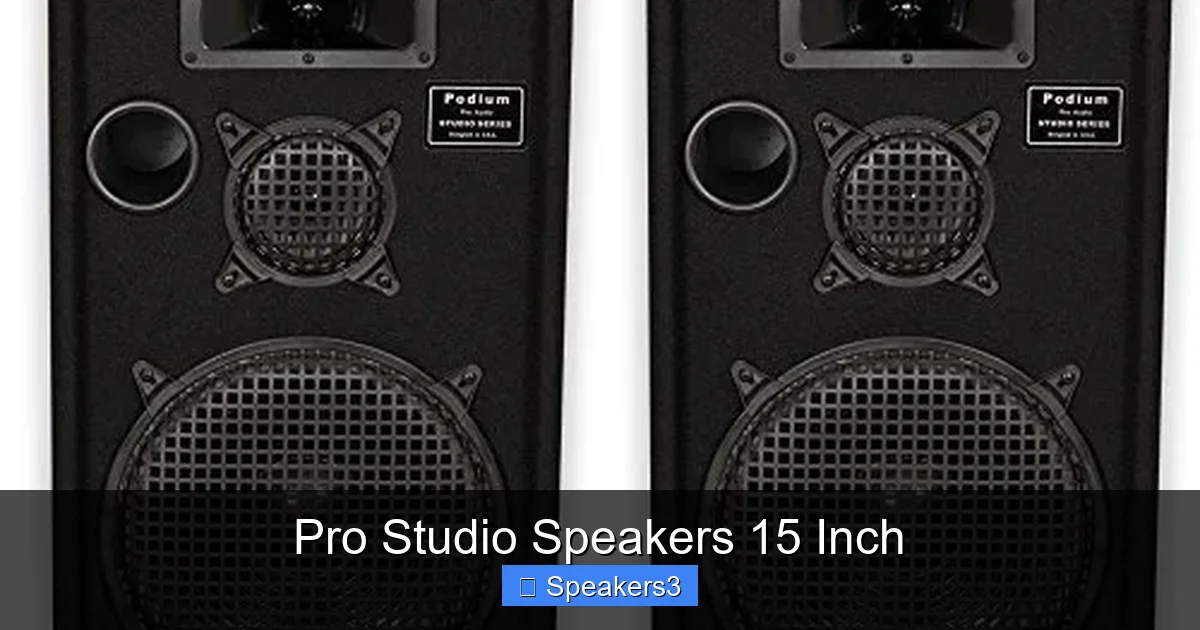
Visual guide about Pro Studio Speakers 15 Inch
Image source: m.media-amazon.com
The Equilateral Triangle
This is your starting point. Position your two monitors and your listening position (the “sweet spot”) to form an equilateral triangle. The distance between the monitors should be roughly equal to the distance from each monitor to your head. This creates a balanced stereo image. For 15-inch monitors, this triangle will likely be larger—you might be sitting 6-8 feet from each speaker.
Distance from Walls: The 1/3 & 1/5 Rules
Bass waves are long and omnidirectional. When a large monitor is placed against a wall, the wall reinforces the bass from the back wave, causing a massive buildup (boundary gain) that makes your room boomy and unbalanced. The rule of thumb is to keep the front baffle (the front face of the speaker) at least 3-4 feet from the front wall. If that’s impossible, use the “1/3” or “1/5” room length rule. Place the speakers at a distance from the front wall that is 1/3rd or 1/5th of the room’s length to avoid the most problematic room modes. The same applies to side walls.
Toe-In and Listening Height
Toe-in is the angle the speaker points inward toward your listening position. Start with the speakers pointed directly at you. You can then adjust slightly outward to widen the soundstage or inward to tighten the imaging. Experiment. Your ear height should align with the tweeter axis. If your tweeters are above or below ear level, you’ll miss the intended high-frequency response. Use speaker stands or adjustable desk mounts to get the height right.
Acoustic Treatment is Not Optional
For a 15-inch system, treatment is mandatory. At a minimum:
- Bass Traps: Place thick, porous absorbers (like 4″ thick rockwool or acoustic foam) in the front and back corners of the room. This is the #1 treatment for controlling the long, powerful bass waves that 15-inch monitors generate.
- First Reflection Points: Place acoustic panels on the walls, ceiling, and floor at the points where sound from the speakers first reflects to your ears. Use the mirror trick: sit in your chair, have a friend slide a mirror along the side wall. Where you can see the speaker in the mirror is a first reflection point. Treat these with broadband absorbers.
- Diffusion: On the back wall, use diffusers to scatter sound energy and prevent a “dead” room, which can make spatial judgment difficult.
Common Mistakes and How to Avoid Them
Even with the right gear, it’s easy to set yourself up for failure. Here are the most frequent pitfalls with large-format monitors.
Mistake 1: Ignoring Room Size and Modes
The biggest error is putting a 15-inch system in a small, square room (e.g., 10×10 ft). The room will have powerful, uneven bass modes at specific frequencies (e.g., everything around 40Hz will be a booming mess, while 50Hz might be nearly absent). Your mixes will sound great on these monitors but terrible everywhere else. Solution: If your room is under 250-300 cubic feet (e.g., 10x10x8), seriously consider a high-quality 8-inch monitor instead. It’s a more sensible tool for the space.
Mistake 2: “Set It and Forget It” on the EQ
Those High-Frequency and Low-Frequency trim switches on the back? They are not tone controls for your enjoyment. They are for compensating for your room’s acoustics. If your room has a lot of hard surfaces, you might need to cut the HF slightly. If your speakers are close to a wall, you will almost certainly need to use the LF “Room Gain” or “Wall” switch to cut the booming low-mids. Use a measurement microphone (like a Dayton Audio iMM-6) and software (REW, SMAART) to see what your room is doing, then adjust the switches accordingly.
Mistake 3: Using Consumer-Grade Cables and Power
These are power-hungry professional tools. Use heavy-gauge, balanced XLR cables from your audio interface to the monitors. Unbalanced cables or long runs can pick up hum and RF interference. Also, plug each monitor into a dedicated circuit or a high-quality power conditioner. Sharing a circuit with a computer, fridge, or dimmer switch can introduce ground loop hum or noise into the amp.
Mistake 4: Not Allowing for Break-In
The suspension and spider of a new woofer are stiff. While not as critical as with vintage gear, new 15-inch drivers can sound slightly tight and less dynamic for the first 20-40 hours of use. Play them at moderate volume with a variety of music for a day or two before doing critical mixing work. The performance will smooth out.
The Future of 15-Inch Monitoring: Trends and Innovations
The world of studio monitors is constantly evolving. Even the classic 15-inch design is seeing exciting new developments.
DSP and Room Correction Integration
The next step beyond simple EQ switches is built-in Digital Signal Processing (DSP). Monitors like the KRK Rokit G4 and newer models from Neumann and Genelec have internal DSP that can be controlled via a computer or phone app. This allows for precise, parametric EQ correction for room modes, delay alignment for multi-speaker setups, and even memory presets for different listening positions. This technology brings professional room correction within reach of project studios.
The Rise of Coaxial Designs
Traditionally, the tweeter is mounted separately from the woofer, causing a physical offset that can affect time alignment. Coaxial monitors (like those from PMC and some high-end Focal models) place the tweeter directly in the center of the woofer’s magnetic gap. This creates a point-source radiator, which can improve imaging and off-axis response. We’re starting to see this technology trickle down into the 15-inch format, offering potentially superior soundstaging.
Sustainability and Materials
As with all industries, sustainability is a growing concern. Brands are exploring recycled plastics for cones, bio-based composites, and more efficient amplifier designs (Class D is now the norm, offering high power with low heat). The look is also shifting, with more studios embracing monitor designs in white, fabric-covered cabinets, or natural wood finishes to blend with modern interior design.
The core principle remains: a large, accurate driver in a well-designed cabinet, powered by a competent amp, placed correctly in a treated room. That formula, executed well, will always be the foundation of a great-sounding studio.
Frequently Asked Questions
Can I use 15-inch studio monitors in a small home studio?
Generally, it’s not recommended. A 15-inch woofer produces powerful, long bass wavelengths that small rooms (under 250-300 cubic feet) cannot contain properly. This leads to severe bass buildup and cancellation, creating an inaccurate listening environment. For small rooms, high-quality 5-inch to 8-inch monitors are a far better choice.
Do I absolutely need a subwoofer with 15-inch monitors?
Not necessarily. A good 15-inch monitor should extend down to 30-40Hz on its own, which covers most musical content. A dedicated subwoofer (like the Yamaha HS8S) is useful if you need to monitor below 30Hz (e.g., for 5.1 film mixes or specific electronic sub-bass) or if you want to calibrate a single, centralized bass source. For stereo music production, the pair of 15s is usually sufficient.
How far from the wall should I place my 15-inch monitors?
Aim for at least 3-4 feet (1 meter) from the front wall. This is the single most effective way to reduce boundary bass boost. If space is tight, use the 1/3 room length rule and be sure to engage the “Room Gain” or “Low Trim” switch on the back of the monitor to cut the exaggerated low-mids.
Do 15-inch studio monitors need a long break-in period?
Yes, but it’s relatively short. The woofer’s suspension will loosen up over the first 20-40 hours of use at moderate volume. You’ll notice a slight improvement in low-end tightness and overall dynamic response. Play them for a day or two before doing your most critical mixing work.
What’s the real difference between a 15-inch monitor and an 8-inch?
The 15-inch will have deeper, more powerful, and less distorted bass extension. It will also have higher maximum output (headroom). However, it requires a larger room and more careful placement. An 8-inch monitor is more “room-friendly,” easier to position, and still provides excellent bass for most genres in a typical project studio. The 15-inch is a specialist tool for large spaces and bass-critical work.
Are powered monitors always better than passive for a 15-inch setup?
For a studio, yes. Powered (active) monitors are the overwhelming standard. The manufacturer designs the amplifier and driver as a complete system, optimizing the crossover and power delivery. They are simpler to set up (just plug in), more efficient, and offer protection circuits. Passive monitors require you to purchase a separate, high-quality power amp and crossover, which is more complex and often more expensive for equivalent performance.