4 4 Ohm Speakers in Parallel

Connecting four 4 ohm speakers in parallel is a smart way to keep your system’s load low while delivering powerful, balanced sound. This article walks you through the wiring math, practical tips, and common pitfalls so you can set up your speakers with confidence and enjoy crystal‑clear audio.
Key Takeaways
- Parallel wiring halves impedance: Four 4 ohm speakers in parallel present a 1 ohm load to the amp.
- Amplifier must handle low impedance: Choose an amp rated for 1 ohm or use a series‑parallel hybrid.
- Wire gauge matters: Use 12‑14 AWG speaker cable to minimize resistance and heat.
- Check power ratings: Ensure each speaker’s RMS rating matches the amp’s output at 1 ohm.
- Use proper connectors: Banana plugs or spade terminals keep connections secure and low‑loss.
- Test before final install: Measure impedance with a multimeter and listen for distortion.
- Safety first: Add a fuse or speaker protection circuit to guard against overload.
📑 Table of Contents
- Introduction: Why Talk About Four 4 Ohm Speakers in Parallel?
- Understanding Impedance and Parallel Wiring
- Choosing the Right Amplifier
- Wiring the Speakers: Step‑by‑Step Guide
- Practical Tips to Keep Your System Healthy
- Common Mistakes and How to Avoid Them
- Real‑World Applications
- Conclusion: Wire with Confidence
- Further Reading
Introduction: Why Talk About Four 4 Ohm Speakers in Parallel?
Imagine you have a home theater or a car audio upgrade and you’ve just bought four brand‑new 4 ohm speakers. They sound great on their own, but you’re not sure how to connect them without blowing out your amplifier. That’s a common dilemma for DIY audio fans.
Wiring speakers in parallel is a popular solution because it keeps the overall impedance low, which can let your amp deliver more power. However, the math can feel a little scary, and the risk of overheating or distortion is real if you get it wrong. In this friendly guide, we’ll break down everything you need to know—step by step, with plain language and real‑world examples—so you can hook up four 4 ohm speakers in parallel and enjoy clean, punchy sound.
Understanding Impedance and Parallel Wiring
What Is Impedance?
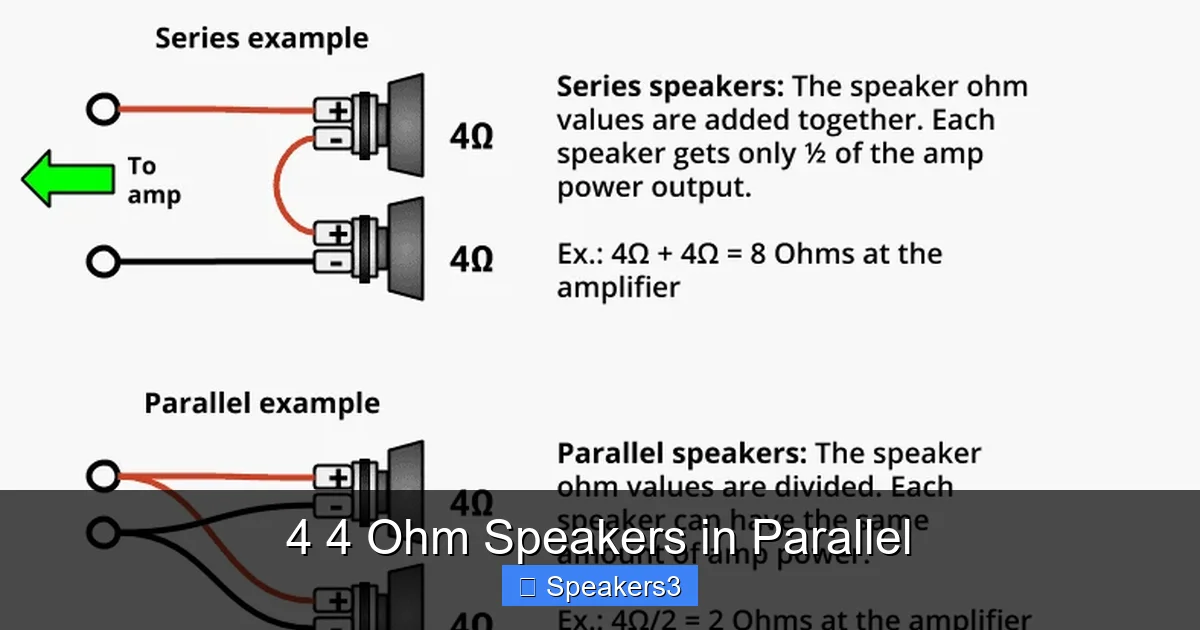
Impedance, measured in ohms (Ω), is the speaker’s resistance to the flow of alternating current. Think of it as the “electrical weight” a speaker adds to the circuit. Lower impedance means the amp works harder, but it can also deliver more power.
Visual guide about 4 4 Ohm Speakers in Parallel
Image source: soundcertified.com
How Parallel Wiring Changes Impedance
When you connect speakers in parallel, the total impedance (Ztotal) is calculated using the formula:
1 ÷ Ztotal = 1 ÷ Z₁ + 1 ÷ Z₂ + 1 ÷ Z₃ + 1 ÷ Z₄
Plugging four 4 Ω speakers into the equation looks like this:
1 ÷ Ztotal = 1/4 + 1/4 + 1/4 + 1/4 = 1
Therefore, Ztotal = 1 Ω. That’s a very low load, and not every amplifier can handle it safely.
Series‑Parallel Hybrid: A Safer Alternative
If your amp isn’t rated for 1 Ω, you can create a series‑parallel network. Pair two speakers in series (4 Ω + 4 Ω = 8 Ω) and then wire the two pairs in parallel:
1 ÷ Ztotal = 1/8 + 1/8 = 1/4 → Ztotal = 4 Ω
This keeps the load at a friendly 4 Ω while still using all four speakers.
Choosing the Right Amplifier
Check the Amp’s Minimum Impedance Rating
Look at the back of your amplifier or its spec sheet. You’ll see something like “4 Ω minimum, 2 Ω stable.” If it says 2 Ω stable, you can safely run the four 4 Ω speakers in parallel (1 Ω) only if the amp explicitly states it can handle 1 Ω. Most consumer amps stop at 2 Ω, so a series‑parallel setup is often the way to go.
Visual guide about 4 4 Ohm Speakers in Parallel
Image source: phxequip.com
Power Matching
Each speaker has an RMS power rating, for example, 50 W RMS. Add the ratings together when wiring in parallel: 4 × 50 W = 200 W total. Your amp should be able to deliver close to this power at the chosen impedance without clipping. Over‑powering can cause speaker damage, while under‑powering can lead to distortion.
Real‑World Example
Let’s say you have a 150 W RMS amp rated for 2 Ω. Running four 4 Ω speakers in parallel (1 Ω) would exceed the amp’s safe limit. Instead, wire them in two series pairs (8 Ω each) and then parallel those pairs. The resulting 4 Ω load is within the amp’s spec, and you’ll still get close to the full 150 W spread across the four speakers.
Wiring the Speakers: Step‑by‑Step Guide
Materials You’ll Need
- 12‑14 AWG speaker wire (length as needed)
- Banana plugs or spade connectors
- Wire stripper and crimper
- Multimeter (for checking impedance)
- Optional: Inline fuse (2‑3 A) for protection
Step 1: Cut and Strip the Wire
Measure the distance from each speaker to the amp. Cut a little extra (about 6 in) to give yourself room to work. Strip about ½ in of insulation from each end.

Visual guide about 4 4 Ohm Speakers in Parallel
Image source: airjetmill.com
Step 2: Attach Connectors
Crimp banana plugs onto each wire end. This makes future swaps easier and ensures a solid connection.
Step 3: Connect the Speakers in Parallel
Join all positive (+) terminals together and all negative (–) terminals together. You can do this by twisting the wires together or using a small terminal block. Then run the combined positive wire to the amp’s positive output and the combined negative wire to the amp’s negative output.
Step 4: Verify the Impedance
Before powering up, set your multimeter to the resistance (Ω) setting and measure between the amp’s speaker terminals. You should see close to 1 Ω (a tiny bit higher due to wire resistance). If you wired a series‑parallel hybrid, you should read about 4 Ω.
Step 5: Power Up and Test
Start with the amp at low volume. Play a familiar track and listen for any distortion or overheating. Increase volume gradually, watching the amp’s temperature. If anything sounds “tight” or the amp gets hot quickly, shut it down and double‑check your wiring.
Practical Tips to Keep Your System Healthy
Use the Right Wire Gauge
Long runs of thin wire can add resistance, raising the effective impedance and reducing power. For runs under 25 ft, 14 AWG is fine; for longer runs, step up to 12 AWG.
Mind the Heat
Low‑impedance loads cause amps to work harder, generating heat. Place the amp in a well‑ventilated spot and consider a small fan if you notice it getting warm.
Protect Against Shorts
Adding a small inline fuse (2‑3 A) on the positive lead can prevent catastrophic damage if a wire shorts to ground.
Balance the Sound
If one speaker sounds louder, check the connections. A loose contact can raise that speaker’s impedance, making the amp favor the others. Tighten all terminals and re‑measure.
When to Choose a Dedicated Multi‑Channel Amplifier
If you frequently run low‑impedance loads, a multi‑channel amp designed for 1 Ω operation (often found in car audio) will give you more headroom and less stress than a generic home‑theater receiver.
Common Mistakes and How to Avoid Them
Forgetting the Amp’s Impedance Rating
Running four 4 Ω speakers in parallel on an amp that only supports 4 Ω can cause immediate shutdown or permanent damage. Always double‑check the spec sheet.
Using Too Thin Wire
Thin wire adds extra resistance, which can make the total load appear higher than 1 Ω, confusing your calculations and potentially leading to uneven power distribution.
Skipping the Multimeter Test
It’s tempting to trust your visual wiring, but a quick resistance check catches mistakes before you power up.
Overloading the Speakers
Even if the amp can handle 1 Ω, feeding too much power into a 4 Ω speaker can blow the voice coil. Match the amp’s power output to the speaker’s RMS rating.
Real‑World Applications
Home Theater Surround Sound
Many surround‑sound setups use four satellite speakers. Wiring them in parallel can simplify cabling, but you’ll likely need a receiver that supports 2 Ω or a series‑parallel arrangement to stay safe.
Car Audio Upgrades
Car amplifiers often list “1 Ω stable” as a feature, making parallel wiring of four 4 Ω speakers a common practice for maximum volume. Just remember to secure all connections against vibration.
Portable PA Systems
Small PA mixers sometimes have separate 4 Ω outputs for each channel. If you want to drive a pair of 4 Ω speakers from a single output, wiring them in parallel (2 Ω) can work if the mixer can handle it.
Conclusion: Wire with Confidence
Connecting four 4 ohm speakers in parallel isn’t as intimidating as it sounds. By understanding the math, respecting your amplifier’s limits, and using proper wiring techniques, you can achieve a low‑impedance load that delivers strong, balanced sound. Remember to test with a multimeter, keep your cables thick enough, and protect your gear with fuses or a well‑ventilated amp enclosure.
Whether you’re setting up a home theater, a car audio system, or a DIY speaker project, the principles in this guide will help you avoid common pitfalls and enjoy crystal‑clear audio for years to come. Happy wiring!
Further Reading
- How To Wire Speakers To Amp – detailed amp‑matching tips.
- Why Do My Speakers Crackle – troubleshoot noise issues.
- Pro Studio Speakers 15 Inch – explore high‑power speaker options.
Frequently Asked Questions
Can I safely run four 4 ohm speakers in parallel with a standard home theater receiver?
Only if the receiver is rated for a 1 Ω load. Most receivers stop at 2 Ω, so a series‑parallel wiring method is usually safer.
What happens if the amp overheats when I use a 1 Ω load?
Overheating can trigger the amp’s protection circuit, causing it to shut down or, in worst cases, damage internal components.
Do I need a special fuse when wiring speakers in parallel?
Adding a small inline fuse (2‑3 A) on the positive lead provides extra protection against short circuits and is a good safety habit.
Is thicker speaker wire really necessary for parallel connections?
Yes. Thicker wire (12‑14 AWG) reduces resistance, keeping the load close to the calculated impedance and preventing voltage drop.
Can I use banana plugs for all four speakers?
Banana plugs work well and make future changes easy. Just ensure they are firmly seated to avoid intermittent connections.
What’s the difference between parallel and series‑parallel wiring?
Parallel wiring lowers total impedance (four 4 Ω speakers become 1 Ω). Series‑parallel keeps impedance higher (two 4 Ω in series become 8 Ω, then two 8 Ω pairs in parallel result in 4 Ω).