Teaching English to Spanish speakers worksheets are powerful tools that turn language lessons into engaging, bite‑size activities. From beginner vocab drills to advanced grammar games, these printable resources help learners progress quickly while keeping the classroom lively.
Key Takeaways
- Focused practice: Worksheets target the exact gaps Spanish‑speaking learners face, such as false cognates and verb‑tense confusion.
- Flexible use: They work for whole‑class instruction, small groups, or solo homework.
- Visual support: Images, color‑coding, and bilingual prompts make meaning clear and memorable.
- Progress tracking: Checklists and self‑assessment sections let students see their growth.
- Free & printable: Many quality sheets are available online at no cost.
- Adaptable: Teachers can modify any sheet to suit age, level, or cultural context.
- Boost confidence: Repeated success on worksheets builds the confidence needed for real‑world conversation.
📑 Table of Contents
- Why Worksheets Still Matter in a Digital Age
- Core Components of Effective Worksheets
- Top Worksheet Themes for Spanish‑Speaking Learners
- How to Create Your Own Custom Worksheets
- Practical Tips for Using Worksheets in the Classroom
- Free Printable Resources You Can Start Using Today
- Measuring Success: Assessment Ideas
- Conclusion
Why Worksheets Still Matter in a Digital Age
Even with apps, podcasts, and video calls, the humble worksheet remains a classroom hero. For Spanish‑speaking learners, the tactile act of writing helps cement new English patterns. When a student copies a sentence, they are not just rehearsing spelling—they are training the brain to shift from Spanish syntax to English syntax.
Worksheets also give teachers a quick snapshot of who understands a concept and who needs extra help. In a busy ESL class, that instant feedback is priceless. Below we explore how to choose, create, and use the best teaching English to Spanish speakers worksheets.
Learning style alignment
Spanish speakers often prefer visual cues and contextual examples. A well‑designed worksheet pairs pictures with words, uses color to highlight gender‑neutral nouns, and provides side‑by‑side translations for tricky phrases.
Cost‑effectiveness
Many high‑quality resources are free. Websites like Hard English Words For Spanish Speakers offer printable lists that can be turned into fill‑in‑the‑blank activities.
Core Components of Effective Worksheets
Not every sheet will work for every student. The most successful teaching English to Spanish speakers worksheets share several key elements.
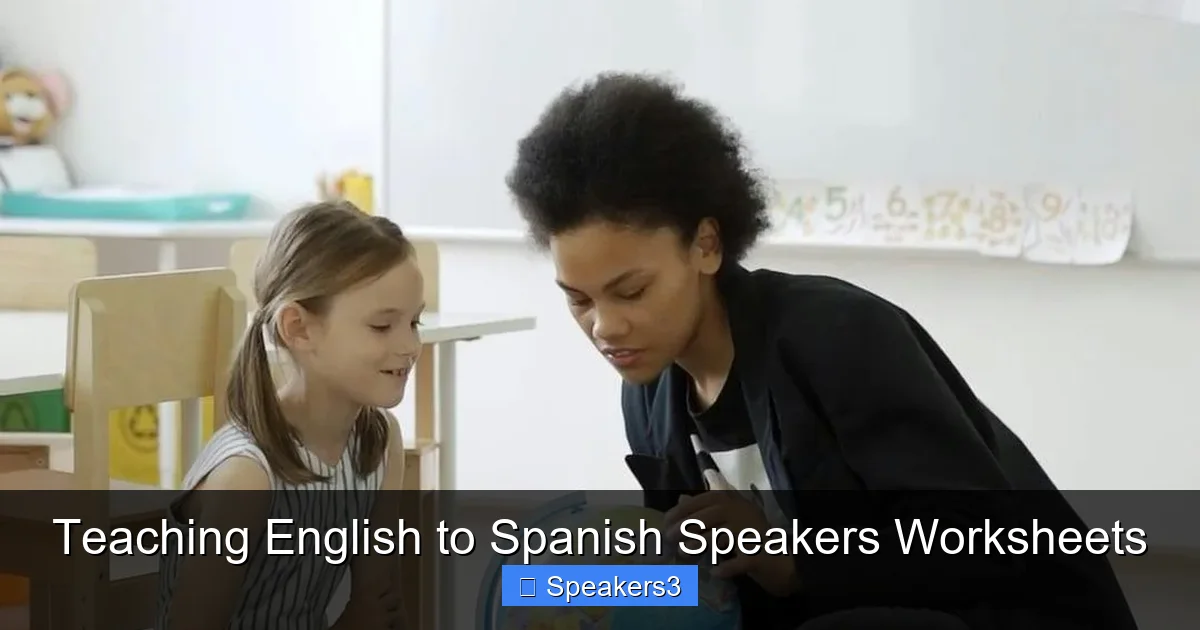
Visual guide about Teaching English to Spanish Speakers Worksheets
Image source: images.pexels.com
Clear objectives
Start each sheet with a short goal statement, e.g., “Practice the present simple of regular verbs.” This tells learners exactly what they will achieve.
Bilingual scaffolding
Include a brief Spanish note for complex grammar points. For example, after a rule about “‑ed” endings, you might add: “En español, el pasado simple se forma con ‘‑ó’, ‘‑í’, etc.” This reduces anxiety and speeds up comprehension.
Variety of task types
- Matching: Pair English words with pictures or Spanish equivalents.
- Fill‑in‑the‑blank: Reinforce verb conjugations.
- Sentence scramble: Practice word order, a common stumbling block for Spanish speakers.
- True/False statements: Check understanding of cultural nuances.
Immediate feedback loops
Include answer keys on a separate page or at the bottom of the sheet. Students can self‑grade, which encourages independence.
Top Worksheet Themes for Spanish‑Speaking Learners
Below are six popular themes that address the most frequent challenges faced by Spanish speakers learning English.
Visual guide about Teaching English to Spanish Speakers Worksheets
Image source: plainbibleteaching.com
1. False Cognates (Falsos Amigos)
Spanish and English share many look‑alike words that mean different things. A worksheet that lists pairs like “actual” vs. “actual” (real vs. current) helps learners avoid embarrassing mistakes.
Example activity:
- Column A: English word
- Column B: Two Spanish options—one correct, one false cognate
- Task: Circle the correct translation.
2. Verb Tenses – Simple Present vs. Present Continuous
Spanish speakers often use the simple present for actions happening right now. A worksheet that contrasts “I eat” with “I am eating” using pictures of ongoing actions clarifies the difference.
3. Gender‑Neutral Nouns
English nouns don’t change with gender, unlike Spanish. Provide a list of common nouns (e.g., “teacher,” “doctor”) and ask students to write a sentence using “he/she/they” to show they understand the neutral usage.
4. Pronunciation Guides
English sounds such as “th” and “v” are rare in Spanish. Include phonetic spellings and a small diagram of mouth position. A simple “listen‑and‑write” worksheet where students hear a word and copy it helps bridge the gap.
5. Everyday Conversation Starters
Role‑play sheets with prompts like “Ask for directions” or “Order coffee.” Provide both the English dialogue and a Spanish translation for reference.
6. Cultural Notes
Understanding idioms and customs is part of language mastery. A worksheet that explains expressions such as “break the ice” with a short story and a matching activity makes culture tangible.
How to Create Your Own Custom Worksheets
While ready‑made sheets are convenient, customizing them ensures relevance to your class’s age, interests, and proficiency level.
Visual guide about Teaching English to Spanish Speakers Worksheets
Image source: teachingandlearning.ie
Step 1 – Identify the Target Skill
Ask yourself: Is the focus vocabulary, grammar, pronunciation, or a mix? Write a concise learning objective.
Step 2 – Gather Authentic Materials
Use short news articles, song lyrics, or TikTok captions in English. Highlight words that align with your objective and translate them into Spanish for support.
Step 3 – Choose a Layout
Use simple tables in Word or Google Docs. Keep fonts large (12‑14 pt) and leave ample white space. Color‑code sections: blue for instructions, green for examples, red for errors to correct.
Step 4 – Add Engaging Elements
Insert a cartoon, a QR code linking to an audio clip, or a mini‑puzzle. These keep motivation high.
Step 5 – Test and Refine
Run the worksheet with a small group. Note any confusing instructions and adjust before the full class uses it.
Practical Tips for Using Worksheets in the Classroom
Even the best worksheets can fall flat if not used strategically. Here are proven tactics.
Pair Work First, Then Solo
Start with a partner activity where students discuss answers aloud. This encourages speaking before they write, reinforcing oral comprehension.
Set a Timer
Give students a clear time limit (e.g., 10 minutes). The pressure mimics real‑world communication where thinking quickly is valuable.
Use “Think‑Aloud” Modeling
Demonstrate how you would solve a fill‑in‑the‑blank sentence. Verbalize each decision, such as “I look at the verb ‘run’, I know the present simple ends with ‘‑s’ for he/she/it, so I write ‘runs.’”
Incorporate Movement
Turn a matching worksheet into a “gallery walk.” Students move around the room, stick their answers on the walls, and peer‑review.
Provide Immediate Praise
Celebrate correct answers with simple phrases: “Great job!” or “¡Excelente!” This bilingual encouragement reinforces confidence.
Link to Real‑World Tasks
After a worksheet on ordering food, have students actually order a snack in English at a mock café set up in the classroom.
Free Printable Resources You Can Start Using Today
Below is a curated list of sites that offer ready‑made teaching English to Spanish speakers worksheets. All are free, printable, and easy to adapt.
- Hard English Words For Spanish Speakers – downloadable word lists that double as vocabulary drills.
- ESL Library – searchable by “Spanish speaker” and “worksheet.”
- British Council – printable grammar sheets with bilingual notes.
- Teach-This.com – “False Cognates” matching games ready to print.
- ISLCollective – a community of teachers sharing custom worksheets.
Measuring Success: Assessment Ideas
Worksheets are not just practice; they can also serve as informal assessments.
Checklist Rubrics
Create a simple rubric with criteria like “Correct verb form,” “Accurate translation,” and “Neat handwriting.” Students self‑rate, fostering metacognition.
Progress Portfolios
Ask learners to keep a folder of completed worksheets. Review the folder every month to see growth trends.
Quick Exit Tickets
At the end of class, hand out a one‑page worksheet with three rapid‑fire questions. Collect them as students leave to gauge the day’s learning.
Conclusion
Teaching English to Spanish speakers worksheets are more than paper—they are bridges that connect two languages, cultures, and ways of thinking. By selecting worksheets that are clear, visually supportive, and aligned with real‑world use, teachers can accelerate fluency while keeping the classroom lively and inclusive. Whether you download a free sheet on false cognates or design a custom dialogue role‑play, remember to pair the activity with spoken practice, immediate feedback, and a splash of fun. Your students will not only master English structures but also gain the confidence to use them outside the classroom.
Start today: pick one of the free resources above, adapt it to your learners’ interests, and watch the progress unfold. Happy teaching!
Frequently Asked Questions
What age groups can benefit from teaching English to Spanish speakers worksheets?
Worksheets are versatile and work for children, teenagers, and adult learners. Adjust the content complexity and visual aids to match the age and proficiency level.
How often should I assign worksheets in an ESL class?
Use worksheets 2–3 times per week for reinforcement. Mix them with interactive activities to keep the learning dynamic.
Can worksheets replace speaking practice?
No. Worksheets support reading and writing, but they should be paired with oral drills, role‑plays, and listening tasks for balanced language development.
Are there digital alternatives to printable worksheets?
Yes. Many platforms offer interactive PDFs or Google Slides that students can complete on tablets, providing instant auto‑grading.
How can I adapt worksheets for low‑literacy Spanish speakers?
Use more pictures, simple sentences, and oral instructions. Keep text short and provide a bilingual glossary for new terms.
Where can I find culturally relevant topics for my worksheets?
Look at local news, popular music, or community events. Incorporating familiar cultural references makes the language feel relevant and engaging.